It is often highly desirable to obtain bio-relevant results as such results increase the confidence and usefulness of the testing. In fact, one should always focus on achieving bio-relevant results as non-bio-relevant results are of limited use.

To obtain bio-relevant results, one should try to evaluate products using experimental conditions as close as possible to the conditions one would expect during the physiological testing and/or product use.

For evaluating in vivo drug dissolution, as conducted based on the bioavailability/bioequivalence studies, it is a common regulatory requirement that products be tested using a standard and common protocol. For example, the study protocol (physiological environment) remains the same for the evaluation of IR vs ER products and any release type in between. Therefore, if one wishes to achieve bio-relevant results, then one has to conduct in vitro testing using a common set of experimental conditions. These should be product-independent.

Conducting dissolution studies using product-dependent experimental conditions violates this principle, thus should not be considered bio-relevant. To obtain bio-relevant results, testing should be done using a common set of experimental conditions, which should also be product-independent.

One of the requirements for dissolution testing is a mixing mechanism to provide efficient product (tablet/capsule) and medium interactions. Within the GI tract, such a mixing mechanism is provided by peristaltic compressions and motions. 

To evaluate dissolution characteristics in vitro, one needs to provide a mixing mechanism as well. The question is should the in vitro environment have this mixing/stirring based on the peristaltic mechanism as well? The answer is not necessarily yes. For any in vitro testing, one tries to simulate an in vivo environment or process but not to duplicate it. This is one of the basic underlying principles of conducting in vitro testing. There are numerous examples of such practices.

For example, in vitro cell growths (cultures) are usually achieved in simple media not in body fluids. Dissolution tests are conducted using simple media (e.g. buffers). Similarly, controlled temperature environments (baths or cabinets) for testing are maintained, including for dissolution testing, using electronic thermostats with heating elements with or without circulating gasses or water. None of these reflect in vivo environments. The mechanisms to simulate the in vivo environments do not require duplication of the physiological (feed-back) processes where such controls are achieved based on enzymatic-based chemical reactions and circulating physiological fluids. It is important to note that arguments (suggestions) of conducting tests by duplicating physiological environments usually reflect a lack of appreciation and experience in the physiological aspect of dissolution testing.

The reason for presenting such weak arguments is to support the continued use of paddle and basket apparatuses, which do not provide the needed stirring and mixing, thus product-medium interactions. One may argue that stirring and mixing based on peristaltic motion may be preferred or used, which does not mean that one needs to keep using a knowingly flawed approach in the absence of such a mechanism. Obviously, an irrelevant testing environment will result in irrelevant dissolution results no matter how such studies, and results thus obtained are presented. One should be watchful of such erroneous suggestions and practices.

On the other hand, it is possible to modify currently used stirrers (paddle/basket) with others, such as crescent-shaped (brush-based), to address the flaws to achieve a better product-medium interaction representative of the physiological process. A number of studies have demonstrated that the use of modified (crescent-shape) sinpdle can provide improved and physiologically relevant dissolution results compared to paddle and basket apparatuses.

One of the criteria to judge the physiological relevancy is that the apparatus must provide testing using a single or common set of experimental conditions, as in vivo products are tested using a single set of experimental conditions. The use of the crescent-shape spindle fulfills this requirement.

IVIVC – Conflict between practices and objective/intent

It is often suggested that as drug release mechanisms may differ from product to product dissolution tests, conditions/methods should also be product-dependent to reflect these differences in drug release mechanisms. Often, such reasoning is provided for extended-release products and, strangely enough, not for immediate-release products. For example, recently (Link, Feb. 2011 issue, Q&A section), such an opinion is provided for nifedipine extended-release tablet products. In reality, however, it is not a correct view and is scientifically invalid as well.

A drug dissolution test does not have a link to the mechanism of drug release of a product. Thus it would not be able to differentiate the mechanism. A dissolution test only measures the amount of drug present in solution form at a specific sampling time. Perhaps the following analogy may explain it better. Monitoring (measuring) the speed of a moving vehicle using a speed gun (radar) does not depend on the type of engine (V4, V6, or V8) or size (car, van, bus, or truck) of the vehicle or type of the fuel (petrol or diesel) the vehicle uses. A speed gun works on the principle of monitoring change in distance per unit time. It is immaterial whether the change in distance is produced by different engine types or vehicle types (car or bus). Similarly, a dissolution test measures drug concentration in a dissolution medium with time, irrespective of the mechanism of drug release such as osmotic-based, diffusion-based or any other type. A dissolution test only reflects the drug in solution at a given sampling time.

On the physiological side, absorption is also independent of the drug release mechanism of a product. Drug absorption, or levels in the blood, depends on the drug in solution form in the GI tract, not how (a mechanism) it is delivered. If a drug is released slowly from the product, then dissolution will be slowed thus, absorption will be slow, irrespective of the release mechanism and vice versa.

Furthermore, the dissolution test conditions (medium, temperature, mixing) mimic the GI tract (intestinal) environment, not the product type or its delivery mechanism. As the GI tract environment remains constant from product to product, dissolution testing environments must also remain constant, otherwise a dissolution test should be considered void.

It is to be noted that the use of product-dependent experimental conditions are employed to accommodate the use of paddle and basket apparatuses which are known to be flawed because of their poor mixing and stirring characteristics. These apparatuses are not capable of providing the required product independent dissolution testing. As a result, product-dependent dissolution testing is a practice that produces useless dissolution data and puts an enormous and unnecessary burden on the pharmaceutical industry and regulatory agencies.

It is hoped that standard-setting organizations will discourage and/or consider discontinuing the current practices of product-dependent dissolution testing.

 All dissolution apparatuses, or perhaps more accurately dissolution testing in general, have serious problems regarding the lack of appropriate and standardized agitation (stirring and mixing) value. Analysts do not know what should be an appropriate rpm (in the case of Apparatuses 1 and 2), flow rate (in the case of Apparatus 4), and dip rate (in the case of Apparatus 3). This is a big problem. Every analyst sets this (e.g., rpm) based on his or her preference to achieve some desired dissolution characteristics. Thus the test loses its usefulness.

Considering the deficiency, a common agitation speed has been suggested using a new spindle (crescent-shaped). It is to be noted that the crescent-shaped spindle was chosen for this purpose because Paddle/Basket would not provide appropriate stirring and mixing. These apparatuses have a design/operation problem, which is very well and extensively documented in the literature. I am of the opinion that if one could make a slight adjustment to Apparatus 1 and 2 by using a crescent-shaped spindle, then the current problems in dissolution testing can easily and economically be resolved.

Title: Limitations of Some Commonly Described Practices in Drug Dissolution Testing and Suggestions to Address These.

 … In conclusion, it may be argued that most of the deficiencies/problems of current practices of dissolution may be related to poor hydrodynamics within the paddle and basket apparatuses, which also lack relevance to the physiological environment. The dissolution testing may significantly be improved if its role may clearly and objectively be established that the tests are to be conducted only to reflect in vivo dissolution characteristics of a product. This clarity of objective will provide an improved basis for selecting appropriate apparatuses and associated experimental conditions. In addition, such an objective will also reduce the significant workload by eliminating repeated IVIVC developments and other physiologically nonrelevant testing requirements. American Pharmaceutical Review, Jan/Feb. 2011. (link)

Current practices of dissolution testing invariably use paddle and basket apparatuses. In fact, describing a dissolution test almost always assumes that the tests been conducted are using these apparatuses.

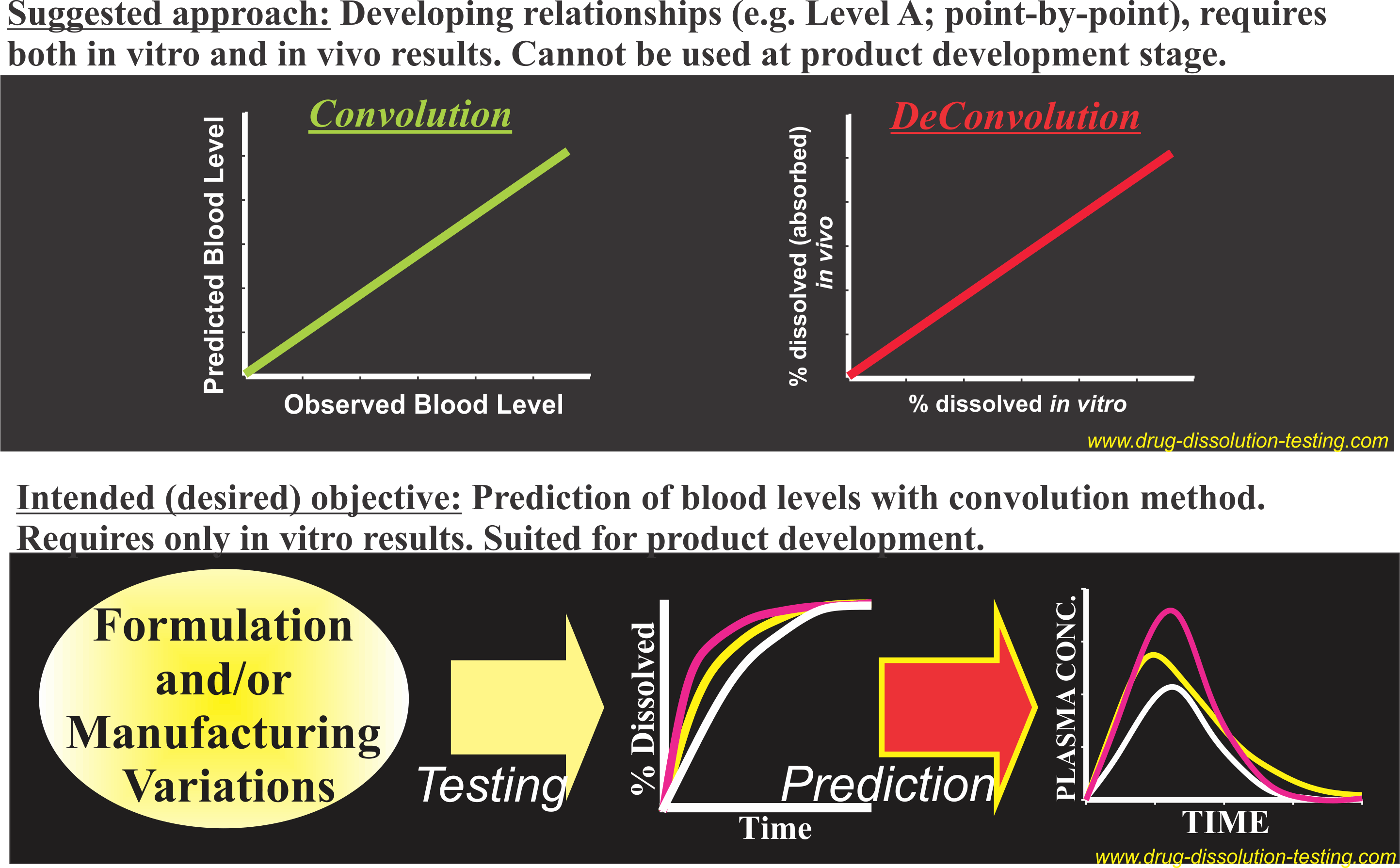
The main objective of a dissolution test is to evaluate or predict dissolution characteristics of a product in vivo, mostly in humans. This link, or predictability aspect, is often referred to as in vitro-in vivo co-relationship (IVIVC).

On the other hand, a supporter of this test often propagate (market) it as a means to facilitate the development of products and later as a quality control test for monitoring batch-to-batch consistency in the production of pharmaceutical products for human use.

In reality, the test is a variation of a simple extraction-based analytical test, but its applications are large and powerful. The test is considered to provide an in vitro simulation of the release and dissolution of the drug in the human GI tract. Therefore, the first and foremost requirement for conducting this test is to make sure (validate) that the extraction process simulates the GI tract environment as closely as possible. In addition, like any other analytical test, the dissolution test should also have an acceptable level of repeatability and reproducibility.

These extraction tests, known as drug dissolution tests, are mostly conducted using paddle and basket apparatuses. These apparatuses have been in use for a long time. However, their relevance to simulate the required GI tract environment and reproducibility aspect appears to have never been established. In other words, these apparatuses have never been validated for their intended use, in particular using pharmaceutical products for human use. For any analytical chemistry test, including a dissolution test, to be acceptable for general use its appropriate validation is essential. Without the validation, the results obtained from the tests or apparatuses may be of limited value or use.

It is often debated as to which approach is better or more appropriate for calibration or standardization of the apparatuses. It appears that calibration may not be a critical or important step at present. The reason being, even if the apparatuses (paddle and basket) are adequately calibrated using any of the two approaches, they still would show a lack of relevance of results and provide very high variability in dissolution results.

It has been shown from experimental studies and computer simulation modeling that paddle and basket apparatuses provide poor hydrodynamics. Thus results obtained from these apparatuses would be of limited value and use. As a result, the calibration aspect becomes secondary.

It is often claimed that drug dissolution testing is a useful technique during the product development stage. Does this claim have merit? Let us explore.

A formulator prepares two or more formulations/products having different dissolution rates using commonly described dissolution test conditions. How would the formulator decide which product can be tested in humans? For this purpose, the formulator needs to have some confidence in the predictability of the dissolution test for the behaviour of a product in humans. It is well known that current practices of dissolution testing do not provide such predictability. Thus the testing cannot be used for product development. There are examples that products having differences in vitro results provide overlapping in vivo results.

Then why do people suggest the use of dissolution testing for product development? Apparently, the suggestion is correct but not its interpretation. In principle, it is correct that dissolution tests should be reflective of in vivo results. However, success will depend on how a dissolution test is conducted and what type of instrument/apparatus is used. Presently, people invariably assume that dissolution testing means conducting a test using paddle and basket apparatus. The missing link here is that these apparatuses have never been validated to provide relevant in vivo conditions (environment) to predict in vivo results? Obviously, these apparatuses cannot provide relevant in vivo results. It is like saying that can a distance from point A to B, 1000 miles apart, be travelled in an hour by road? Of course, yes, but we need a car that would run at a speed of 1000 miles/hour. The objective is fine, but the practicality of achieving the objective is not. This is exactly what is happening with the current practices of drug dissolution testing, i.e., the objective is fine, but means (paddle and basket apparatuses) to achieve the objective is not.