
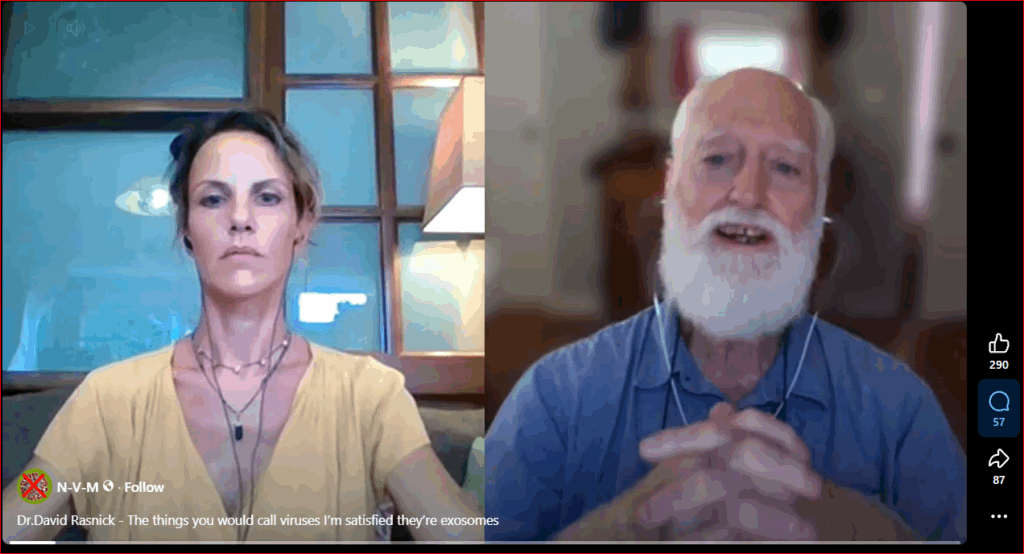
I recently watched a clip of Dr. David Rasnick, Ph.D., a trained (bio-) chemist—speaking confidently about the existence of viruses (link). I must admit, it left me genuinely saddened. Here is someone with a scientific background, someone who should instinctively rely on empirical evidence, yet he has accepted the idea of viruses as real, physical entities.
Some attempt to soften the claim by saying viruses are “actually exosomes,” as if a new label resolves the scientific issue. But it does not.
Whether one calls them viruses or exosomes makes no difference. The fundamental question remains: Where is the physical evidence of their existence?
The confirmation can only occur through isolation, not through assumption, interpretation, or narrative.
Dr. Rasnick’s belief appears to rest on a common but flawed assumption:
That is because these entities have been discussed and “studied” on paper for a long time; they must therefore be real.
From a scientific standpoint, this reasoning is unacceptable.
In science—true science—nothing exists unless it can be physically isolated, measured, characterized (directly or indirectly), and photographed as a real substance or particle. That is the foundation of chemistry, and the foundation of all empirical science.
Where is the real evidence of physical isolation?
Where is the conclusive scientific characterization?
Where is the purified sample that independent chemists can analyze?
None of it exists.
This is not a matter of opinion—it is a matter of scientific principle. Without isolation and chemical characterization, all claims about viruses or exosomes remain speculative narratives rather than demonstrable facts.
It is unfortunate, but understandable, that even someone with a scientific background—like Dr. Rasnick—could be misled. The institutional narrative is powerful. Decades of repeated claims can overshadow the fundamental scientific requirement that something must first be proven to exist before it can be studied, discussed, or used in medical interventions.
The tragedy is that many brilliant minds have fallen into this trap: accepting assumptions as facts and mistaking procedural declarations for genuine science.
Until a real, isolated particle is presented, the claim remains unproven—no matter who believes it.