
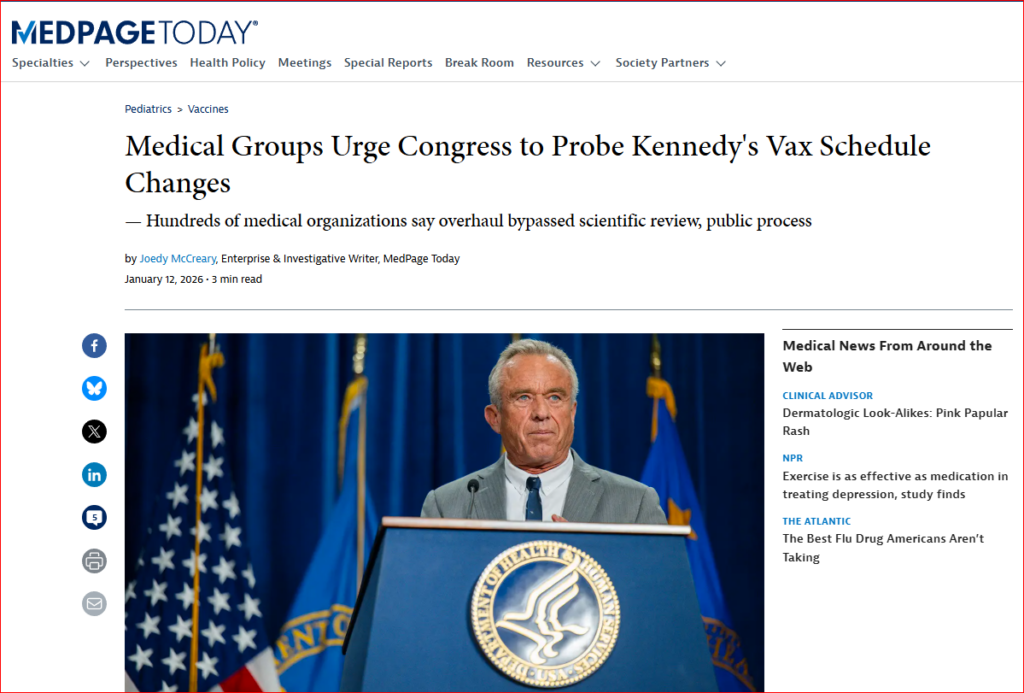
Articles such as the one published by MedPage Today rely heavily on the repeated assertion that “medical experts” and “scientists” have settled the questions surrounding viruses and vaccines. That assertion itself deserves scrutiny—because it is foundationally flawed (link).
If I were sitting next to Robert F. Kennedy Jr., I would urge him to request Congress to examine a far more fundamental issue than any individual policy dispute: the systematic misrepresentation of medical credentials as scientific credentials.
Medical practice is not a science in the strict sense.
Physicians are trained to diagnose and prescribe. They are not trained in fundamental science or to conduct scientific research, nor in the disciplines that define scientific inquiry at its core—chemistry, physics, and mathematics. Medical education does not include rigorous training in experimental design at the molecular level, chemical isolation, purification, characterization, or validation of physical entities. These are not peripheral skills. They are the foundation of science.
Yet medical professionals routinely present themselves—and are presented by the media—as “science experts.”
They are not.
Virus and vaccine claims rest on a false scientific foundation
All research claims regarding viruses and vaccines originate from this same misclassification. The core problem is simple and unavoidable:
- No isolated, purified, and chemically characterized virus samples are available
- Without such samples, neither viral existence nor viral causation can be scientifically established
- Without a defined physical entity, vaccine efficacy and safety cannot be scientifically evaluated
What is presented instead are models, narratives, statistical associations, and biological assumptions—not chemically validated evidence. This is not science. It is inference layered upon inference, enforced by authority rather than proven by experiment.
The consequences are not academic—they are real.
When claims lacking scientific validity are elevated to unquestionable truth, the consequences are severe—especially when applied to children. Policies, mandates, and medical interventions are imposed based on unvalidated premises, while dissent is dismissed as “anti-science.”
In reality, what is being protected is not science, but institutional credibility.
Why should further research by medical experts be disqualified
Continuing “research” in this domain—conducted by individuals without training in fundamental science and based on unverifiable assumptions—only compounds the problem. It produces more publications, more funding, more authority, and more public harm, without ever resolving the core scientific deficiencies.
Any research claim regarding viruses or vaccines that does not begin with:
- physical isolation,
- chemical purification,
- structural characterization,
- and reproducible validation,
must be considered scientifically invalid and potentially dangerous.
What is required is a correction toward genuine science, grounded in chemistry, physics, and verifiable measurement, rather than authority-driven claims.
Congress should assess not merely outcomes, but credentials and methods. The question is not whether experts disagree, but whether those making scientific claims are qualified to do so at all.
Medical professionals must return to their legitimate role: clinical practice.
Scientific research must be conducted by those trained in actual science.
And claims that cannot meet scientific standards must be disqualified—immediately.
This is not anti-science.
It is the defense of science itself.
“Science”: A Term of Convenience for Authority (link)
What Science Saw Before Medicine Admitted (and Pseudoscience Ignored), (link)