
Further to my earlier post on the interaction between science and medicine, I recently asked ChatGPT to provide a historical overview of the role and contribution of chemistry in medical development, using the discovery of antibiotics as an example.

The results were quite revealing. The history clearly shows that medicines were developed through the work of chemists, while physicians primarily provided clinical observations. This collaboration once defined true medical progress — observation by physicians and discovery, isolation, and synthesis by chemists.

The same model should have been followed in the case of viruses. Physicians observed that people were becoming sick and assumed there must be a tiny infectious particle — which they named a “virus.” At that point, they should have sought the expertise of chemists to identify, isolate, and characterize this supposed causal agent. If such a particle truly existed, chemistry would have revealed its structure and properties.

(more…)

I have long argued that many cases labeled as “cancer” may actually be misdiagnoses. While direct, irrefutable proof is hard to obtain, the pattern of illness and its response to treatment point strongly in this direction. In several cases, the condition has improved with antimicrobial treatments such as ivermectin, doxycycline, curcumin, mebendazole, and fenbendazole — drugs designed for microbial infections, not cancer.

This possibility is rarely considered because cancer is defined and classified largely through imaging and pathology — methods not unlike the “imagery” used to depict viruses that have never been truly isolated or characterized. Image-based diagnosis alone is not a valid scientific method; at best, it is an observation or an educated guess. A truly scientific approach would require independent physical and chemical confirmation: isolating the microorganism, identifying its components, and proving treatment efficacy with antibiotics or antimicrobials.

(more…)

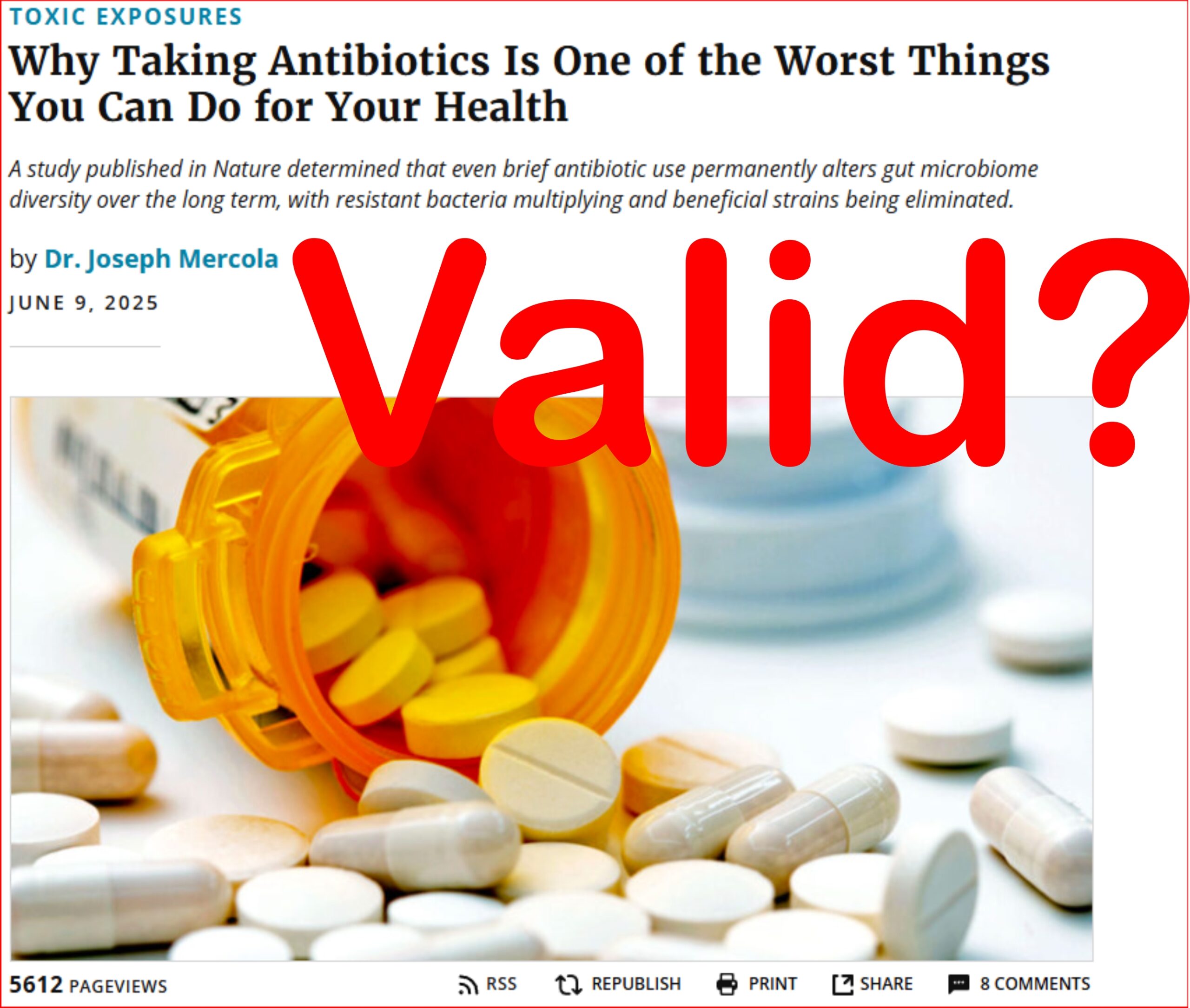
I started reading the article (link) but got bored after reading a few lines. I find it typical nonsensical narrative by medical professionals to sell fear to promote their “science” and products/services with convoluted and dodgy narratives.

For example, consider the first two words of the article “Antibiotic abuse.” Of course, the abuse of anything can be detrimental and must be avoided, but that does not mean it should be avoided all the time, including for its proper use. There is a definite need for antibiotics, and they have been used successfully for very long periods.

@ “According to the CDC, 2.8 million cases of antibiotic-resistant infections are diagnosed yearly, and 35,000 people die from them …” Citing the CDC claim is of limited authenticity of validity, as recently, the CDC has been under scrutiny for providing false or invalid reporting.

Next, are the narratives referring to “intrinsic resistance, acquired resistance, genetic change, DNA transfer.” These are all chemicals and chemistry/science terms, along with antibiotics, about which doctors have no knowledge or training. Therefore, it can be said with almost certainly that these are scientifically false or unproven narratives. It is like the hoopla about viruses and vaccines based on a genetic and DNA narrative, which has clearly been shown to be fraudulent.

Therefore, I suggest that medical professionals limit their practice and claims to the training and education they have received and refrain from engaging in science that has not been taught or learned – noting that a medical degree, such as M.D., is not a science degree.

An M.D. degree is not a science degree! (link)
Unlawful Science Practices By Physicians (link)