I have written several articles on PCR for my blog, but it seems many readers may not have understood them fully. So, here is another attempt to explain.

PCR stands for Polymerase Chain Reaction. Breaking it down, polymerase is a combination of two parts: polymer and -ase. Polymers are chemical compounds that can come from natural or synthetic sources. Examples of natural polymers include cellulose, starch, glycogen, proteins, enzymes, and nucleic acids such as DNA and RNA, while synthetic polymers include polyethylene, polypropylene, polystyrene, PVC, Teflon, and nylon. All of these substances are well-characterized, certified, and widely available, mostly from chemical suppliers.

The suffix “-ase” indicates an enzyme, a protein that acts as a catalyst in biochemical reactions. For instance, hydrogen and oxygen will not combine to form water on their own; a spark or catalyst is required to initiate the reaction. Similarly, in biological systems, enzymes trigger countless reactions essential for life.

(more…)
Question Asked:

Are particles like urea in urine, sugar in blood, and bacteria in blood different from what we call “viruses”?

Response:


Urea, sugar, bacteria, and enzymes can all be detected, identified, and even purified with relative ease. These are real, demonstrable substances. I avoid using the term particles here because “particle” refers to a physical state that may or may not be observable under all conditions. For example, table salt exists as particles in solid form, but when dissolved in water, its particulate state disappears, forming ions—yet it is still considered salt. However, sand exists as particles almost all the time, even when mixed with water. The important point is that these substances are tangible, measurable, and their testing is valid.

(more…)

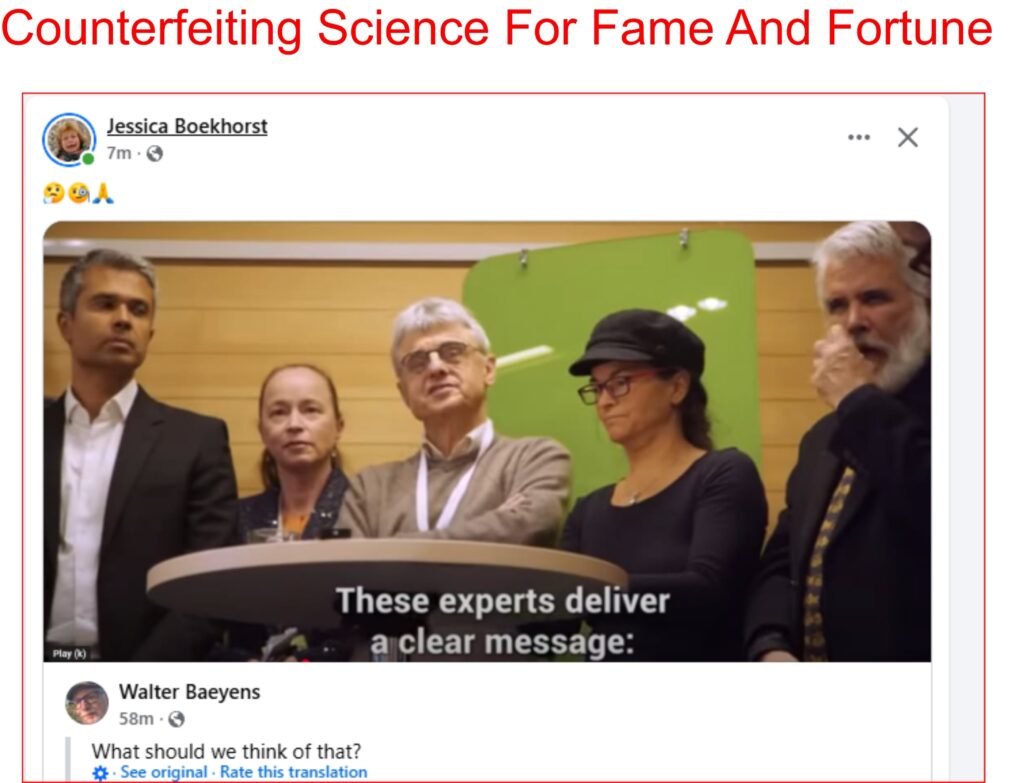
Yesterday, I watched a documentary (Premiere: Inside mRNA Vaccines), about an hour long, which tells a troubling story that deserves wider attention (link). I highly recommend watching it. From my perspective, the so-called medical experts featured in the film largely rely on theoretical assertions disconnected from reality and genuine science. Their artwork (labelled “science”) is no different than animation shown in the movie. They continue to promote their version of “science” to explain mRNA technology — yet there is little to no actual technological or scientific substance behind their claims.

(more…)

Two of the most abused and fraudulent words of our time — especially in medicine.

In reality, so-called modern medicine has little to no connection with actual science, like physics or chemistry.

These labels are mostly worn by people who have never studied real science, yet parade around as “experts,” “scientists,” or “researchers.”

Beware.

What is science, and who are scientists? (link)
My training and expertise – people ask! (link)

The U.S. National Institutes of Health (NIH) and the U.S. Department of Health and Human Services (HHS) have recently announced what they are calling a “next-generation, universal vaccine platform.” The project, branded Generation Gold Standard, is being promoted as a major leap forward in vaccine science and safety assessment. Public figures, including RFK Jr., have spoken about it as if it were the solution to the failures of the COVID-19 vaccines — the dawn of a new, “safe and effective” vaccine era.

Before accepting these claims, it is worth examining them from the standpoint of actual science — specifically chemistry — to assess the validity of the approach and the likelihood of success (more like its failure).

(more…)

I have long argued that many cases labeled as “cancer” may actually be misdiagnoses. While direct, irrefutable proof is hard to obtain, the pattern of illness and its response to treatment point strongly in this direction. In several cases, the condition has improved with antimicrobial treatments such as ivermectin, doxycycline, curcumin, mebendazole, and fenbendazole — drugs designed for microbial infections, not cancer.

This possibility is rarely considered because cancer is defined and classified largely through imaging and pathology — methods not unlike the “imagery” used to depict viruses that have never been truly isolated or characterized. Image-based diagnosis alone is not a valid scientific method; at best, it is an observation or an educated guess. A truly scientific approach would require independent physical and chemical confirmation: isolating the microorganism, identifying its components, and proving treatment efficacy with antibiotics or antimicrobials.

(more…)

The medical community has a new trick. After decades of virus-vaccine failure, fraud, and public harm, some doctors are now rebranding under terrain theory. See the recent article by Richard Z. Cheng, M.D., Ph.D. (Editor-in-Chief, Orthomolecular Medicine News Service) promoting it (link). The motive is obvious: the virus narrative has collapsed under its own lies, so they need a new story to keep the funding flowing.

Now they pitch terrain theory as a “new” scientific model — and are already calling for funding to run clinical trials comparing vaccine-based vs. terrain-based strategies. This is audacious. After decades of massive funding, they’ve delivered nothing but damage. Before they get another cent, they must account for their record: not progress, but failure on a historic scale.

(more…)

A Facebook follower recently brought this article (link) associated with Dr. Stefano Scoglio to my attention and asked for my thoughts. I’ve heard of Dr. Scoglio and his work before and have looked into it to some extent. However, this article provides a clearer overview of his views, particularly regarding the ongoing scientific critique of viruses, vaccines, and transfection technologies. As a microbiologist, Dr. Scoglio presents his perspective from a biological standpoint, offering valuable insight from within that domain.

That said, I must clarify that I do not regard biology — as it’s commonly practiced — to be a true science (link). In this case, one of the article’s subheadings is particularly striking: “When Biology Meets Physics: The Transfection Paradox.” It’s unclear whether this title originated from Dr. Scoglio or the article’s author, but either way, it’s deeply problematic. Why invoke physics when discussing proteins, mRNA, and complex biochemical interactions — all of which clearly belong to the domain of chemistry?

(more…)

I read a recent article titled “Freedom in a Post-Covid World” by the well-known and respected author Jeffrey A. Tucker (link). I found the article informative and containing many valid observations. However, from a scientific standpoint, I found one particular comment troubling and misplaced:

“Notice that all the above deal with invasions to the human body and mind via science and labs, all backed by hugely powerful industries that work directly with the government.”

The phrase “invasions to the human body and mind via science and labs” reflects a common misunderstanding — one shared by many who lack formal scientific training but are nevertheless assumed to speak with authority. Mr. Tucker, like most others, assumes that these invasions were carried out via science. In truth, they were carried out under the banner of science — more accurately, the propaganda of so-called “medical science” — not science itself.

What actually happened is that the pharmaceutical industry exploited this false narrative. They co-opted the prestige of real science — like physics and chemistry, which historically led to revolutionary discoveries — and attached it to what they called medical science. But unlike those genuine sciences, medicine and health (including nutrition) are not sciences in any rigorous sense. There is no such thing as “medical science” or “health science” in the way we speak of chemistry or physics. These terms are not only misleading but also fraudulent — and most people, including learned individuals and industry experts, accept them as legitimate science.

(more…)

I read Dr. Robert Malone’s recent article with great interest (link). His recognition of the deep flaws in the U.S. regulatory medical system—including research funding, approval processes, and oversight—is both timely and important. However, his critique largely reflects the common physician’s viewpoint, blaming bureaucracy and government agencies such as the FDA, CDC, and NIH for the dysfunction. This perspective, while partly valid, misses the core of the issue.

The problem isn’t just bureaucratic mismanagement. The root of the dysfunction is the fraudulent framework of so-called “medical science” itself—a system run by professionals who claim scientific authority without actually practicing science. Dr. Malone is beginning to see aspects of this breakdown, but he stops short of identifying its real cause: the widespread lack of scientific literacy among medical professionals, particularly in areas where rigorous scientific analysis and measurement are required, such as pharmaceutical quality assessment.

(more…)