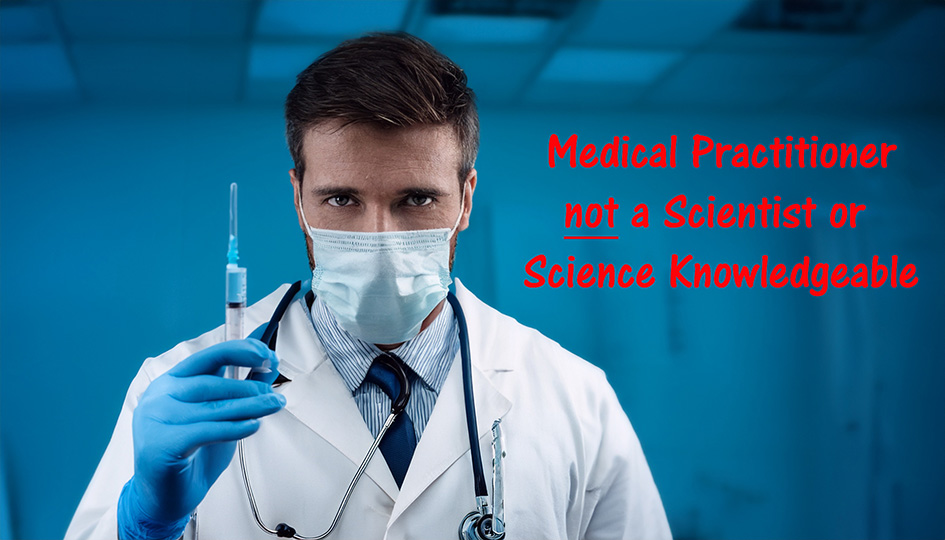
Physicians and related medical experts claim to follow and practice science. Billions of dollars in funding support their so-called “scientific research.” Yet in reality, they hold no genuine credentials (education and expertise) in science or science research. Their education and expertise rest on a standard, non-scientific undergraduate degree—an M.D. Is it not outright fraud to practice and promote something for which one has no credentials?

Will HHS, FDA, CDC, NIH, and similar regulatory agencies worldwide dare to investigate this fraud?

What is science, and who are scientists? (link)
My training and expertise – people ask! (link)
Chemistry, Not Medicine, Defines Science (link)
An M.D. degree is not a science degree! (link)

Seeking advice from physicians on medications, including vaccines, is not the issue. They are trained for that purpose—mainly to prescribe medicines as needed. It is no different from asking the front-end clerk at an auto shop for advice about a car part or a potential issue with your car. Their role is functional, not foundational.

The real problem begins when physicians are assumed to understand how medicines are developed, how they actually work, or how they are manufactured. They do not. That knowledge belongs to science—specifically chemistry, a discipline with centuries of rigorous foundations.

Medicines are chemicals. Their discovery, testing, and production are properly the domain of chemistry, not medicine. Physicians are not scientists, and when they speak as though they are, their claims are misleading at best and fraudulent at worst. For this reason, anyone without training in science and chemistry should be excluded from directing or conducting scientific research.

This confusion has fueled dangerous misconceptions and harmful developments. Viruses, vaccines, PCR tests, antibody tests, and countless diagnostic products have been falsely presented under the banner of “medical science.” But there is no such thing as “medical science.” Medicine is a practice of prescribing and administering treatments; science—real science—belongs to chemistry and physics.

Allowing physicians to lead in areas where they have no true expertise has led to repeated disasters. The narratives surrounding viruses, infections, and even cancer—promoted as if grounded in science—are, in fact, constructs built on fragile foundations. These practices have not delivered genuine medical benefits; instead, they have imposed massive harm on public health and drained societal wealth.

The solution is clear: separate medicine from science. Let doctors prescribe, but let scientists—true scientists—develop and evaluate the treatments. Only then can society avoid the cycle of fraud, fear, and failure that has shaped the modern “medical science” – the fake and false one.

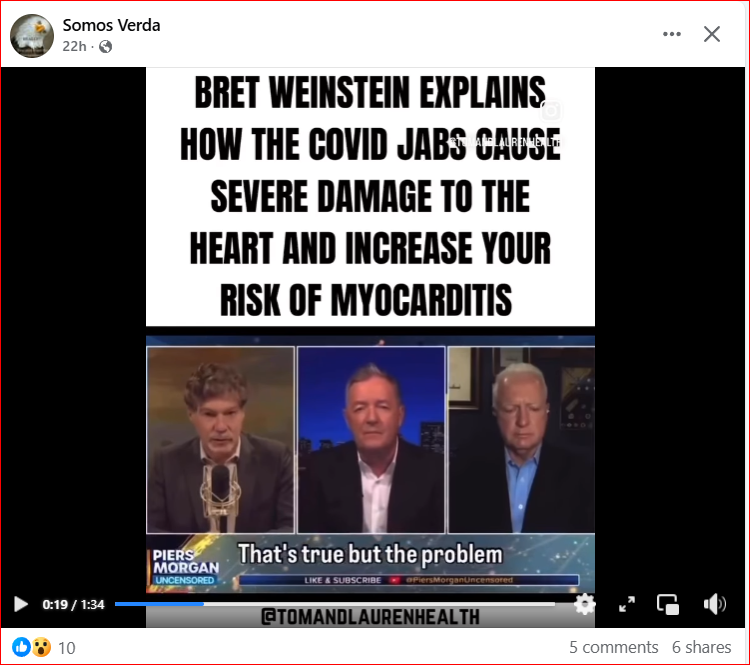
I listened to Dr. Bret Weinstein’s response to Piers Morgan’s question in this 1:34-minute video clip and noted several errors or unsupported claims (link). For example:

He stated: “… in an effort to provide immunity against COVID-19 …”

There is no scientifically valid evidence that COVID-19 exists. It is a belief that COVID-19 is caused by a virus named SARS-CoV-2. However, there is no evidence that this virus has ever been shown to exist. Therefore, a disease attributed to this virus cannot exist.

Dr. Weinstein is an evolutionary biologist or biology expert, not in the true sense of the word a scientist—particularly in the field of substance isolation and characterization, like viruses. That domain belongs to science proper, specifically chemistry, not biology. Hence, not only is he making a false statement, but he may not even realize it. He should reconsider his position on this topic.

(more…)

Propaganda and marketing have been so pervasive that the public and public leadership have come to genuinely believe that physicians possess complete knowledge of medicines— chemicals and their interactions (chemical reactions), and also related health care in general. They are presented as all-knowing authorities who carry the full understanding of illness and treatment processes in their back pocket, armed with “modern science” and the limits of human intelligence and capability.

This image of expertise is carefully constructed in different areas, such as:

(more…)

I have written several articles on PCR for my blog, but it seems many readers may not have understood them fully. So, here is another attempt to explain.

PCR stands for Polymerase Chain Reaction. Breaking it down, polymerase is a combination of two parts: polymer and -ase. Polymers are chemical compounds that can come from natural or synthetic sources. Examples of natural polymers include cellulose, starch, glycogen, proteins, enzymes, and nucleic acids such as DNA and RNA, while synthetic polymers include polyethylene, polypropylene, polystyrene, PVC, Teflon, and nylon. All of these substances are well-characterized, certified, and widely available, mostly from chemical suppliers.

The suffix “-ase” indicates an enzyme, a protein that acts as a catalyst in biochemical reactions. For instance, hydrogen and oxygen will not combine to form water on their own; a spark or catalyst is required to initiate the reaction. Similarly, in biological systems, enzymes trigger countless reactions essential for life.

(more…)

Question Asked:

Are particles like urea in urine, sugar in blood, and bacteria in blood different from what we call “viruses”?

Response:


Urea, sugar, bacteria, and enzymes can all be detected, identified, and even purified with relative ease. These are real, demonstrable substances. I avoid using the term particles here because “particle” refers to a physical state that may or may not be observable under all conditions. For example, table salt exists as particles in solid form, but when dissolved in water, its particulate state disappears, forming ions—yet it is still considered salt. However, sand exists as particles almost all the time, even when mixed with water. The important point is that these substances are tangible, measurable, and their testing is valid.

(more…)

A Facebook follower recently brought this article (link) associated with Dr. Stefano Scoglio to my attention and asked for my thoughts. I’ve heard of Dr. Scoglio and his work before and have looked into it to some extent. However, this article provides a clearer overview of his views, particularly regarding the ongoing scientific critique of viruses, vaccines, and transfection technologies. As a microbiologist, Dr. Scoglio presents his perspective from a biological standpoint, offering valuable insight from within that domain.

That said, I must clarify that I do not regard biology — as it’s commonly practiced — to be a true science (link). In this case, one of the article’s subheadings is particularly striking: “When Biology Meets Physics: The Transfection Paradox.” It’s unclear whether this title originated from Dr. Scoglio or the article’s author, but either way, it’s deeply problematic. Why invoke physics when discussing proteins, mRNA, and complex biochemical interactions — all of which clearly belong to the domain of chemistry?

(more…)

Terms like “science,” “scientific research,” “science experts,” and “scientists” are frequently used in the medical field — especially when discussing viruses, diagnostic testing, vaccines, or drug approvals. But in this context, such claims are often false and deeply misleading. Modern medicine, particularly in these areas, has little to no connection with actual science.

Physicians who invoke scientific language typically do so to secure government funding or promote their services — not because they possess genuine expertise in scientific disciplines like method validation, analytical chemistry, or test design. In reality, most have no formal training in these critical fields.

This is not a matter of opinion; it is a demonstrable fact. As such, any report or publication that uses the veneer of science to support medical claims — even those appearing in so-called scientific journals — should be approached with deep skepticism and rejected as lacking true scientific credibility.

What is medical science?

Medical science is a narrative constructed by medical professionals—primarily physicians—to explain illness and treatment according to their own interpretations and preferences. These explanations are not necessarily grounded in reality; many are speculative, hypothetical, or outright fabricated.

Crucially, medical science does not meet the standards of true science. It bears little to no connection with the actual sciences that deal with measurable substances—such as particles, atoms, and molecules—or with disciplines like chemistry that rigorously study them.

In essence, medical science is a belief system, propped up by ritualistic practices and unverified assumptions. At its core, it is a distortion of science—if not an intentional deception.


What are pharmaceutical and pharmacological sciences?

These are subdisciplines of medical science that claim to focus on the body’s chemistry—studying substances introduced into or produced within the body. However, they are largely practiced by individuals with limited training in real science, particularly in chemistry.

Although these fields claim to deal with compounds and molecular interactions, they operate without the scientific rigor found in true chemical sciences. Instead, they follow a medical science mindset that lacks depth in both theoretical and experimental chemistry. At best, these disciplines are superficial approximations; at worst, they are misrepresentations of actual science.


What is virology?

Virology is presented as the study of viruses—microscopic particles said to cause disease. Yet, there is no solid evidence that these viruses exist as physical entities, either in laboratories or in nature. They remain hypothetical constructs—mythical agents without direct scientific confirmation.

Virology, therefore, resembles a modern form of medical folklore—a narrative grounded more in belief and assumption than in empirical evidence. It remains detached from the hard sciences, which are based on observable and measurable entities. Despite its scientific appearance, virology operates outside the framework of real science, often in a ritualistic and uncritical fashion.

“The Trump administration can not stop Springer Nature from publishing, nor should they. But they can and should stop financially supporting their operations.

It is not a First Amendment issue, as some claim. Stopping payments that support woke science is a fiscal policy grounded in doing what is right for science (and science workers) in America.”

Dr. Malone wrote in a recent post on his blog (link), who was recently appointed to the Advisory Committee on Immunization Practices (ACIP) to address vaccine safety in general, with a particular focus on mRNA-based vaccines.

I read the article by Dr. Robert Malone—an M.D., not a Ph.D.—criticizing Nature and other high-profile journals for publishing what he calls “junk science.”

While I share concerns about the quality and bias of modern scientific publishing, Dr. Malone’s critique is ironic. He condemns biased, politically-driven science while defending the very institutions and funding streams that enable it. That contradiction deserves scrutiny.

(more…)