
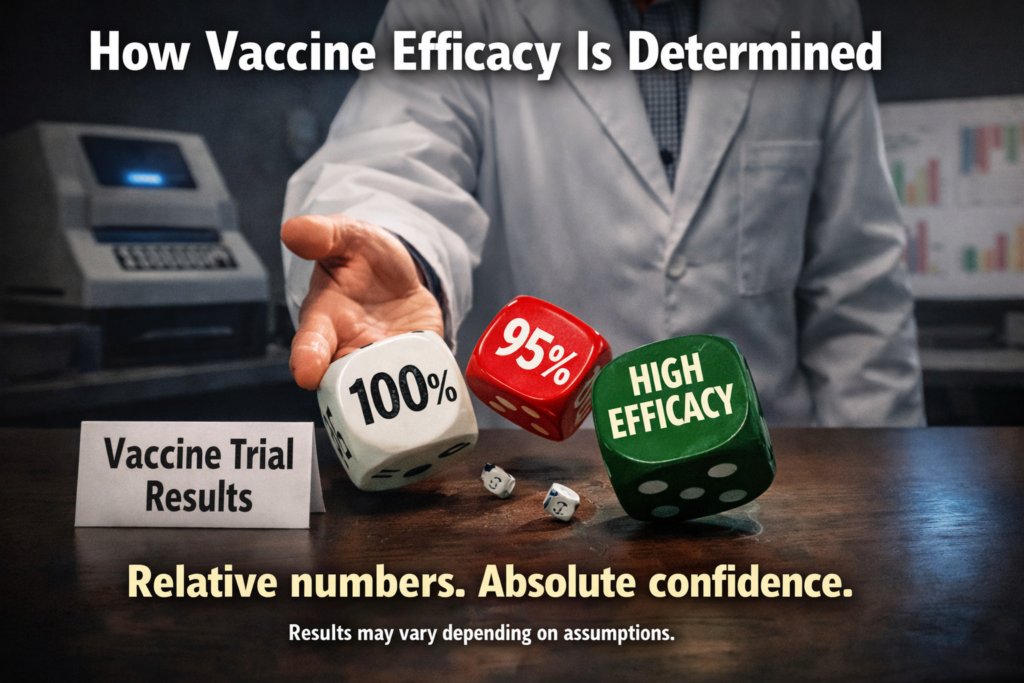
In principle, efficacy is intended to represent the proportion of patients who are cured. Traditionally, this has been inferred from clinical improvement—the resolution of visible or reported symptoms. More rigorously, however, a true cure should be demonstrated objectively through testing, using measurable markers whose changes reliably reflect disease progression or recovery.
For example, in the case of a viral infection, effective treatment would be expected to reduce viral load or specific viral markers, such as viral RNA or proteins. This framework assumes that such markers are elevated in sick individuals compared to healthy ones, and that their reduction corresponds to recovery. This is the model upon which claims of efficacy are meant to rest.
However, this framework does not operate in virology as practiced today. There is no scientific evidence demonstrating the existence of viruses as claimed, and therefore, no validated evidence for their supposed markers. As a result, the fundamental requirements for objective measurement are neither met nor applied.
Instead, an illusory system has emerged, built on unverified assumptions. A positive PCR test result is automatically equated with viral illness, despite the test’s inability to establish a causal link between a positive result and disease. This linkage is assumed, not demonstrated.
Vaccine efficacy is therefore not assessed in a scientifically valid manner. In principle, efficacy should be determined by comparing confirmed cases of illness between two groups—one receiving the intervention and the other receiving a true placebo.
Instead, efficacy is inferred indirectly: fewer PCR-positive results in the vaccinated group are declared evidence that the vaccine “worked,” while higher numbers in the control group are taken as proof of illness, regardless of the assumptions involved.
Compounding the problem, results are typically reported in relative terms—Relative Risk Reduction (RRR)—rather than absolute terms—Absolute Risk Reduction (ARR). For example, if two individuals test positive in an unvaccinated group and none test positive in a vaccinated group, the vaccine may be declared “100% effective,” regardless of whether the trial included 10, 1,000, or 10,000 participants. This figure reflects relative, not absolute, efficacy.
This distinction is critical yet widely misunderstood. Many assume that “100% efficacy” means that all treated individuals were cured while all controls remained ill. That is not what RRR represents. RRR is emphasized because it appears dramatic, while ARR—representing the actual reduction in risk for an individual—is often omitted or minimized.
Reporting RRR without ARR creates a misleading impression of benefit, particularly when baseline risk is low, as is the case in so-called viral infections. This practice has become routine in medical literature and regulatory communications, leading to exaggerated claims of vaccine efficacy.
I have examined this issue in detail using the Pfizer mRNA vaccine as an example in my own analysis (link). That work has largely been ignored, dismissed behind claims that medical science is too advanced for non-experts to question, and that vaccine efficacy is therefore beyond dispute.
In reality, the framework itself is unsound. There is no demonstrated virus, no illness shown to be caused by it, no validated tests, and no evidence that vaccines have cured anyone. Consequently, there is no scientifically meaningful vaccine efficacy.