
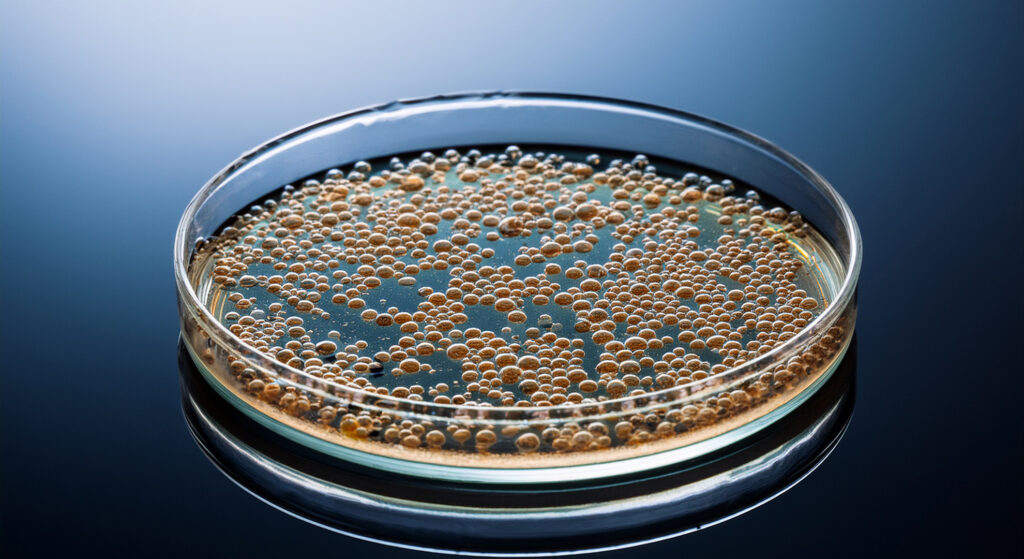
When people hear the word nanoparticle, they often imagine tiny hard specks—like dust or sand—floating around. But in pharmaceutical science, the “nanoparticles” used in vaccines are not solid particles at all. They are more like microscopic bubbles made of fatty molecules (lipids).
Lipids have a dual nature: one end of the molecule loves water, the other end avoids it. This is the same principle that makes soap work. When you wash your hands, soap molecules surround oily dirt or dust, hiding the “water-fearing” parts inside and keeping the “water-loving” parts outside. This forms small bubbles, called micelles, which carry away the dirt when rinsed with water.
In the same way, when lipids are mixed in water during pharmaceutical manufacturing, they self-assemble into tiny bubbles—liposomes or lipid nanoparticles (LNPs). Instead of dirt, however, these bubbles are said to carry messenger RNA (mRNA).
Life itself relies on this same chemistry. Every cell in the body is wrapped in a lipid bilayer membrane. This is like a double-layer bubble of lipids, where the water-hating tails face inward and the water-loving heads face outward, as explained in my book (link). This bilayer is the essential barrier that separates the cell’s inside from the outside world.
Embedded proteins for regulation
Unlike liposomes, natural cell membranes are not just simple lipid bubbles. They are reinforced with proteins that regulate entry, exit, signaling, and repair. This makes the natural cell membrane stable, self-maintaining, and capable of complex communication. Liposomes or LNPs, in contrast, lack proteins and are fragile—closer to soap bubbles than to living barriers.
Comparison – Cell Membrane vs. Liposome/Lipid Nanoparticle:
- Cell membrane (natural):
- Double-layer lipid bilayer.
- Very stable and self-repairing.
- Embedded proteins control transport and communication.
- Built for long-term survival.
- Liposome/Lipid nanoparticle (artificial):
- Same bilayer principle, but made in the lab.
- Fragile, short-lived, easily broken down.
- No proteins—so no regulation or repair.
- Useful only for short-term delivery of cargo.
The whole story of liposomes and nanoparticles rests on science—especially chemistry. It is chemistry that explains how lipids arrange themselves in water, why bubbles form, and how they can enclose other molecules. This is straightforward for those trained in the field, but for those without chemistry expertise, the term nanoparticle often leads to confusion. Many imagine hard metallic fragments or foreign specks, when in truth these are delicate, soap-bubble–like lipid droplets.
The mRNA question
Here, the story becomes more uncertain. It is claimed that fragile strands of mRNA are packaged inside lipid nanoparticles in vaccines. But for this claim to be scientifically verified, one would need a valid analytical test. To design and validate such a test, a pure and isolated mRNA standard would be required. Without such a reference material, there is no reliable way to demonstrate that intact mRNA exists in the production mixture or inside nanoparticles.
This means the central claim—that lipid nanoparticles deliver functional mRNA into cells—remains an assumption rather than a demonstrated fact. Without proper isolation, characterization, and testing, the “mRNA inside nanoparticles” story in vaccines must be considered suspect.
In addition, as noted above, because of the fragile nature of LNPs, it is uncertain where they actually break down—whether in the product vial, at the site of injection, or later after entering the body cells, as commonly assumed. The only way to determine this with certainty would be through proper testing. However, given their fragility and lack of available, valid testing, it can reasonably be argued that LNPs are already broken either in the vial or shortly after injection. This undermines the claim that intact mRNA is reliably delivered into cells.
Furthermore, people often assume that the vaccine contains only purified mRNA molecules encapsulated in LNPs. This assumption may not hold true. In practice, encapsulation during manufacturing appears to occur directly from the culture broth, not from purified mRNA. As I explained here (link), this means one may actually be dealing with impurities and residues from the culture or manufacturing process—an issue that could help explain the high rate of adverse effects.