
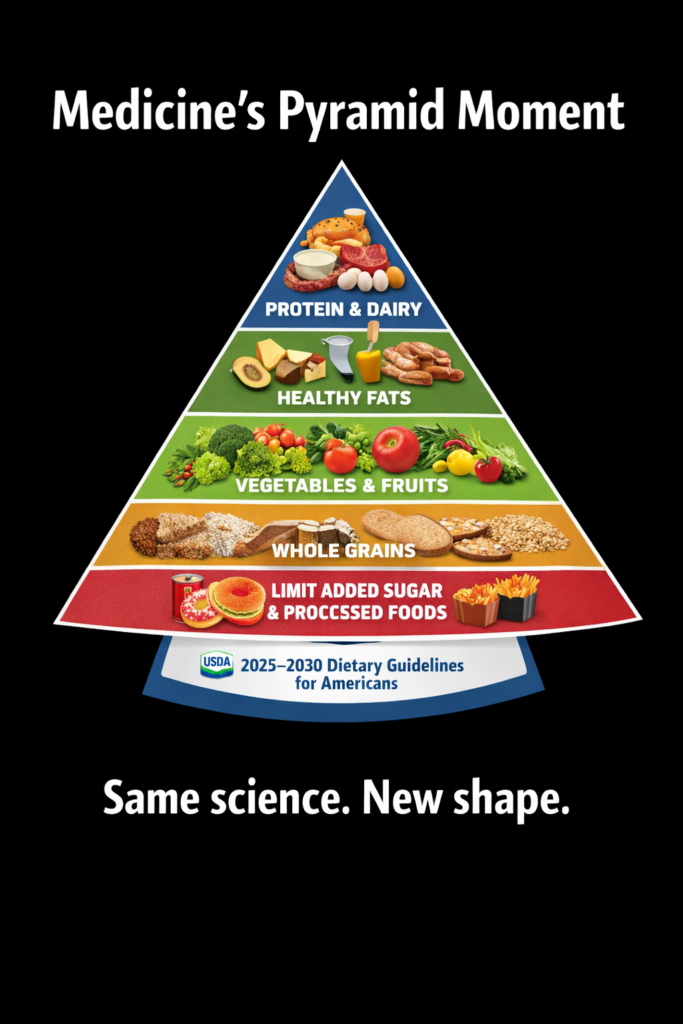
The medical “science” discussion increasingly begins with the HHS Food Pyramid, offered as a sign of reassessment and progress (e.g., https://www.facebook.com/watch?v=805927289135368 ). Updating nutritional guidance may be useful at a public-health level, but revising a visual framework is not the same as strengthening scientific foundations. A change in presentation does not, by itself, resolve deeper methodological questions.
In that sense, the food pyramid functions largely as a symbol. If medicine is moving toward lifestyle guidance and population-level management, one might even imagine changing the laboratory coat from white to green—an acknowledgment of a broader, more policy-oriented role. Yet symbols aside, the underlying scientific approach remains unchanged. The same system that previously framed vaccine promotion as “science” continues to operate with similar assumptions and validation practices.
Calling this framework “medical science” does not automatically align it with the standards of chemistry or physics. Those disciplines rely on isolation, characterization, reference standards, and direct testing. When such requirements are relaxed or replaced by models and narratives, the result is guidance rather than science in the strict sense.
The revised food pyramid does not correct this distinction. It updates the message, not the method. Meaningful progress will come not from new graphics or terminology, but from a renewed commitment to rigorous scientific principles at the core of medical practice.