
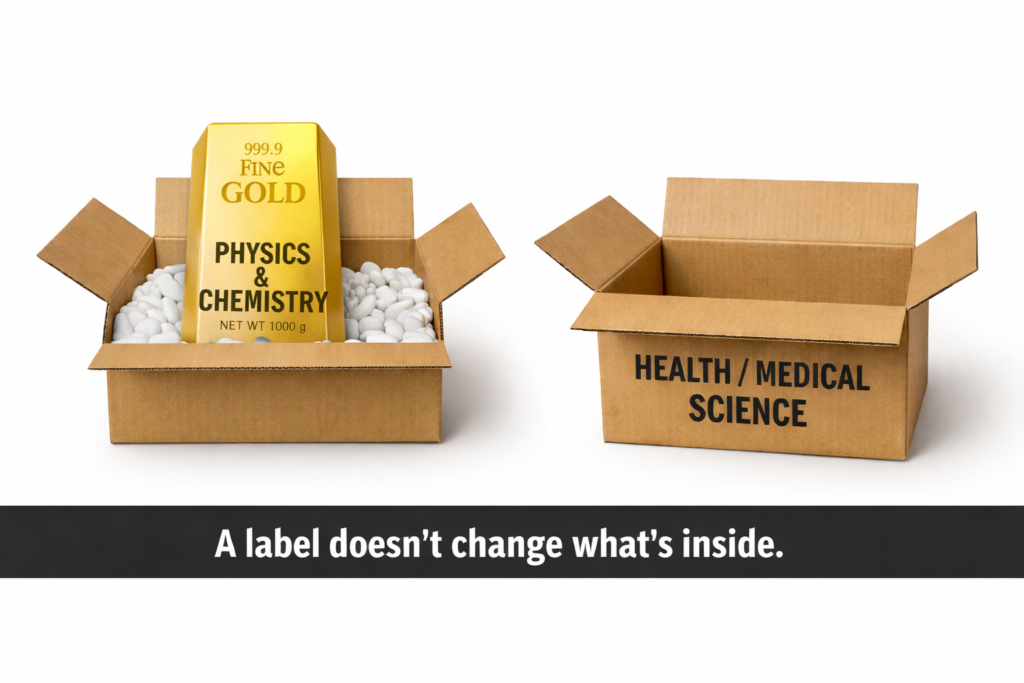
Much criticism has been directed at my definition of science: the study of physically existing substances, investigated using well-established principles of physics and chemistry at the atomic and molecular level (link). This definition is often portrayed as narrow or outdated. In reality, it is the classical definition of science that has guided human understanding for centuries and has delivered extraordinary, reproducible results. It is this framework that built modern technology, materials science, engineering, and chemistry-based medicine—fields that consistently produce high-yield, verifiable outcomes and command enduring respect for their practitioners.
The controversy arises because, over time, alternative definitions of “science” have been introduced—not to improve rigor, but to include disciplines that do not meet the foundational requirements of physical science. These newer definitions often emphasize methodology, institutional consensus, philosophy, or observational models rather than direct interaction with physically isolated and characterized material. While such approaches may be intellectually demanding, they are definitions about science, not science itself. The distinction is subtle but critical.
This definitional shift has enabled entire professions to claim scientific authority through methodological labeling rather than scientific substance. By redefining science broadly, these fields gain prestige, funding, and institutional power without adhering to the core requirements that govern true scientific inquiry. The most prominent examples are what are now called medical science, pharmaceutical science, health science, and biological sciences. These are defined-as-science disciplines, not true science disciplines in the classical sense.
True science remains rooted in physics, chemistry, and mathematics. These fields deal exclusively with measurable, isolatable, and characterizable physical entities. Claims must be anchored to material reality, reference standards, and reproducible measurements. There is no substitute for this foundation.
The recent pandemic represents a profound failure of defined-as-science. It could not have originated from true science, because true science works only with physically existing substances. Instead, decision-making was driven by disciplines that rely heavily on models, assumptions, indirect measurements, and theoretical constructs—most notably in medicine and biology. From a true science perspective, entities such as viruses, pandemic-scale causation, population-wide testing claims, and rapid vaccine development lack the required physical and chemical grounding.
This is not a rejection of inquiry or investigation, but a call for disciplinary honesty. When a field departs from physical substance and validated reference standards, it departs from science. Continuing to label such work as science does not make it so—it merely institutionalizes assumptions.
It is time to critically re-examine how science is defined and who is permitted to speak in its name. Progress does not come from expanding definitions to include everything intellectually demanding. It comes from preserving rigor, respecting boundaries, and insisting that scientific claims remain tethered to physical reality.