I read Dr. Robert Malone’s recent article with great interest (link). His recognition of the deep flaws in the U.S. regulatory medical system—including research funding, approval processes, and oversight—is both timely and important. However, his critique largely reflects the common physician’s viewpoint, blaming bureaucracy and government agencies such as the FDA, CDC, and NIH for the dysfunction. This perspective, while partly valid, misses the core of the issue.

The problem isn’t just bureaucratic mismanagement. The root of the dysfunction is the fraudulent framework of so-called “medical science” itself—a system run by professionals who claim scientific authority without actually practicing science. Dr. Malone is beginning to see aspects of this breakdown, but he stops short of identifying its real cause: the widespread lack of scientific literacy among medical professionals, particularly in areas where rigorous scientific analysis and measurement are required, such as pharmaceutical quality assessment.

(more…)

Terms like “science,” “scientific research,” “science experts,” and “scientists” are frequently used in the medical field — especially when discussing viruses, diagnostic testing, vaccines, or drug approvals. But in this context, such claims are often false and deeply misleading. Modern medicine, particularly in these areas, has little to no connection with actual science.

Physicians who invoke scientific language typically do so to secure government funding or promote their services — not because they possess genuine expertise in scientific disciplines like method validation, analytical chemistry, or test design. In reality, most have no formal training in these critical fields.

This is not a matter of opinion; it is a demonstrable fact. As such, any report or publication that uses the veneer of science to support medical claims — even those appearing in so-called scientific journals — should be approached with deep skepticism and rejected as lacking true scientific credibility.

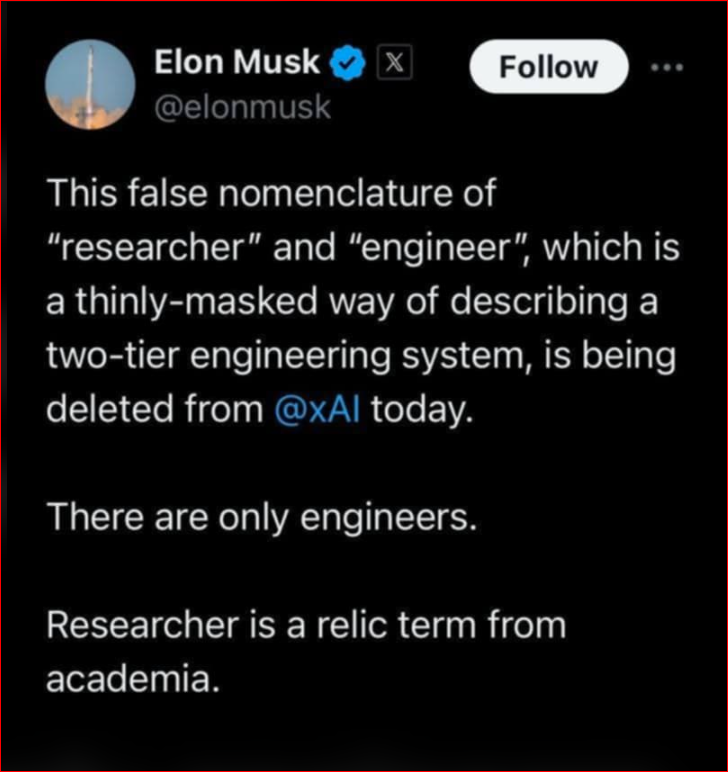
Mr. Elon Musk recently sparked an important and timely debate by commenting on the overlap between research and engineering. While his observation may seem benign on the surface, it actually highlights a much deeper issue: the misuse—and often complete distortion—of the words science and research.

As Musk aptly noted: “This false nomenclature of ‘researcher’ and ‘engineer’, which is a thinly-masked way of describing a two-tier engineering system, is being deleted from @xAI today. There are only engineers. Researcher is a relic term from academia.”

Although Musk was addressing internal structures at xAI, the broader implications of his statement resonate across many fields. The casual use of the word research to describe development work not only confuses the public—it also erodes the credibility of real scientific research.

(more…)

Understanding the Distinction Between Clinical Practice and Scientific Research. Physicians undergo extensive training in clinical diagnosis and treatment protocols, with a primary focus on identifying diseases and prescribing appropriate medications to manage patient conditions. Their education emphasizes pattern recognition, symptom analysis, and evidence-based treatment guidelines rather than the foundational scientific research that underpins medical knowledge. While doctors must understand basic scientific terminology to practice effectively, their training is oriented toward the practical application of medicine, not the conduct of original research or the advancement of scientific theory.

(more…)

What is medical science?

Medical science is a narrative constructed by medical professionals—primarily physicians—to explain illness and treatment according to their own interpretations and preferences. These explanations are not necessarily grounded in reality; many are speculative, hypothetical, or outright fabricated.

Crucially, medical science does not meet the standards of true science. It bears little to no connection with the actual sciences that deal with measurable substances—such as particles, atoms, and molecules—or with disciplines like chemistry that rigorously study them.

In essence, medical science is a belief system, propped up by ritualistic practices and unverified assumptions. At its core, it is a distortion of science—if not an intentional deception.


What are pharmaceutical and pharmacological sciences?

These are subdisciplines of medical science that claim to focus on the body’s chemistry—studying substances introduced into or produced within the body. However, they are largely practiced by individuals with limited training in real science, particularly in chemistry.

Although these fields claim to deal with compounds and molecular interactions, they operate without the scientific rigor found in true chemical sciences. Instead, they follow a medical science mindset that lacks depth in both theoretical and experimental chemistry. At best, these disciplines are superficial approximations; at worst, they are misrepresentations of actual science.


What is virology?

Virology is presented as the study of viruses—microscopic particles said to cause disease. Yet, there is no solid evidence that these viruses exist as physical entities, either in laboratories or in nature. They remain hypothetical constructs—mythical agents without direct scientific confirmation.

Virology, therefore, resembles a modern form of medical folklore—a narrative grounded more in belief and assumption than in empirical evidence. It remains detached from the hard sciences, which are based on observable and measurable entities. Despite its scientific appearance, virology operates outside the framework of real science, often in a ritualistic and uncritical fashion.

Practically all medically dominated panels—especially those claiming to represent “science”—need to be dismantled, without exception. There is no such thing as “medical science” in the true, rigorous sense. Medical professionals (physicians) neither study nor practice actual science; they lack formal training or credentials in it.

What they do practice is based on flawed or false interpretations of science. As a result, we are left with a healthcare system that is not only enormously expensive but often ineffective—and in many cases, outright fraudulent.

This is not merely an opinion. It is a fact, grounded in my education and training in science, as well as my work experience (30 years) at Health Canada.

As I’ve explained previously, one of the central issues is medical testing, which underpins diagnosis. Most of these tests are developed either by medical professionals or under their guidance. The fatal flaw is that these tests are rarely, if ever, scientifically validated for their intended purposes—this includes tests related to viruses, cancer, and associated treatments.

In an earlier article, I stated that if actual scientists, trained in disciplines like analytical chemistry, where testing of chemical compounds is a rigorous and exact science, evaluated such tests—the entire structure of modern medicine would collapse. I wrote:

“This is equivalent to a scientific checkmate against the claim of virus existence. There is no escape from it. The entire scenario of viruses, vaccination, virology, medical science, and pandemics collapses, as all depend on testing and testing methods that are not valid or validated. Game over!”

Indeed, the game would be over—immediately. There would be no need or demand for further so-called “research.” The cycle of fear, driven by false testing and imaginary diseases, would come to an end.

And arguably, many of the illnesses attributed to viruses or even cancer begin to disappear—simply because the unvalidated testing that “discovered” them would no longer be in use.


Separating Science From Filth (link)
 Explaining My Disagreement With Non-Virus Camp Medical Experts (link).
Is Cancer An Illness Or An Imaginary (Misdiagnosed) Thing Like Viral Infections? (link)
PCR testing and the viruses (link)

“The Trump administration can not stop Springer Nature from publishing, nor should they. But they can and should stop financially supporting their operations.

It is not a First Amendment issue, as some claim. Stopping payments that support woke science is a fiscal policy grounded in doing what is right for science (and science workers) in America.”

Dr. Malone wrote in a recent post on his blog (link), who was recently appointed to the Advisory Committee on Immunization Practices (ACIP) to address vaccine safety in general, with a particular focus on mRNA-based vaccines.

I read the article by Dr. Robert Malone—an M.D., not a Ph.D.—criticizing Nature and other high-profile journals for publishing what he calls “junk science.”

While I share concerns about the quality and bias of modern scientific publishing, Dr. Malone’s critique is ironic. He condemns biased, politically-driven science while defending the very institutions and funding streams that enable it. That contradiction deserves scrutiny.

(more…)

The idea that vaccines were deliberately designed to harm or kill may sound extreme—but it only makes sense if we assume the developers actually understood the science needed to do so. The truth is, they don’t. Most come from medical or biological fields, not from core scientific disciplines like chemistry. That’s not just a gap—it’s a fatal flaw.

This isn’t so much a case of malicious intent as it is a blatant fraud: people falsely claiming scientific authority they don’t have. They parade as scientists, yet lack the training, understanding, or qualifications. This deception has pulled in massive funding and driven the deeply flawed narratives around viruses and vaccines.

Pretending to be a scientist without real scientific grounding isn’t just dishonest—it is the root of the crisis. And it’s time we called it what it is: scientific fraud, hiding in plain sight.

An M.D. degree is not a science degree! (link)
Biology vs Science (link)
What is science, and who are scientists? (link)
My training and expertise – people ask! (link)

Response to the FB discussion (link)

This is an excellent and timely topic—actually, several questions wrapped into one. If even a trained pharmacist feels confused by the endless claims about supplements, nutrients, and health advice, imagine the situation for the average person constantly bombarded with contradictory information and marketing.

“I wanted to ask you what your opinion is on dietary supplements? Especially about what they call vitamin D, and the promotion that is made for minerals, trace elements? I am a Pharmacist in Greece, I know that all of these are chemicals, I am confused by the fact that they have a lot of promotion even from alternative doctors while we all know that their production is in the hands of big pharma.”

This is not just a valid question—it is a crucial one. I offer the following scientific perspective, which I hope helps clarify the confusion and cuts through the noise.

(more…)

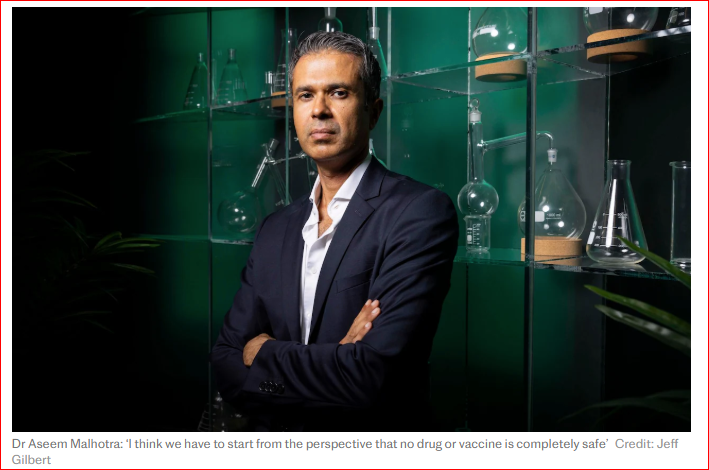
I was genuinely surprised to see a photo of Dr. Aseem Malhotra—a widely promoted UK cardiologist—posed in front of glass flasks and labware commonly used to symbolize a chemistry lab (link). It struck me as both ironic and misleading.

Physicians often distance themselves from chemistry, dismissing it as irrelevant to medical practice. Rarely do they study, engage with, or publish in actual scientific literature—particularly in fields like chemistry. So why pose with the trappings of a science they neither practice nor understand? It seems like a deliberate attempt to cloak medical opinion in the authority of science—especially when addressing issues like vaccine safety and toxicity.

(more…)