
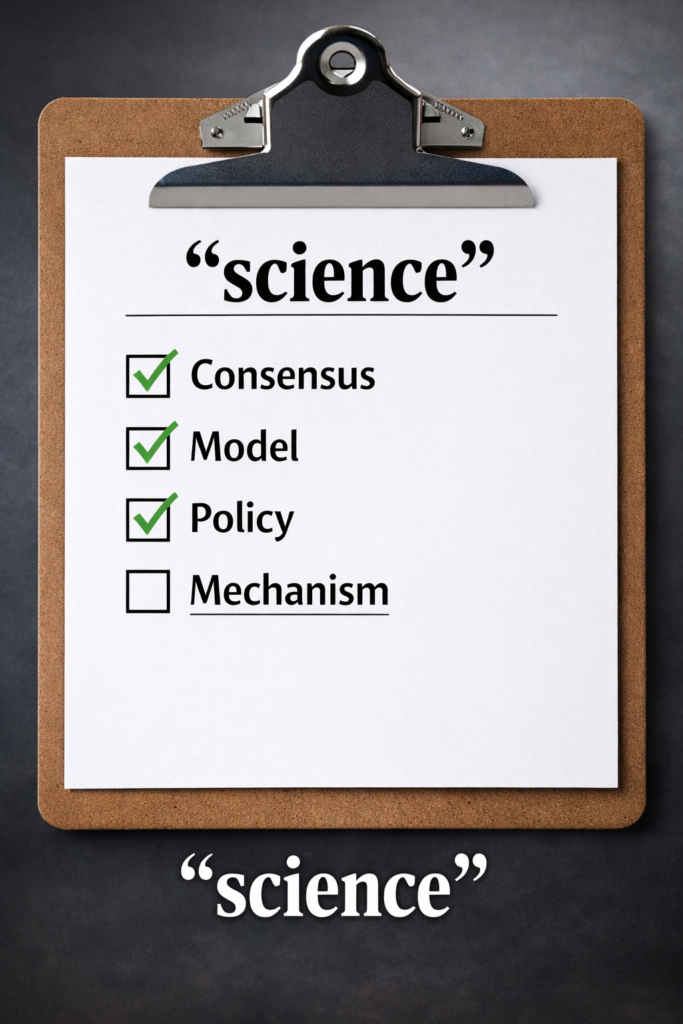
I did not define science, nor am I proposing a personal or alternative version of it. The redefinition of science—through the creation of new “sciences” operating within conceptual, administrative, or policy frameworks and then granted legitimacy—has been carried out by others. When I am told that this (chemistry and physics being the only science subjects) reflects my definition of science, that claim is misplaced. I am not advancing an opinion; I am pointing to what science has historically been and what it methodologically requires.
Science, in its foundational sense, is grounded in the study of physical reality—matter, energy, and mechanism—as established through chemistry and physics. These disciplines set the standards that came to define science: isolation, characterization, measurement, reproducibility, and causal explanation. Those standards did not originate in medicine, pharmaceuticals, biology, computing, or policy-driven disciplines; they were inherited from the physical sciences.
Many modern fields now labeled as “sciences” emerged much later and operate primarily at applied, observational, statistical, or administrative levels. While such fields may be useful in practice, their dependence on models, correlations, and inference does not meet the foundational standards that originally defined science. Utility, prediction, or consensus does not substitute for mechanistic understanding grounded in physical evidence.
This distinction is not a matter of personal bias or preference. It is a matter of historical development and methodological rigor. Expanding the label of science does not change what science is; it alters the label without altering the science.