
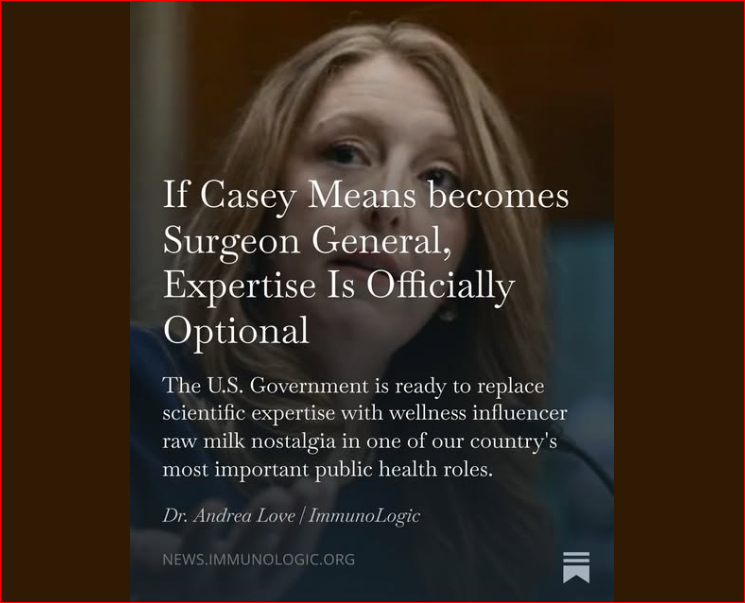
The article, “If Casey Means becomes Surgeon General, Expertise Is Officially Optional ” link), discussing the possibility of Dr. Casey Means becoming U.S. Surgeon General, raises concerns about her qualifications. The central criticism is that she did not complete a medical residency and therefore lacks sufficient expertise to assess and guide public health policy. While this argument may appear reasonable at first glance, it reflects a deeper misunderstanding of the nature of medical scientific expertise.
The core issue is the widespread assumption that medical doctors are scientific experts. In reality, physicians are primarily trained as clinicians. Medical education focuses on diagnosis, treatment, and patient management. A typical medical degree involves approximately four years of training centered on recognizing symptoms, applying diagnostic frameworks, and prescribing therapies. It is not designed to train students as research scientists or as experts in the foundational scientific disciplines.
For that reason, the claim that Dr. Means is unqualified because she did not complete residency misses the underlying point. Residency training primarily deepens clinical experience. It provides additional years of supervised practice in patient care, decision-making, and procedural work within the healthcare system. However, it does not fundamentally transform a physician into a research scientist or a specialist in foundational scientific disciplines.
In other words, whether Dr. Means completed residency or not does little to change the level of scientific training involved. Residency may produce a more experienced clinician, but it does not provide extensive education in analytical chemistry, physics, or other core sciences that form the foundation of rigorous experimental inquiry.
This distinction is important because public discussions often treat medical credentials as equivalent to scientific expertise. Medicine is frequently portrayed as a science-driven discipline, yet the majority of medical practice operates through clinical training, protocols, and guidelines developed within medical institutions. Direct engagement with the foundational scientific disciplines is limited in typical medical education.
Another concern arises from the author of the article, Dr. Andrea Love, who holds a Ph.D. in microbiology and immunology and presents herself as a scientific authority in the debate. While this background certainly reflects specialized training, microbiology and immunology belong to the broader field of biology. Biology, although an important area of study, often relies heavily on descriptive observation, classification, and statistical association rather than on the strict analytical frameworks typical of the physical sciences.
The foundational sciences—physics, chemistry, and mathematics—establish the principles of measurement, reproducibility, and precise characterization of physical entities. These disciplines form the methodological backbone of rigorous experimental science. Without grounding in these principles, many claims presented as “scientific” may rely primarily on models, assumptions, or indirect observations rather than on direct physical demonstration.
This distinction becomes particularly relevant when the article presents certain medical claims as settled scientific facts. For example, the author asserts that human papillomavirus (HPV) is the root cause of numerous cancers and that vaccination is therefore the solution. Similarly, she describes dental caries as resulting from bacterial acid production and promotes fluoridation as the appropriate preventive measure.
These claims are presented as definitive conclusions supported by science. However, from a strict scientific perspective grounded in analytical methodology, such assertions often rely heavily on biological models and epidemiological correlations rather than on direct experimental demonstration of causation through the methods characteristic of the physical sciences.
Furthermore, claims about viruses and viral causation are frequently presented as established scientific facts despite the absence of rigorous analytical demonstration in the traditional sense of isolating, purifying, and fully characterizing a physical entity as an independent causal agent. Without such demonstration, assertions regarding viral causation and related interventions remain open to scientific scrutiny.
Consequently, the debate about Dr. Means’s qualifications should not be framed solely around whether she completed residency training. The more fundamental issue is the broader conflation of medical credentials with scientific expertise. Physicians, microbiologists, and other biomedical professionals often operate within systems described as scientific, yet their training may not include the methodological foundations associated with the physical sciences.
If society wishes to evaluate major public health claims—particularly those involving widespread interventions such as vaccination programs or large-scale policy decisions—then genuine scientific scrutiny is essential. Such scrutiny requires disciplines capable of precise measurement, isolation, purification, and full characterization of the entities being studied.
Without that level of analytical rigor, many claims made under the banner of “medical science” risk remaining assumptions supported primarily by models, statistical associations, or institutional consensus rather than by direct scientific demonstration.
For this reason, debates about authority in public health should not rely solely on professional titles such as M.D. or Ph.D. Instead, the critical question should be whether the claims being advanced withstand rigorous scientific examination grounded in the foundational sciences. Only through such scrutiny can the credibility of science—and the public trust that depends on it—be properly maintained.