
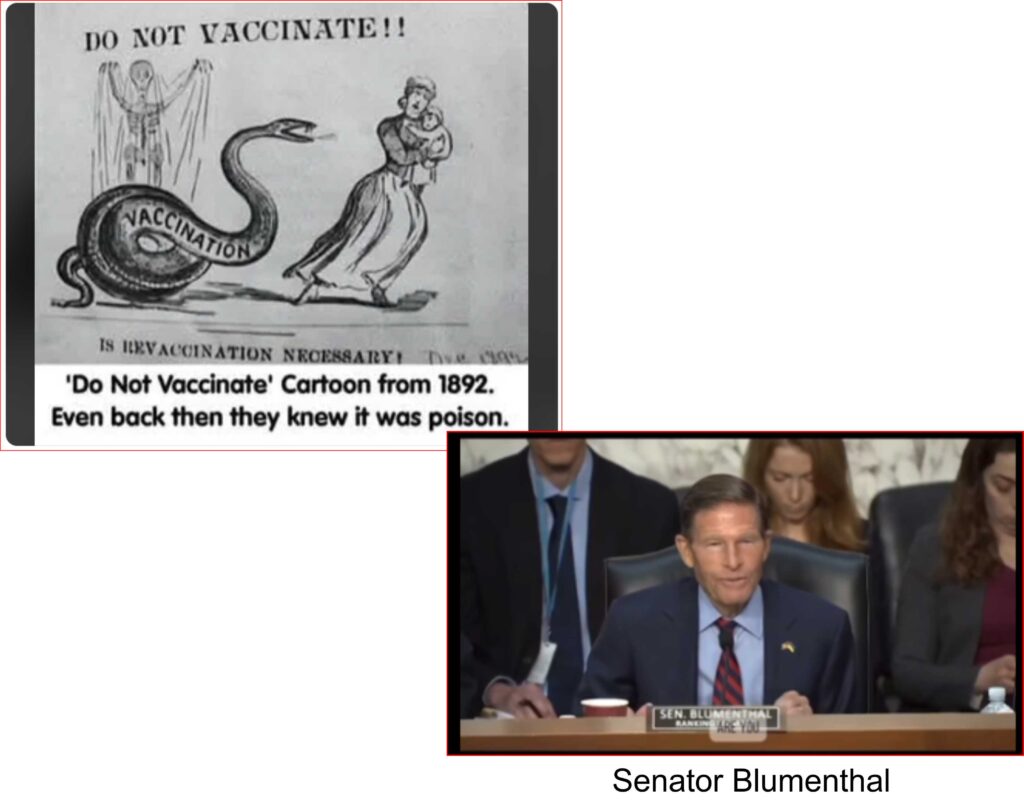
I saw this picture (left) and began to think: if the poisonous view of vaccines was already known and circulating in the late nineteenth century, how did vaccine use and recommendation become so widespread—even into modern times? A brief review of the literature shaped my conclusion: physicians are not scientific experts but rather professionals rebranded under a misleading title—medical science, or more precisely, fraudulent science. No wonder we remain trapped in a profession that labels itself “science” when, in truth, it is not.
If this deception was recognized even in its early days, why has it continued to be accepted as legitimate science? The answer lies in the gradual transformation of the medical profession during that period. Until the mid-1800s, physicians were regarded as healers—educated in anatomy, herbs, and observation—but they were not engaged in experimental or physical science. Their practice was practical and empirical, at times even philosophical, but never chemical or quantitative.
The Birth of a False Science
This situation began to change when figures such as Louis Pasteur, known for his work in microbiology, and Robert Koch, for his studies in bacteriology, began linking medicine with laboratory investigation. Their work belonged to biology, not to chemistry or physics, yet they branded their biological observations as “scientific.” This association gave medicine the appearance of scientific rigor, even though their methods lacked the precision, validation, and repeatability that characterize true science.
Contemporary critics noted that their work was essentially descriptive biology, not experimental or mechanistic science. Yet, the labeling endured—and through repetition, medicine acquired a new and undeserved identity as “scientific.”
As a result, anyone wishing to study medicine had to adopt this false version of science—a parallel and fraudulent branch that came to be known as medical science. Medical schools, which had once functioned primarily as trade institutions for training practitioners, rebranded themselves as medical universities. By borrowing the language and symbolism of science—terminology, laboratory imagery, and white coats—they gained academic prestige without achieving scientific validity.
This transformation created an enduring illusion: the healer now appeared to be a scientist, even though nothing fundamental had changed in the nature of the work, even today. The new “medical scientists” relied on observation, speculation, and consensus—principles that stand in contrast to the laws, measurements, and reproducibility required in true science.
Even modern physicians who question Pasteur or Koch continue to operate within the same false framework established in the nineteenth century. They remain convinced that they understand and practice science, yet they are confined to the very misconception they inherited.
The True Victim: Real Science
The greatest casualty of this false doctrine has been true science itself, particularly chemistry, which provides the foundation for all legitimate scientific inquiry. Unfortunately, chemists remained largely silent as this imitation science gained prominence. Their passivity served as implicit approval, allowing the fraudulent version of science to flourish. Medicine thus acquired the authority of science without possessing its substance.
This silence has had profound consequences. Physicians—trained neither in experimental design nor in the laws governing matter and reaction—now claim exclusive authority to define what is or is not “scientific” in health. Genuine scientists, particularly chemists and physicists, have been marginalized and treated as irrelevant to the discussion.
The absurdity of this hierarchy is exemplified by political hearings where medical authority is treated as absolute. In one such exchange (link), Senator Blumenthal — a lawyer himself, not a physician or scientist — “dismissng” Aaron Siri, a lawyer presenting a valid and reasoned argument, as a “crying baby” simply because he was “not a doctor.” Such displays reveal how deeply the illusion of medical science has permeated both public perception and institutional thought.
Science is now debated on behalf of physicians who themselves possess limited or no training in true science. How, then, can this scientific fraud be exposed or corrected? It can only be done by bringing actual scientists—those trained in chemistry, the science of matter and reactions—into the discussion. After all, medicines are chemical substances, and their evaluation belongs properly within the realm of chemistry.
Conclusion
Modern medicine is, in essence, a rebranded version of the old healing profession—without a true scientific foundation, yet cloaked in the language and authority of science. Today’s physicians, trained largely in biology and microbiology rather than in chemistry or physics, continue to operate under the illusion that they practice science. In truth, they rely on weak, unverifiable, or non-existent scientific principles while claiming the prestige and authority of science.
Thus, the falsehood persists. Medicine continues to parade as science, while true science—silent, sidelined, and misunderstood—remains its greatest and most tragic victim.
This issue will not be resolved until scientific experts—particularly chemists—are involved in addressing it. For medicine, being fundamentally chemical in nature, can only be properly understood and validated through true science, not through imitation.