
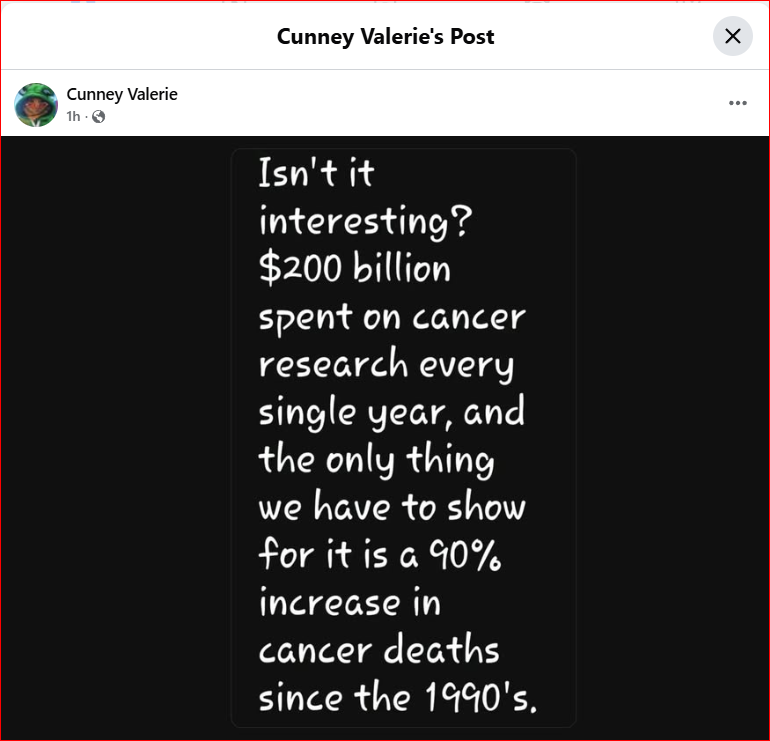
“Is it not interesting? Over $200 billion spent on cancer research every year — and a reported 90% increase in cancer deaths since the 1990s.”
Whether the numbers are framed precisely or rhetorically, the sentiment behind such a meme reflects a growing public unease. A massive financial investment is assumed to yield proportional scientific and health benefits. When that outcome does not appear obvious, questions begin to surface. But the real question is not whether billions are spent. The real question is whether the underlying model of disease is grounded in physical science or constructed within a self-reinforcing clinical framework.
Billions of dollars are spent each year on what is confidently described as medical research. The public hears the word “research” and assumes science in its pure form — rigorous, measurable, grounded in chemistry and physics. The label itself carries authority. Yet the deeper methodological foundation is rarely examined. Does medical research operate according to the standards of science, or has medicine developed a parallel structure that resembles science without consistently adhering to its core requirements?
True science rests on measurable substance. It requires isolation, purification, characterization, quantification, and reproducibility. It demands that claims be demonstrated with physical evidence, not inferred from association or reinforced by consensus. Chemistry does not operate on narrative. Physics does not operate on statistical persuasion. Both demand demonstrable material reality. Without that foundation, the word “science” becomes descriptive rather than substantive.
Physicians are trained in diagnosis and treatment. They are trained to manage symptoms, interpret guidelines, and apply established protocols. This is clinical expertise. It is not the same as foundational scientific training in analytical chemistry, molecular characterization, thermodynamics, or physical measurement systems. Yet medical conclusions are frequently presented as though they arise directly from deep physical-science investigation. That distinction is rarely acknowledged, but it lies at the center of the broader debate.
Over time, medicine has developed what it calls “medical science.” It borrows the language of chemistry. It employs laboratory terminology. It uses complex technical processes that appear scientific to the general observer. But vocabulary does not create scientific validity. When core claims cannot be demonstrated through physical isolation and chemical characterization of the entities involved, the framework rests more on structured interpretation than on direct proof.
Much of modern diagnosis relies on symptom clusters, indirect biomarkers, and statistical associations. These methods may assist in organizing clinical observations. They may guide treatment decisions. But usefulness is not equivalent to scientific validation. Statistics can describe patterns; they cannot establish physical existence. Consensus can standardize practice; it cannot substitute for demonstrable chemical reality.
The present controversy surrounding viruses and vaccines illustrates this structural issue. The debate is often framed politically, yet its underlying nature is methodological. Are the foundational entities established according to the standards of physical science, or are they sustained through repetition, institutional authority, and statistical modeling? If the foundation is not physically demonstrated, then the structure built upon it remains conceptually fragile.
This concern extends beyond infectious disease. Many modern medical claims, particularly within the pharmaceutical model, depend heavily on statistical modeling and regulatory approval rather than on direct chemical demonstration of underlying mechanisms. The appearance of scientific structure is maintained. The language of science is preserved. Yet the foundational requirements of physical science are not consistently foregrounded.
If medicine wishes to retain the credibility implied by the word “science,” it must welcome scrutiny at the level of chemistry and physics — not rhetorically, not administratively, but demonstrably. True science does not fear examination. It rests on measurable reality. Until that distinction is openly addressed, the term “medical science” will continue to function more as an institutional identity than as a rigorously demonstrated scientific discipline.