
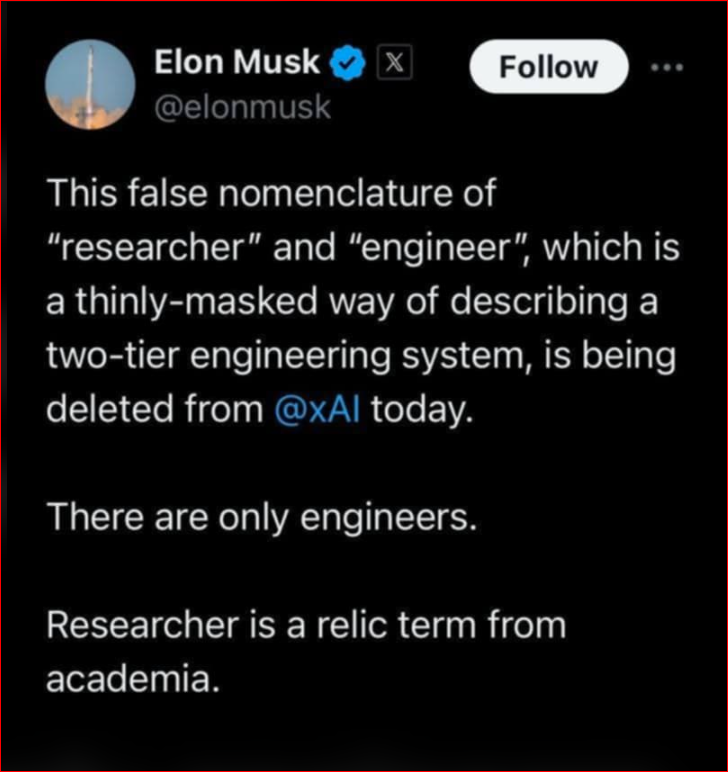
Mr. Elon Musk recently sparked an important and timely debate by commenting on the overlap between research and engineering. While his observation may seem benign on the surface, it actually highlights a much deeper issue: the misuse—and often complete distortion—of the words science and research.
As Musk aptly noted: “This false nomenclature of ‘researcher’ and ‘engineer’, which is a thinly-masked way of describing a two-tier engineering system, is being deleted from @xAI today. There are only engineers. Researcher is a relic term from academia.”
Although Musk was addressing internal structures at xAI, the broader implications of his statement resonate across many fields. The casual use of the word research to describe development work not only confuses the public—it also erodes the credibility of real scientific research.
From personal experience, I speak as someone with a postgraduate degree (Ph.D.) in chemistry and a career rooted in scientific research. My work has consistently focused on understanding and applying fundamental scientific principles—specifically in chemistry—to understand and solve problems in pharmaceutical and medical contexts. I have always made it a priority to remain anchored in the core scientific disciplines, particularly the analytical sciences, being my speciality or expertise, which are the true bedrock of knowledge generation.
However, in recent decades, a troubling shift has occurred. The word research has been redefined to include nearly any form of development work, especially in pharmaceuticals, medicine, and technology. Individuals working in labs—mixing chemicals, programming algorithms, or testing products—are often given the title scientist, and their routine development activities are labeled as research. This is not just a semantic mistake; it is a misrepresentation that weakens science as a whole.
Worse still, those working outside the fundamental sciences—engineers, physicians, technologists—are increasingly described as scientific researchers. In reality, what they are doing is product development, quality control, or applied experimentation. These activities are valuable, but they are not scientific research, which is about discovering new knowledge, not simply optimizing or repackaging existing information.
This blurring of lines between scientific inquiry and technical development has allowed entire professions to adopt the label of scientist without engaging in true scientific research. Engineers, technologists, and medical practitioners increasingly carry the title of researcher or scientist based solely on their involvement in lab or product work. But calling this science is a misrepresentation.
Consider the following examples:
- AI and Machine Learning Engineers: These professionals are often introduced in the media or in publications as AI scientists. In reality, they are applying well-known statistical and computational methods to specific problems—innovative, yes, but not exploratory science. Their work is development, not fundamental discovery.
- Biomedical Device Engineers: Those designing new sensors, diagnostic tools, or software for medical devices are regularly referred to as biomedical researchers. Yet, their work typically involves engineering applications based on existing physical and chemical principles—not uncovering new scientific laws.
- Software Engineers in Research Labs: In institutions like NASA, pharmaceutical companies, or tech giants, software developers who build data systems or analysis platforms are often titled research scientists. But much of this work involves refining tools, not generating new scientific understanding.
These examples demonstrate how the label of research has been stretched to cover nearly all technical and developmental activities, even when they lack the core elements of scientific methodology: hypothesis testing, controlled experimentation, and theoretical exploration rooted in physics and chemistry.
The irony is profound. As chemistry and physics—the foundational sciences—are being sidelined, derivative fields such as medicine and engineering are being elevated as the new face of “science.” Medical doctors, for instance, often require minimal formal education in science itself. An MD is a professional credential, not a scientific one. Yet, by merely participating in clinical studies or pharmaceutical trials, they are frequently presented as “medical scientists” or “clinical researchers,” despite having little to no training in the scientific method or underlying theory.
This blurring of roles has consequences. Funding bodies now disproportionately support research in applied or commercial fields, leaving basic science underfunded and underappreciated. Real scientific research, which seeks to understand the laws of nature, has become an afterthought in a system obsessed with short-term products and marketable outcomes. Scientists, especially in fields like chemistry and physics, are often left scrambling for support—viewed as thinkers with little relevance to modern-day innovation.
Meanwhile, engineers and physicians benefit from being able to directly sell their products or services to the public. Their fields are rewarded not for discovering truth, but for generating outcomes that are profitable or popular. As a result, grants, funding, and public recognition have increasingly shifted away from real science and toward applied development. The unfortunate result is that genuine scientific advancement has slowed, while superficial innovation has been mistaken for progress.
Why This Matters
Scientific research must be based on science—meaning the fundamental disciplines like chemistry, physics, and mathematics—not just any profession that uses tools or data. Scientists are those who contribute to our foundational understanding of reality. Developers, engineers, and medical practitioners serve essential roles, but their work should be clearly identified as applied or technical, not scientific, unless it genuinely meets the standards of scientific inquiry.
This confusion not only erodes the integrity of science but also creates public misunderstanding. When a physician makes a statement about virus detection or a software engineer publishes a paper on neural networks, the public often assumes these are contributions to science itself. In reality, such claims may lie far outside their domain of expertise and often reflect a surface-level understanding of the underlying science.
Conclusion
We must protect the distinction between science and application, between scientific research and development work. True scientific research is not product testing or clinical trial management—it is the pursuit of knowledge, guided by curiosity, rigor, and deep theoretical understanding.
Unless we restore integrity to how we use the words science and research, we risk diminishing the value of actual science and misleading the public about where real knowledge comes from. Let us be clear: not all research is scientific, and not everyone in a lab coat is a scientist. The future of scientific progress depends on making—and maintaining—that distinction.
Mr. Musk’s comment about the overlap between engineering and research is valid. Using the word research casually in the context of engineering can indeed be misleading. My suggestion is simple: instead of labeling such work as research, we should call it what it truly is—development. And those involved should be referred to as developers. This would help preserve the meaning of scientific research and ensure that credit and credibility are given where they are truly due.
The integrity of science depends on our commitment to precise language and clear boundaries. Only by maintaining these distinctions can we preserve the foundation upon which genuine scientific progress is built.