
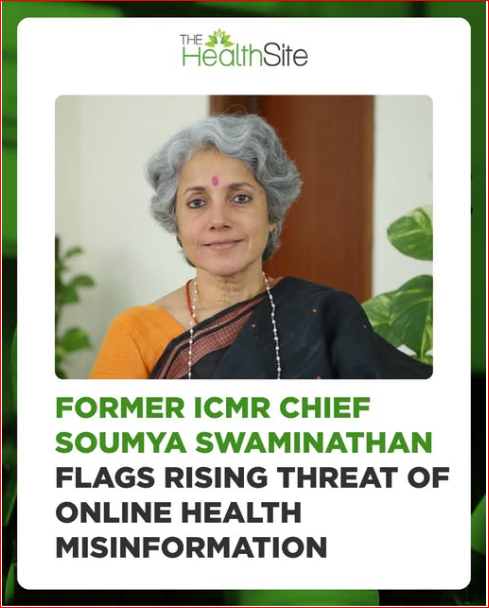
“Former ICMR Director General Soumya Swaminathan has warned that unchecked health misinformation on social media, especially related to vaccines can spread fear, mislead the public, and trigger the return of preventable diseases. She urged stronger regulation and swift removal of harmful medical claims online to safeguard public health.” (link)
When I read such comments from senior physicians, I take them not as evidence of confidence, but as evidence of concern. These reactions suggest that the information now circulating publicly appears logical, internally consistent, and difficult to rebut using traditional medical talking points.
We are seeing this increasingly in paediatrics, and similar patterns are evident in the United States. This shift became especially visible after Robert F. Kennedy Jr. publicly challenged long-standing claims made by medical authorities—particularly regarding childhood vaccination.
The response from many physicians has been revealing. Rather than addressing the substance of the questions raised, they assert authority. This reflects a deeper problem: physicians are not accustomed to being questioned on foundational assumptions. Their training positions them as decision-makers whose claims are expected to be accepted as valid, logical, and scientific—without challenge.
However, the questions now being asked are not clinical. They are scientific and logical in nature. They ask for mechanisms, material evidence, test validation, and experimental grounding. These are not areas in which physicians are trained to respond.
When physicians are asked to justify vaccination claims scientifically, rather than clinically or administratively, they are also implicitly being asked to demonstrate credentials in science itself. By any objective standard, most do not possess such credentials. Their qualifications lie in diagnosis, clinical evaluation, and prescribing authority, not in chemistry, experimental physics, or analytical validation.
Faced with this gap, the response has often been to label the questions themselves as “misinformation” and to call for suppression rather than engagement. Authority is defended not by evidence, but by institutional power.
Unfortunately for those attempting this strategy, that moment has passed.
It has become increasingly difficult to demonstrate scientific credentials where none exist. It is equally difficult to sustain claims of “scientific research” when the work rests on assumptions that cannot be experimentally verified. When stripped of borrowed scientific language, what remains are credentials for clinical practice—not for establishing physical truth.
Blaming the internet for “misinformation” then becomes a convenient escape, even when the information originates from physicians themselves—spoken publicly, recorded, and widely disseminated. The contradiction is unavoidable.
What we are witnessing is not a crisis of misinformation. It is a crisis of misapplied authority, revealed as medical claims are subjected to scientific scrutiny rather than accepted on trust.