
Let me try another way in the hope that it will be clearer for both the public and experts to see where the confusion lies.
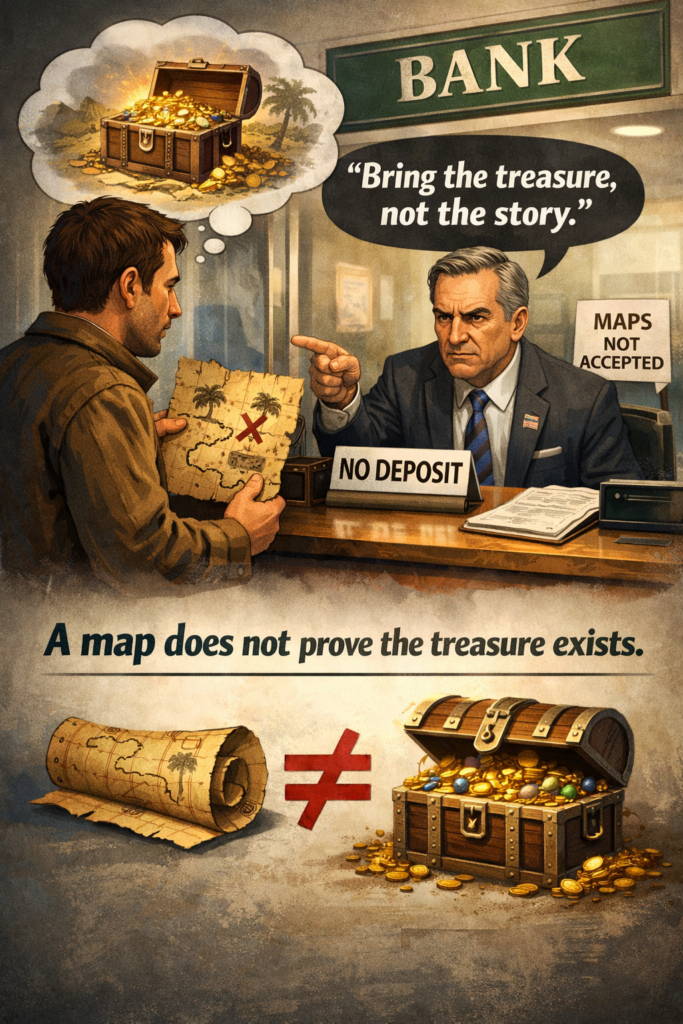
Imagine that I ask to see the actual treasure. Instead, I am handed a map and told that the treasure exists. I am even declared wealthy on that basis. However, when I attempt to deposit this supposed wealth, I am told: “Bring the treasure, not the story.” A map may describe where something is claimed to be, but it does not demonstrate that the treasure itself is real.
In the same way, presenting models, protocols, genomic sequences, or culture systems is not the same as presenting an isolated, purified, and fully characterized physical entity. A description is not the entity. A procedure is not proof of existence.
You keep presenting maps — protocols, models, reconstructed sequences, and complex mixtures — and declaring that the treasure exists. But a map is not the treasure. If a virus truly exists as a discrete physical entity, then it should be possible to present it as such: isolated, purified, and fully characterized. Instead, what is often offered are descriptions and inferred frameworks, with the assumption that the entity must be there.
Science operates on demonstrable physical evidence, not narrative structures. If all that can be shown are maps — genetic reconstructions, modeled particles, or interpretive systems — then one must ask whether the field has mistaken the map for the treasure.
This may not stem from bad intent. It may simply reflect that generations have been trained to accept description as proof of existence. But from a strict methodological standpoint, claims of existence require direct, reproducible, and tangible evidence.
A map does not prove the treasure exists. It only suggests where it is supposed to be.