
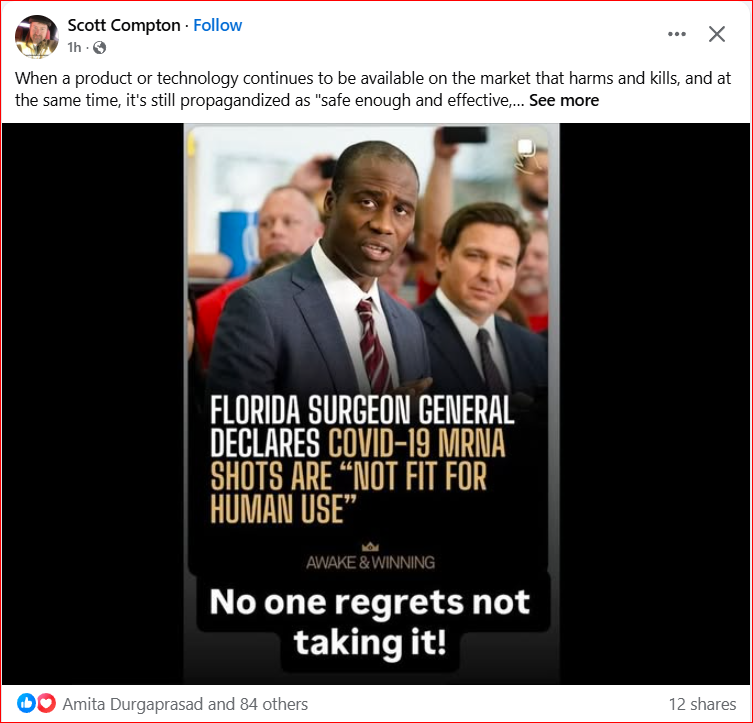
Science has led medicine and biology, not the other way around. Only now—after widespread and serious adverse outcomes associated with mRNA vaccines have become difficult to ignore—are some medical experts beginning to concede that medical practice lagged behind genuine science. This acknowledgment comes years too late.
These failures were not unforeseeable. Based on formal education and professional expertise in chemistry, the methodological flaws and risks were evident from the outset. They were explicitly predicted in 2020, before the development, authorization, and mass administration of these products (vaccines) —at a time when dissenting scientific voices were dismissed, censored, or ridiculed.
As stated in 2020:
“On the other hand, it is impossible to develop a proper vaccine because, as noted, one cannot monitor the virus or disease and then how the vaccine’s effectiveness will be established. It cannot be! Therefore, a fake vaccine will most likely be developed to satisfy the regulatory wish and calm down the created public hysteria and fear. Unfortunately, such vaccines, if developed and administered, will undoubtedly create potentially dangerous side effects, without any presumed benefits, by interfering with the body’s immune system and other related physiological processes.” (link)
This was not speculation. It was a direct consequence of ignoring foundational scientific principles.
The core problem is methodological failure. Claims made under the banner of “medical science” or biology (pseudosciences) are routinely accepted on authority rather than validated through rigorous scientific standards. True science—rooted in chemistry and physics—demands defined substances, controlled experimentation, measurable mechanisms, and reproducible results. Most medical interventions, including vaccines and pharmaceuticals, are ultimately chemical entities, regardless of how they are produced. Their safety and efficacy must therefore withstand chemical scrutiny. When this step is bypassed, harm is not accidental—it is predictable.
Going forward, when claims are made by medical science or biology, the public should seek independent verification through chemistry and chemists trained in analytical, mechanistic evaluation. Methodology matters more than consensus. Labels such as “clinical study” or “clinical trial” should not be accepted uncritically. Many such studies are observational, survey-based, or opinion-driven—not grounded in true scientific testing or validated analytical methods.
A similar pattern is now emerging in nutrition and so-called “food science.” The same authorities that once dominated medical narratives are increasingly promoting dietary doctrines involving cholesterol, saturated fats, sugars, and “healthy foods.” These matters are fundamentally chemical and metabolic in nature, yet they are once again framed through assumptions, population correlations, and visual persuasion rather than rigorous chemical understanding. Caution is therefore warranted (link, link).
This migration of pseudoscience from medicine into nutrition follows a familiar cycle: first healthcare, now “healthy food.” Authorities must remain alert to the infiltration of the same narrative-driven thinking into the food chain—complete with colorful images and simplistic visuals, much like those previously used to sell concepts of viruses, tumors, and other biological abstractions. Renaming substances as “nutrients” does not change their nature. They remain chemicals, governed by physical and chemical laws, and must be evaluated accordingly—through chemistry, not storytelling.
As we move into the coming year, the wish is simple: good health, honest food, and decisions guided by real science—not slogans, authority, or recycled narratives. Pseudoscience may shift domains, but its pattern remains unchanged. Recognizing it early is the first step toward avoiding its consequences.
Wishing you a healthy and thoughtful year ahead—grounded in genuine science and informed choice.