
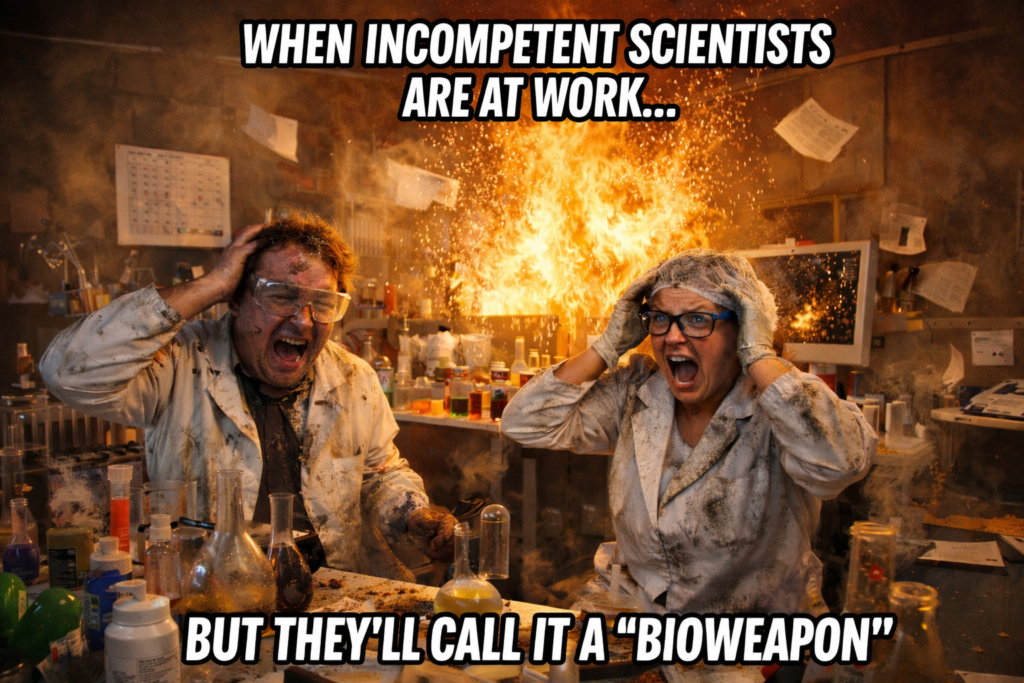
The term “bioweapon” is often repeated with dramatic certainty. Yet it should be read with sadness and concern, because it hides a serious deception: it projects the appearance of advanced science and expert authority where neither has been demonstrated.
Calling something a “bioweapon” implies that rigorous, high-level science is being conducted — that defined biological agents are understood, controlled, and intentionally weaponized. It suggests precision, expertise, and a legitimate scientific foundation. But the uncomfortable reality is that this framing can be used to legitimize a practice that has not met basic scientific standards.
True science — physics and chemistry — begins with defined objects: substances that are isolated, purified, characterized, and measurable, with methods that are reproducible and transparent. Without that foundation, “advanced research” becomes a performance: sophisticated language wrapped around assumptions, mixed materials, and unverified claims.
This is where the “fire” analogy matters.
If an untrained person walks into a chemical laboratory, mixes reactive compounds they do not understand, and causes an accidental fire, that incident is not evidence of “high-level chemical research.” It is incompetence producing harm. The danger is real — but it is not the result of mastery. It is the result of working beyond training, beyond definition, beyond control.
Now imagine that same person, after causing the fire, claims: “This proves I was working on a highly advanced, lethal project.” That claim would be absurd — yet it is structurally similar to how “bioweapon” language is often used. Harm becomes “proof” of sophistication. Accidents are rebranded as deliberate capability. Incompetence is relabeled as elite science.
This is precisely the problem with much of modern biology and “medical science” when it presents itself as true science. It imitates chemistry — it uses chemical reagents, complex protocols, and impressive instrumentation — but often without the defining discipline of chemistry: working with known, fully characterized entities. Instead, it frequently works with complex biological mixtures and speculative constructs, then builds authoritative stories around them.
Vaccines illustrate this pattern clearly. These products are promoted as outcomes of sophisticated, controlled science — as if the active entities and mechanisms are fully defined and validated. Yet harms and failures are routinely reframed as expected tradeoffs in “advanced medicine,” rather than the predictable consequences of working without rigorous chemical definition and accountability. The result is not “weaponized science.” It is more consistent with unintended harm from poorly grounded practice, followed by a marketing narrative designed to preserve legitimacy.
The same pattern appears in “virus research” and “gain-of-function” claims. These phrases are treated as the pinnacle of modern expertise, implying that researchers are manipulating a clearly defined, isolated, and characterized viral entity. But if no such defined entity is provided — if the “virus” remains an inferred narrative rather than a purified reference material — then there is nothing concrete to “enhance,” nothing scientifically anchored to modify, and nothing to treat as a legitimate object of high-level experimentation. In that case, “gain-of-function” becomes a label that sounds scientific, while concealing the absence of a properly defined subject.
This is why “bioweapon” rhetoric is so effective: it elevates biology and medical authority into the status of true science without requiring true scientific standards. It replaces chemical definition with institutional permission. It replaces proof with storytelling. It replaces accountability with fear.
The remedy is not a theatrical debate about imaginary “weaponization.” The remedy is to restore boundaries:
- Biology and medicine must stop claiming to be science unless they meet scientific standards.
- Funding and authority should follow demonstrated scientific validity, not branding and credential theater.
- When harm occurs, it must not be recast as evidence of “high-level work,” but examined as potential incompetence, overreach, and methodological failure.
Until society stops granting biology and medical practice the identity of true science, the cycle will continue. Undefined claims, institutional protection, public harm, and louder labels like “bioweapon,” “gain-of-function,” and “advanced technology” will continue to legitimize what has not been scientifically valid or earned.