
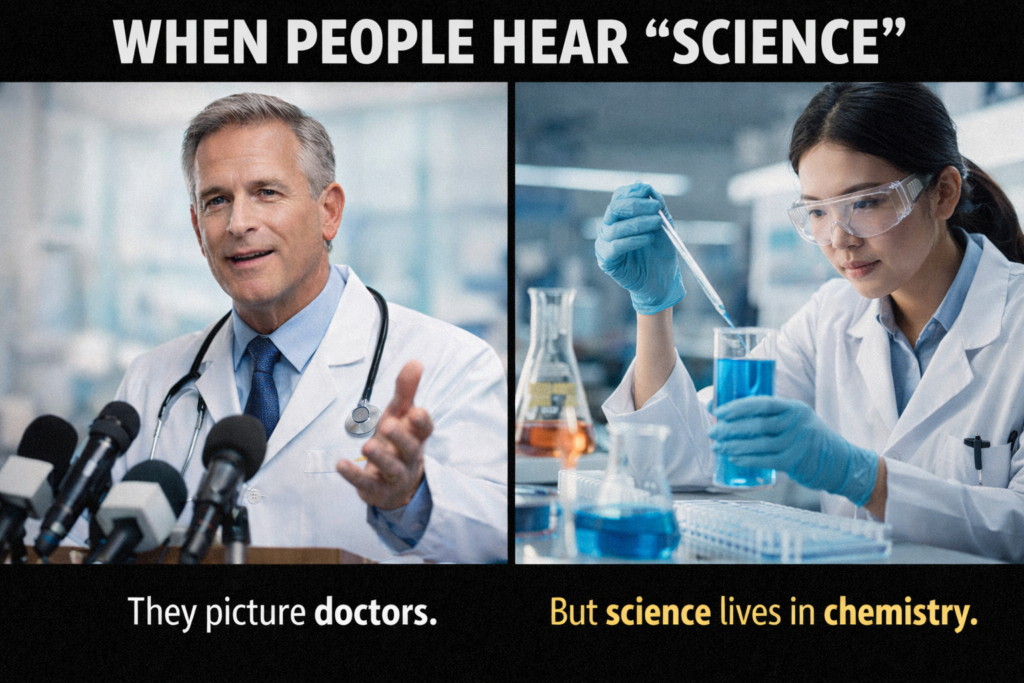
In public discourse, the words science, scientists, and research are used constantly. In the context of health and medicine, these terms are almost automatically assumed to refer to medical professionals, particularly physicians, and to what is commonly called medical science. This assumption is so deeply ingrained that it is rarely questioned. Yet it is categorically incorrect.
Neither the public nor most professionals stop to ask a basic question: what exactly is meant by science? And more importantly, who is actually trained to practice it?
This confusion lies at the heart of modern medicine’s claimed authority.
Allopathic medicine—the so-called modern medical system—is widely promoted as superior to alternative traditions such as homeopathy, Ayurveda, and naturopathy. This claimed superiority rests almost entirely on the assertion that modern medicine is “science-based” and supported by “scientific research.” However, this assertion collapses once the term science is defined correctly.
True science is rooted in chemistry and physics. It is concerned with isolating, purifying, identifying, and characterizing real material substances, as well as the physical laws governing them. Scientific knowledge is established through controlled experimentation, material evidence, reproducibility, and quantitative measurement. Without these elements, claims may be observational or professional, but they are not scientific.
What medicine commonly refers to as medical science does not meet these criteria.
Medical practice is fundamentally a professional trade qualification, not a scientific discipline. An M.D. degree trains practitioners to recognize symptom patterns, apply diagnostic labels, follow standardized treatment guidelines, and prescribe approved products. It does not train physicians in chemistry, analytical methods, experimental design, or the isolation and characterization of substances. Nor does it train them to conduct foundational scientific research.
In this respect, medicine is no different from other applied professions. Engineers, pilots, accountants, and lawyers all rely on bodies of knowledge developed elsewhere. None of these professions claims to be science. Medicine, however, uniquely does—and this is where the misrepresentation begins.
Despite lacking scientific training, medical professionals are routinely presented—and present themselves—as scientific authorities. The words science, research, and evidence are repeatedly invoked, creating the impression that medicine operates on the same footing as chemistry or physics. In reality, medical claims are largely derived from observational studies, statistical correlations, consensus panels, and regulatory frameworks, not from direct material science.
This false scientific identity has had serious consequences.
It is precisely this mislabeling that gave rise to fields such as virology, which assert the existence of “viruses” as causal agents of disease without ever producing chemically isolated, purified, and characterized samples that meet scientific standards. Instead, complex biological mixtures, indirect signals, and assumed interpretations are treated as proof. Under the principles of real science, such claims do not qualify as evidence.
A brief examination of the primary literature reveals that these foundational assumptions do not withstand chemical scrutiny. Yet because the field is shielded by the authority of “medical science,” these shortcomings are rarely challenged in meaningful scientific terms.
The problem is not that medicine is useless or malicious. The problem is that it misrepresents its nature. Medicine is a practice guided by policy, regulation, and professional convention—not a science grounded in chemistry and physics. When this distinction is ignored, medicine gains an authority it has not earned, and scientific standards are quietly abandoned.
Given these facts, it is clear that medicine should not be classified as a science, nor should its narratives be automatically treated as scientific research. The widespread public belief that physicians are scientists—and that medical claims are therefore scientific facts—must be corrected.
Accountability begins with honesty.
That means clearly distinguishing science from medical practice and addressing foundational errors in which scientific language has been misused—most urgently in virology and vaccine development. Until medicine returns to a framework grounded in true science, claims of being “science-based” will remain rhetorical assertions rather than demonstrable facts.
What is science, and who are scientists? (link)