
In recent discussions, particularly on social media, I have encountered a recurring response to my critique of virology: “Stay within your field. Your chemistry knowledge does not translate to virology.”
At first glance, this may sound reasonable. Specialization matters. Expertise matters. However, this response fundamentally misunderstands the nature of the issue being raised.
This Is Not About Virology — It Is About Scientific Claims
I am not attempting to practice virology. I am not describing clinical medicine. I am not proposing alternative biological models.
The issue is far more basic.
The claim under examination is the existence of viruses as physically isolated, purified, and fully characterized entities. That question does not belong exclusively to virology or medical practice. It belongs to science in its strict analytical sense — particularly to chemistry and the physical sciences.
Isolation, purification, and physicochemical characterization of substances are not “medical” procedures. They are foundational scientific processes. They fall squarely within analytical chemistry.
When a substance is claimed to exist, science requires that it be:
- Isolated from confounding material
- Purified from mixtures
- Fully characterized using established physicochemical methods.
Without these steps, one does not have a defined material entity. One has an assumption.
The Inversion of Competence
Ironically, the accusation that I am “outside my field” reverses the actual situation.
I am not critiquing clinical decision-making or epidemiological modeling. I am addressing the scientific claim of material existence. That is a matter of chemistry — the discipline concerned with identifying, isolating, and characterizing matter.
If a field asserts the existence of a physical particle, it enters the domain of analytical science. At that point, the standards of chemistry apply.
The objection “chemistry does not translate to virology” overlooks a critical fact: if viruses exist as claimed, they would be chemical entities composed of molecules. Their verification must therefore meet chemical standards of evidence.
The Problem of Representation
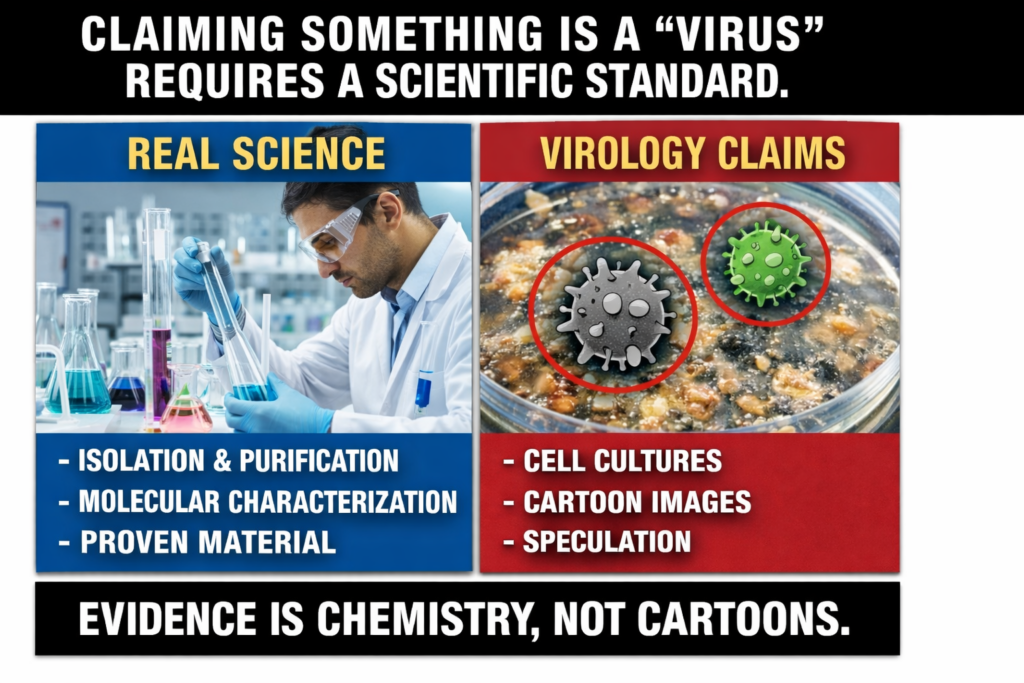
Much of what is presented as “evidence” consists of images of cell cultures with highlighted structures labeled as viruses.
This approach resembles taking a photograph of a bowl of soup, circling a few shapes that resemble chicken pieces, and declaring the entire mixture to be chicken soup — without ever isolating and confirming that the highlighted material is, in fact, chicken.
An image of a complex mixture does not constitute isolation. A labeled diagram does not constitute characterization. A cartoon rendering is not material evidence.
Science requires demonstration, not illustration.
This Is Not Opinion — It Is Methodology
The core issue is methodological. If isolation, purification, and full characterization have not been performed according to rigorous physicochemical standards, then claims of existence remain unverified.
This is not a matter of belief or ideology. It is a matter of scientific procedure.
When critics respond with “stay in your lane,” it suggests an appeal to disciplinary boundaries rather than engagement with methodological substance. But scientific claims do not become valid simply because they are made within a professional field.
If a claim concerns the existence of a material entity, it must withstand the standards of material science. Until such standards are demonstrably met, the claim remains unsupported.