
This article is written in response to a Facebook comment and serves to clarify the intent and meaning of my original post (link).
Question: “just a question for you. I’m sure there are medicinal products, medicines and pharmaceuticals that are helpful and beneficial to humans when needed, but simply improving one ‘s diet, exercising and getting the proper sleep would be a major contributing factor into improving one’s health and overall body homeostasis. Injecting useless gunk provides no benefit to the body.” (link)
Response: Thank you for your comment. I understand your concern; however, I believe my position has been misunderstood.
Your interpretation is common, and that is precisely the issue. It reflects a prevailing mindset shaped by routinely used terms such as “diet” and “health.” These words are often treated as self-evident and objective, when in fact they are rarely examined critically. My position is not that diet and health are invalid or unrelated—on the contrary, they are clearly connected. The more fundamental questions are these: what constitutes proper diet and proper health, who defines them, and on what scientific basis are those definitions made?
This is where confusion begins, and authority replaces science. Many so-called health experts operate with vague, subjective notions of health. Their opinions are often no more rigorous than anyone else’s. Opinion may be acceptable in personal discussion, but when claims are elevated to public policy or presented as scientific fact, clear, objective, and scientifically valid criteria are required.
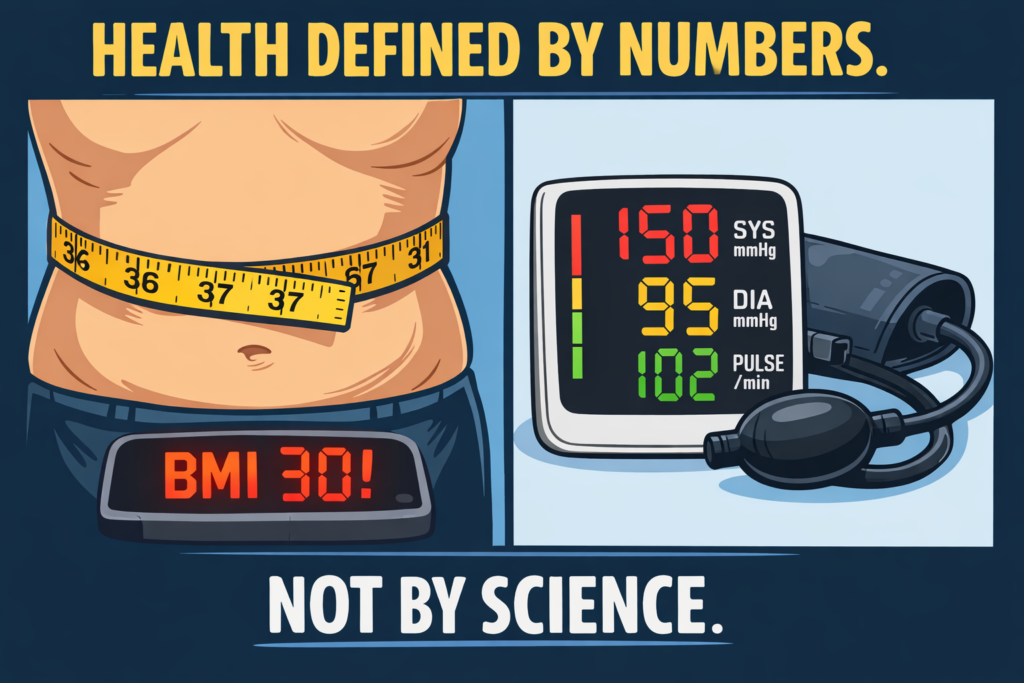
Instead, modern health standards rely on arbitrary benchmarks: waist circumference must fall within a prescribed range; blood pressure must meet predefined limits; cholesterol, sugar, or fat levels must conform to numerical thresholds. Once someone falls outside these ranges, they are labeled “abnormal” or “unhealthy.” Individuals are then directed toward interventions—medical treatments, dietary restrictions, or lifestyle changes—often justified by claims that sugar, fat, or cholesterol are causal agents. Yet the central question remains unanswered: who decided this, and how was it established scientifically?
Were these dietary factors demonstrated as causes, or were they merely associated with outcomes through observational studies, surveys, or population correlations? Association is not causation, yet it is repeatedly presented as such—wrapped in the language of science and reinforced by institutional authority.
When examined properly, the entire discussion reduces to chemistry. Food—whether labeled “healthy” or not—consists of proteins, carbohydrates (including sugars), fats, and micronutrients. These are chemicals. The human body has processed these substances successfully for thousands of years. If these same chemicals are now being blamed for widespread health problems, the issue must be addressed scientifically—through direct chemical analysis and mechanistic understanding—not through statistical associations, dietary models, or observational inference. The latter are not science; they are speculation and, in some cases, may be harmful.
The deeper problem is that these narratives are presented as logical, factual, and scientific, when in reality they are none of these—least of all scientific. They are promoted through persuasive messaging, appealing visuals, and authority figures in lab coats, rather than through rigorous chemical evidence.
We have seen this pattern before. Large populations are told they are at risk of viral infection. A cause is declared (virus)—often without physical or scientific confirmation. Massive funding is allocated. Solutions (vaccines) are developed for problems that were never scientifically established and then sold back to governments and the public under the banner of “cutting-edge science.” Questioning the science itself is discouraged or dismissed. Only after widespread harm and failure does it emerge that those advancing these claims were neither scientists in the true sense nor trained in the science they invoked.
My argument is simple and consistent: modern concepts of health, medicine, diet, and “healthy food” are built on arbitrary criteria and narrative-driven claims, not on chemistry-based science. Before prescribing solutions, these concepts must be clearly and scientifically defined. Otherwise, dietary doctrines risk becoming the nutritional equivalent of vaccines—widely promoted, insufficiently grounded, and shielded from proper scientific scrutiny.
To date, I have not seen a clear scientific demonstration—based on chemical causality—that sugar, including refined sugar, is the direct culprit it is claimed to be. Associations may exist, but extrapolating them into universal dietary rules is scientifically unjustified and remains unvalidated.
Caution is therefore warranted when evaluating health claims and the remedies being promoted. One must ask whether these recommendations are genuinely evidence-based or simply marketing strategies designed to sell “health foods” and related products—often at higher prices and profit margins than ordinary alternatives. It is also essential to examine which authorities are being invoked to legitimize these claims.
In my article, I provide links to statements from members of the medical profession who neither study science nor nutrition in any rigorous sense, yet now promote “healthy lifestyle” doctrines without offering valid scientific criteria for health. Instead, these claims rely on arbitrary numerical thresholds advanced by individuals lacking formal training and expertise in the relevant scientific disciplines.
I fully support the goal of a healthy population, nutritious food, and a balanced lifestyle. What I oppose is the substitution of science with self-promotion—where individuals present themselves as experts and invoke the appearance of elite science where none actually exists. These claims are delivered with confidence and authority, yet lack genuine scientific grounding. Rather than surrendering judgment to marketing narratives, people would be better served by enjoying the food nature provides, living sensibly, and refusing to fuel a profit-driven industry built on fear, exaggeration, and unsubstantiated promises.
Ultimately, this is a call to restore actual science—chemistry—to discussions of health and nutrition, a foundation that people urgently need but have been systematically denied.