
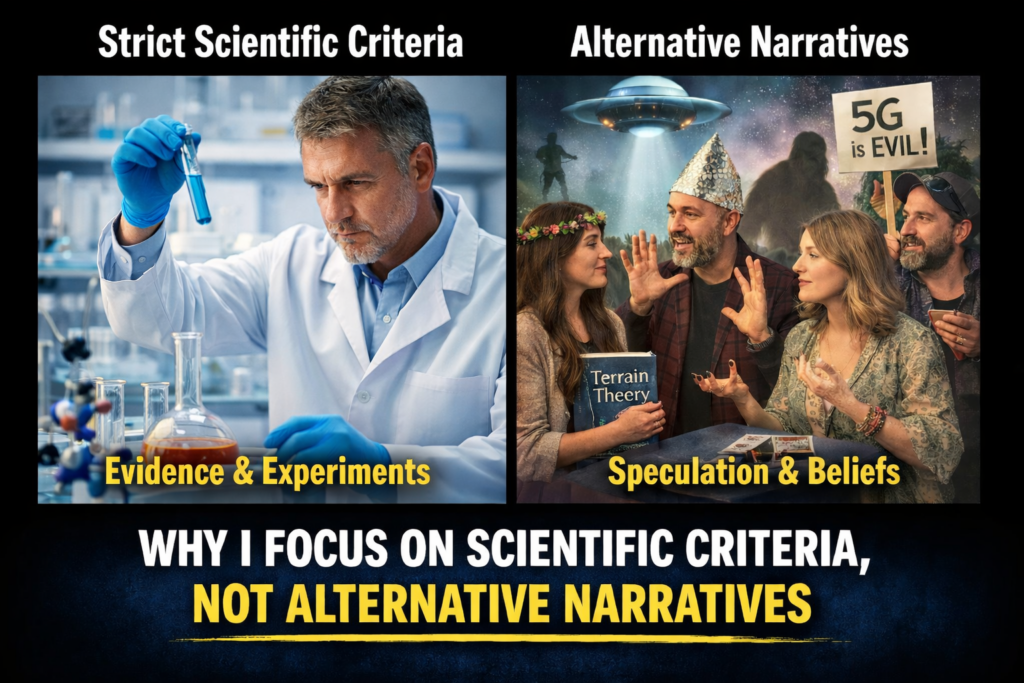
Public discussions about viruses, vaccines, and modern medicine often move quickly into competing narratives. Some defend the conventional medical view, while others introduce alternative explanations such as terrain theory or statistical critiques of viral pandemics. While these debates may appear to challenge the mainstream view, they often leave a deeper question unaddressed: what constitutes a valid scientific demonstration in the first place?
A recent comment illustrates this dynamic well. The commenter largely agreed that proper scientific criteria—such as isolation, purification, and full characterization of a claimed entity—are rarely discussed in virology in the rigorous sense expected in the physical sciences. However, the commenter suggested that focusing solely on these criteria may not persuade many people and that broader arguments, such as statistical evidence or terrain-based explanations, might be more effective.
The comment reads as follows:
When it comes to presenting scientifically rigorous criteria for what virus purification and characterisation, I agree with you. Pointing out that none (apart from phages and “giant viruses”, neither of which are viruses) have been purified directly from sample, and there’s no logical reason why they wouldn’t have been if they existed only gets you so far, and then it seems like a boring dead end. At that point, we need a stronger challenge.
I don’t see any problem with it as a piece of basic reasoning though, nor in the detective work of people like Jon Rappoport and the authors of Virus Mania, who pointed out a lot of statistical evidence against various alleged viral pandemics via plenty of immediately plausible terrain explanations for the symptoms supposedly caused by viral infection.
If you poo poo these basic lines of reasoning that if viruses existed they ought to at least be able to provide attempts at claiming they’ve been isolated that don’t rely on “culturing” and “sequencing” of unpurified sample, and also ignore the statistical support that exists for the idea that viruses are an unnecessary hypothesis, then I suspect you’ll lose a lot of people who would have followed you to the next level. But perhaps you’re right. I know I’m shouting in the wind whether you are or not.
The comment is thoughtful and constructive, and it raises an important strategic question: should criticism of virology rely on broader narratives and alternative explanations, or should it remain focused strictly on scientific criteria?
I see this issue somewhat differently.
The comment correctly recognizes the importance of the lack of proper isolation and purification of viruses from clinical samples. From a scientific standpoint—particularly from the perspective of the physical sciences—such steps are fundamental. A claimed physical entity must be isolated, purified, and fully characterized before meaningful conclusions about its properties can be drawn.
However, my approach is intentionally narrower and more strictly scientific. While broader arguments—such as terrain theory, statistical anomalies, or epidemiological inconsistencies—may appear persuasive, they often do not address the central scientific issue. Instead, they tend to introduce alternative narratives within the same framework that already assumes the legitimacy of “medical science” as a scientific authority.
In other words, the discussion shifts, but the underlying problem remains untouched.
This situation resembles what is often seen in political leadership. When a problem arises, the response is frequently to replace one group of authorities with another group trained within the same system. The rhetoric and emphasis change, but the underlying assumptions remain intact.
A similar pattern can be observed in medicine. Over time, the focus of dietary and health narratives has shifted—from cholesterol to sugar, for example—supported by extensive surveys and statistical analyses. Yet both cholesterol and sugar are chemical substances. Properly understanding their biological effects requires rigorous chemical knowledge and analytical methodology. Medicine, however, is largely a clinical discipline and is not structured around the fundamental scientific analysis of chemical systems.
Thus the narrative changes, but the authority structure remains the same.
For this reason, I deliberately maintain a strict focus on scientific criteria, even if doing so appears limited or less appealing to a broader audience. The goal is not simply to debate viruses or vaccines as isolated topics. Rather, the issue runs much deeper.
The central problem, in my view, is the broader absence of rigorous scientific methodology—particularly the methods of chemistry and physics—within biology and medicine as they are commonly practiced and presented to the public.
Viruses and virology have simply become one of the more visible examples of this deeper issue.
By maintaining a clear and consistent scientific standard, even if it attracts fewer followers initially, I believe it would help bring attention to the underlying methodological problem. Once that problem becomes clearer, the broader implications for modern medical claims, diagnostics, and treatments may become easier for others to recognize.
In that sense, the goal is not popularity but clarity. And while thoughtful comments such as the one above highlight alternative strategic approaches, they also help clarify the core question: not which narrative is more persuasive, but whether the claims being made meet the basic standards of science at all.