
A very telling—and revealing—comment was posted by Rense Rozeboom on Facebook:
“Saeed Qureshi, I see you weren’t trained in (micro)biology, so I understand you don’t ‘believe’ in viruses (or bacteria?). But I’ve seen and worked with them, and I can say your idea is very wrong—and worse, you mention things without personal experience. That’s dangerous! Someone claiming to be an ‘expert in chemicals/pharmaceuticals’ should know to remain silent on other fields.” (link)
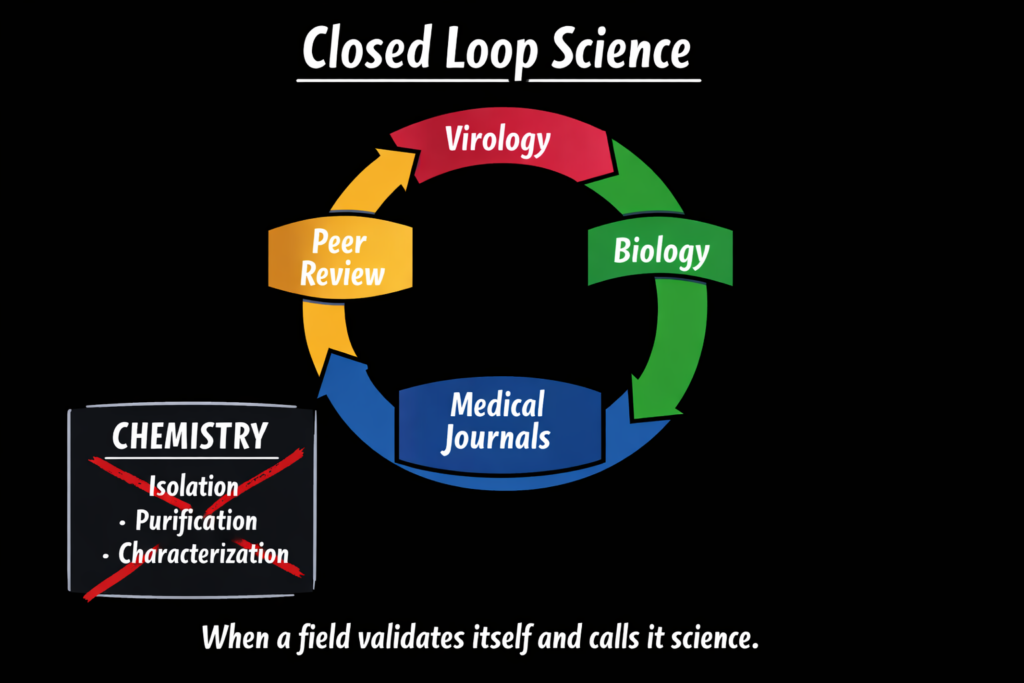
This comment illustrates exactly why the problem—the persistence of false claims in virology and medicine—continues. These fields operate within a closed framework, promoting internally generated assumptions as “science,” while insulating themselves from external scientific scrutiny.
Microbiologists, biologists, and medical professionals often fail to recognize that I am operating squarely within my field, while they are not. Their claims rely on scientific and chemical methodologies that are incorrectly attributed to their disciplines. Isolation, purification, characterization, test-method development, and the purification and characterization of vaccine or pharmaceutical contents—including the establishment of quality standards—do not belong to microbiology, biology, or medicine. They belong to science in the strict sense: chemistry, which is my area of education and expertise.
Yet these fields routinely appeal to chemistry without proper training or comprehension, drawing conclusions that chemistry itself does not justify. The result is a fundamental scientific error.
From the perspective of true science—chemistry—the methodologies cited and the conclusions drawn do not meet established scientific (chemistry) standards. Claims of viral isolation, validated testing, and authentic purification and characterization of vaccines fail the most basic requirement: the availability of an isolated, purified, and fully characterized physical virus sample in a test tube. Instead, what is presented are mislabeled “virus isolates,” or lysates—complex biological mixtures (having known or unknown components) implied to be pure viruses.
Without isolated, purified, and fully characterized physical entities, such as these viruses, the narrative remains unsupported. From a scientific standpoint, it is not evidence-based.
That is the core issue.