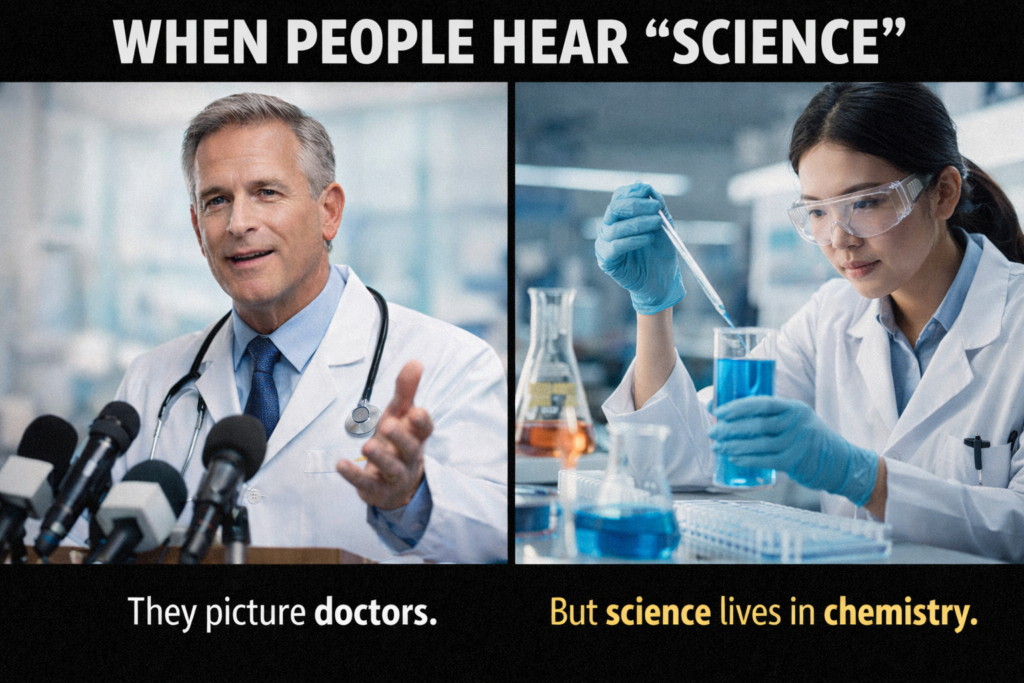
In public discourse, the words science, scientists, and research are used constantly. In the context of health and medicine, these terms are almost automatically assumed to refer to medical professionals, particularly physicians, and to what is commonly called medical science. This assumption is so deeply ingrained that it is rarely questioned. Yet it is categorically incorrect.

Neither the public nor most professionals stop to ask a basic question: what exactly is meant by science? And more importantly, who is actually trained to practice it?

This confusion lies at the heart of modern medicine’s claimed authority.

Allopathic medicine—the so-called modern medical system—is widely promoted as superior to alternative traditions such as homeopathy, Ayurveda, and naturopathy. This claimed superiority rests almost entirely on the assertion that modern medicine is “science-based” and supported by “scientific research.” However, this assertion collapses once the term science is defined correctly.

(more…)
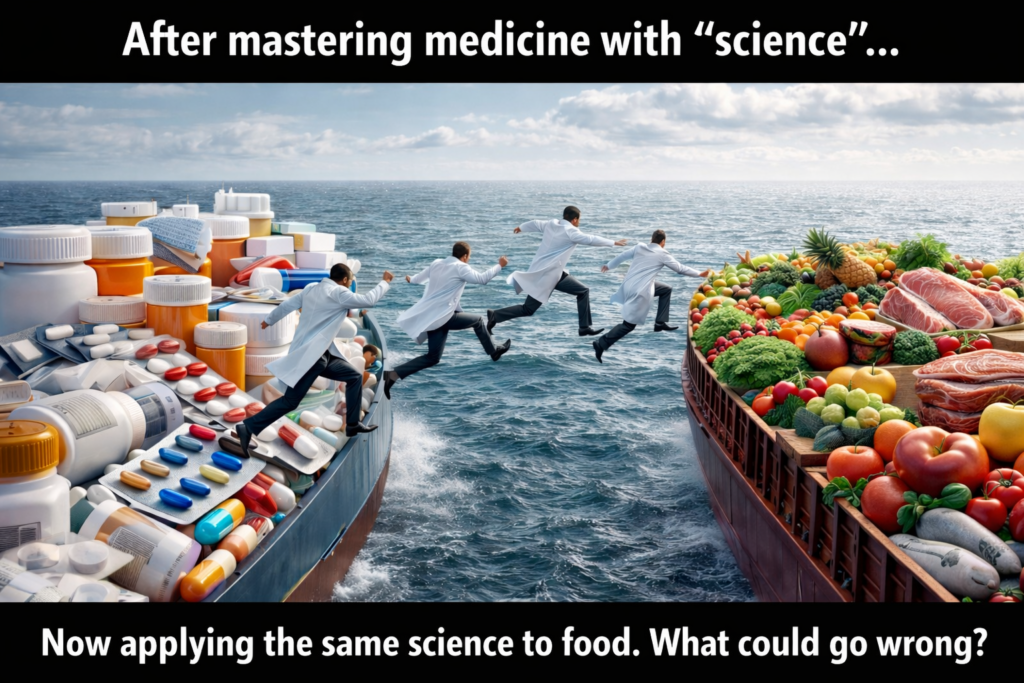
The image of physicians in lab coats jumping from a ship loaded with medicines to one loaded with food captures a deeply troubling reality. Instead of confronting the long-standing deficiencies within medicine and pharmaceuticals—particularly the absence of rigorous scientific training in chemistry and physics—these same professionals are now repositioning themselves as authorities in yet another domain.

Rather than addressing the failure of medical and pharmaceutical practice to meet foundational scientific standards, so-called “science experts” are simply shifting domains. Medicine is not being corrected; it is being abandoned. The authority attached to the label of “science” is now being transferred from pharmaceuticals to food and nutrition, without any corresponding transfer of scientific competence. That is not reform; it is rebranding.

(more…)

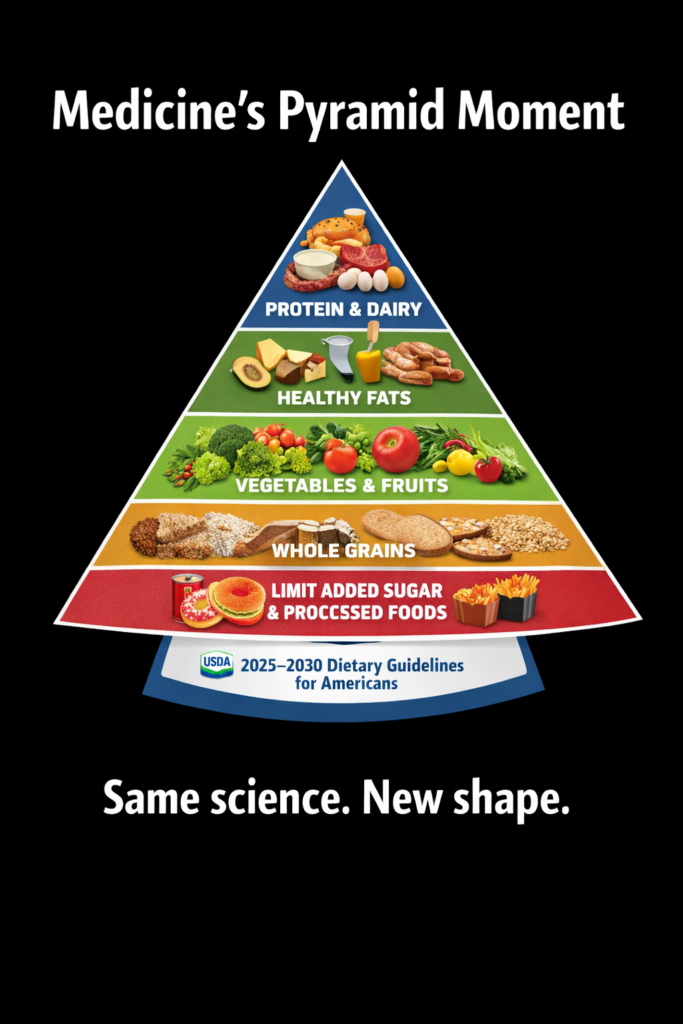
The medical “science” discussion increasingly begins with the HHS Food Pyramid, offered as a sign of reassessment and progress (e.g., https://www.facebook.com/watch?v=805927289135368 ). Updating nutritional guidance may be useful at a public-health level, but revising a visual framework is not the same as strengthening scientific foundations. A change in presentation does not, by itself, resolve deeper methodological questions.

In that sense, the food pyramid functions largely as a symbol. If medicine is moving toward lifestyle guidance and population-level management, one might even imagine changing the laboratory coat from white to green—an acknowledgment of a broader, more policy-oriented role. Yet symbols aside, the underlying scientific approach remains unchanged. The same system that previously framed vaccine promotion as “science” continues to operate with similar assumptions and validation practices.

Calling this framework “medical science” does not automatically align it with the standards of chemistry or physics. Those disciplines rely on isolation, characterization, reference standards, and direct testing. When such requirements are relaxed or replaced by models and narratives, the result is guidance rather than science in the strict sense.

The revised food pyramid does not correct this distinction. It updates the message, not the method. Meaningful progress will come not from new graphics or terminology, but from a renewed commitment to rigorous scientific principles at the core of medical practice.

This article is written in response to a Facebook comment and serves to clarify the intent and meaning of my original post (link).

Question:just a question for you. I’m sure there are medicinal products, medicines and pharmaceuticals that are helpful and beneficial to humans when needed, but simply improving one ‘s diet, exercising and getting the proper sleep would be a major contributing factor into improving one’s health and overall body homeostasis. Injecting useless gunk provides no benefit to the body.” (link)

Response: Thank you for your comment. I understand your concern; however, I believe my position has been misunderstood.

Your interpretation is common, and that is precisely the issue. It reflects a prevailing mindset shaped by routinely used terms such as “diet” and “health.” These words are often treated as self-evident and objective, when in fact they are rarely examined critically. My position is not that diet and health are invalid or unrelated—on the contrary, they are clearly connected. The more fundamental questions are these: what constitutes proper diet and proper health, who defines them, and on what scientific basis are those definitions made?

This is where confusion begins, and authority replaces science. Many so-called health experts operate with vague, subjective notions of health. Their opinions are often no more rigorous than anyone else’s. Opinion may be acceptable in personal discussion, but when claims are elevated to public policy or presented as scientific fact, clear, objective, and scientifically valid criteria are required.

(more…)

The medical community has a new trick. After decades of virus-vaccine failure, fraud, and public harm, some doctors are now rebranding under terrain theory. See the recent article by Richard Z. Cheng, M.D., Ph.D. (Editor-in-Chief, Orthomolecular Medicine News Service) promoting it (link). The motive is obvious: the virus narrative has collapsed under its own lies, so they need a new story to keep the funding flowing.

Now they pitch terrain theory as a “new” scientific model — and are already calling for funding to run clinical trials comparing vaccine-based vs. terrain-based strategies. This is audacious. After decades of massive funding, they’ve delivered nothing but damage. Before they get another cent, they must account for their record: not progress, but failure on a historic scale.

(more…)

Response to the FB discussion (link)

This is an excellent and timely topic—actually, several questions wrapped into one. If even a trained pharmacist feels confused by the endless claims about supplements, nutrients, and health advice, imagine the situation for the average person constantly bombarded with contradictory information and marketing.

“I wanted to ask you what your opinion is on dietary supplements? Especially about what they call vitamin D, and the promotion that is made for minerals, trace elements? I am a Pharmacist in Greece, I know that all of these are chemicals, I am confused by the fact that they have a lot of promotion even from alternative doctors while we all know that their production is in the hands of big pharma.”

This is not just a valid question—it is a crucial one. I offer the following scientific perspective, which I hope helps clarify the confusion and cuts through the noise.

(more…)

Blog Article: Fake And False Science Of Illnesses And Diagnoses (link). FB (link). For convenience, questions are copied below the response.

Response:

@ “… is vacciantion build on the simmilar principle as homeopathy / administering a small doses of alleged poison to treat the illness/”

I have some knowledge and personal experience with homeopathy. Based on this, I would say that they are not similar. To me, they are as similar to comparing electric and gas-powered vehicles because they both require a (small) battery or electric power to start the car. So, they both could be considered electric-powered. However, they are very different in operation – there is no comparison.

Concerning “small doses/amount of alleged poison,” I do not think homeopathy injects poison. On the other hand, I am certain, based on what is available in the literature about vaccines, that they are not in small amounts (compared to homeopathic doses) but certainly significantly large amounts of filth/gunk (potentially poison). I would not suggest anyone take it, considering the science/chemistry aspect of it.

(more…)

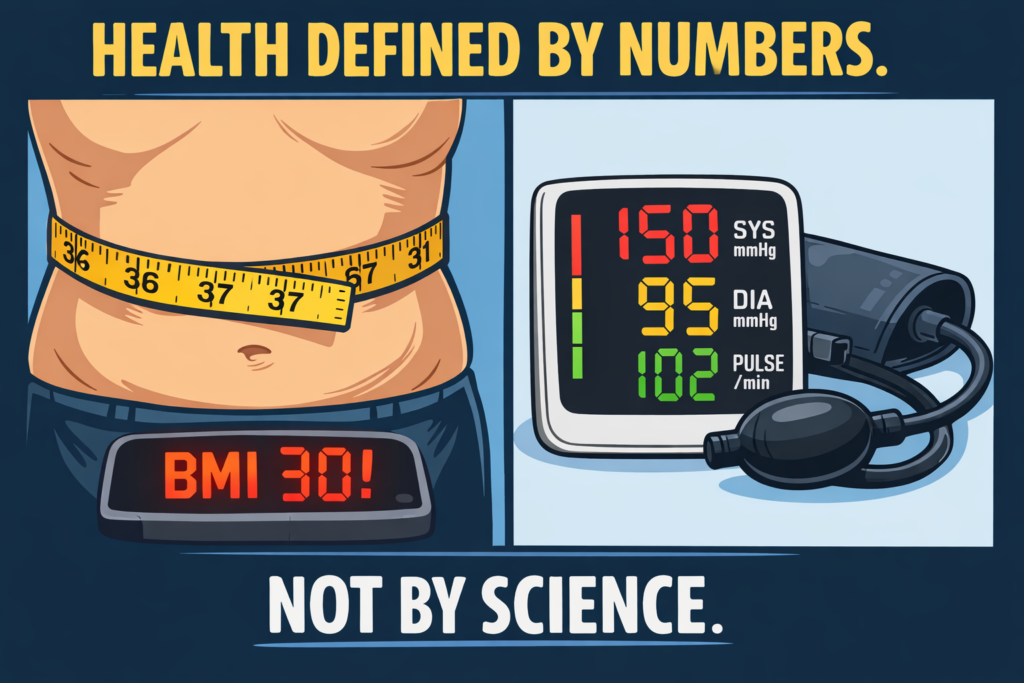
Currently, two views are commonly used to explain illnesses. One is that people get sick by the presence/infection of some invisible particles (viruses). Second, illness reflects the body’s detoxification process to eliminate toxins. Doctors and health experts often promote and support both views, implied as science-based.

Note that these are opinions or narratives presented as theories to sound factual and scientific. However, these theories are not supported by actual science. Both viruses and toxins (cell debris) are imaginary and fictional objects/substances. No scientific evidence supports the presence or existence of such entities and their relevance.

The only way to make such a claim scientifically valid and acceptable is that the so-called viruses or the toxins must be isolated, purified, and fully (physically and chemically) characterized, and these must be available as such in vials or test tubes. Nothing of this sort happens or is available. Hence, all these claims are scientifically baseless.

Use caution when considering doctors’ (medical and health experts’) science as actual science. There is no medical/health science. It is a made-up science (fake and false) based on personal opinions and narratives.

A better alternative to understanding and addressing illnesses is to try to understand the body’s chemistry, i.e., the working of chemicals (in and outside the body). It is essential to note that the body is built on chemicals (fats, proteins, sugars, minerals, vitamins, water, oxygen, etc), and these are supplied by food and the environment. An imbalance of these can result in issues (called illnesses) and should easily be addressed by appropriate testing and adjusting chemical imbalances. Please consider studying the science of chemicals (chemistry) or seek help from science/chemistry experts.  

What is science, and who are scientists? (link)

An M.D. degree is not a science degree! (link)

Like a celebrity, Dr. Aseem Malhotra is a high-profile physician (cardiologist) from the U.K. Recently, I had an opportunity to watch his interview on YouTube (link). I am disturbed by his advice about maintaining good health.

The first part of his interview is mostly about vaccines, particularly COVID-19. He is highly critical of COVID-19 vaccines, presumably because of a family incident. Otherwise, he fully supports vaccines and vaccination, saying, “Some of the greatest achievements in medicine are traditional vaccines, no doubt.”

(more…)