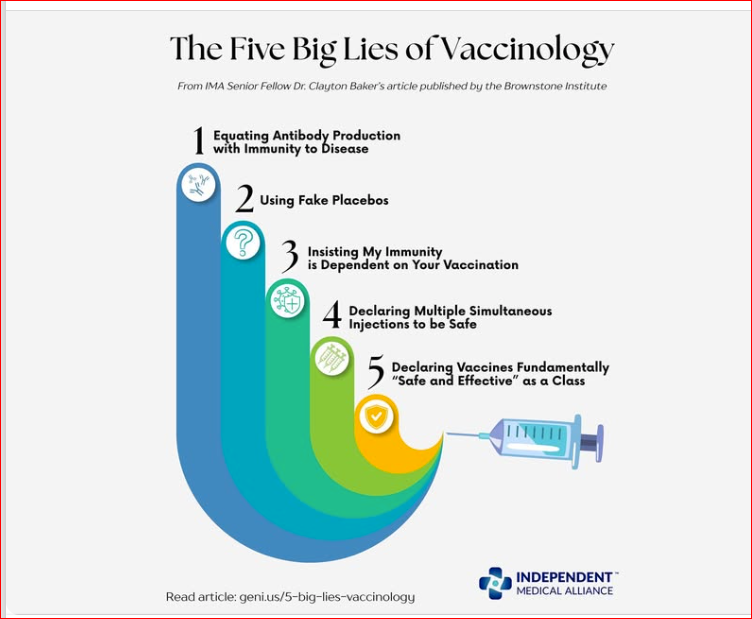
The article “The Five Big Lies of Vaccinology” presents itself as a scientific critique of vaccines—particularly mRNA products—by analyzing Pfizer trial data (link). However, this review is authored from a medical, not a scientific, perspective. This distinction is not semantic; it is fundamental.

In fact, the five lies of vaccinology are themselves the result of one larger and more consequential lie: that medical science is science, and that physicians are scientists.

The central problem with vaccines and vaccinology is therefore not merely flawed trials, exaggerated claims, or regulatory misconduct. Those issues are secondary. The primary problem is that modern medicine is not grounded in true science. Medical professionals—whether arguing for or against vaccines—are not educated or trained in the foundational sciences required to make scientific determinations: chemistry, physics, and mathematics.

As a result, both pro-vaccine and anti-vaccine medical arguments suffer from the same structural defect. They rely on assumptions inherited from medical doctrine rather than on independently established scientific evidence.

The Unexamined Premise: Virus Existence

The article critiques vaccinology while preserving its most critical assumption: that viruses exist as isolated, purified, and scientifically characterized entities. This assumption is never questioned. Yet from a true scientific perspective, this is precisely where scrutiny must begin.

There is no scientifically valid evidence demonstrating the isolation, purification, and characterization of viruses in accordance with the standards required by chemistry and physics (science). Without such evidence, the entire framework of virology—including disease attribution, pathogenic mechanisms, and vaccine targets—rests on an unverified premise.

If the causal agent itself has not been scientifically established, then:

  • Claims of virus-specific diseases are unsubstantiated.
  • Pathology attributed to viruses is speculative.
  • Preventive or therapeutic interventions—vaccines included—are scientifically unjustified.

Under these conditions, debating vaccine safety, efficacy, or platform technology (including mRNA) is misplaced. There is no scientific necessity for vaccines to exist in the first place.

Medical Debate Is Not Scientific Debate

The article reflects an internal dispute within medicine, not a scientific evaluation of medicine itself. Medical experts reviewing medical studies—even critically—remain confined to a non-scientific framework. Statistical analysis of clinical trials does not substitute for establishing the physical reality of the entities being claimed.

This is why such reviews, while appearing rigorous, ultimately reinforce the same foundational error: they challenge vaccine implementation while leaving the existence of viruses—and thus virology itself—unexamined and implicitly validated.

Conclusion

The failure of vaccinology is not isolated. As even the article indirectly illustrates, it is part of a broader pattern. It is the consequence of medicine presenting itself as science when it is not, and of physicians being portrayed as scientists when they are not trained as such.

Until medicine is grounded in true scientific methodology—beginning with the physical isolation, purification, and characterization of claimed agents—both pro- and anti-vaccine arguments remain scientifically incomplete.

A genuine scientific critique must challenge first principles, not merely debate outcomes.

The Medical Shell Game: The Illusion of Science (link)

LINK

Many so-called “awake” doctors speak out against vaccines, but usually after the harm has already been done and continues to be done.

Vaccines were being developed right under their noses for years, and concerns about harm were repeatedly raised — yet these doctors never acted meaningfully or effectively.

Why? Because they still do not understand where the real problem lies.

The core issue is this: doctors claim they are conducting “science” and “scientific research,” including for vaccine development, but this is a false claim. Physicians — including specialists — do not have education, training, or credentials in true science. They are not scientists. Their entire system is built on a self-declared brand called “medical science,” which produces diagnoses, tests, treatments, and pharmaceuticals — including vaccines.

None of this is grounded in true science. It belongs in the domain of chemistry, where isolation, purification, and characterization must be performed for diagnosis, testing, and product development. These “awake” doctors simply assume those steps were done. They never verify them because they do not have the education and training to do so.

Thus, even their criticisms remain shallow. They talk about side effects and mandates — but never question the core claim: Was there ever a virus? Most cannot even define a pure, isolated virus sample.

The truth is simple: from the perspective of true science (chemistry), viruses have never been isolated, purified, or characterized. Therefore, they cannot be the cause of illness. Most “viral illnesses” are diagnosed using scientifically fraudulent tests — PCR, antibody tests, etc. — not by identifying any actual physical entity.

So, are “awake” doctors helpful?
Unfortunately, no. They cannot solve the problem because they are part of it — even if unknowingly. Their ignorance and misplaced confidence helped create false vaccines, false diseases, and false fears.

The real solution is not more medical advice.
The real solution is to challenge the fraudulent scientific foundation.

Bring in experts in true science—chemistry—to address the issue of virus isolation. The moment it is honestly examined, the entire problem disappears.

No virus → no viral disease → no need for vaccines.
Remove the fraudulent testing and fraudulent medical science, and people recover naturally.

This is what must be addressed—not repeated medical narratives, even from “awake” doctors.

Please forward this message directly to Senator Ron Johnson—it is important that he sees it.

Rethinking Cancer: A Mislabelled Mystery (link)
Vaccines and the COVID virus (link)
Claims of vaccines’ relevancy and efficacy – a big fat lie! (link)
The science behind COVID and vaccines! (link)
A Simple And Direct Question RFK Jr Needs To Ask – A Suggestion (link)
Quackery in White Coats (link)
Chemistry, Not Medicine, Defines Science (link)
Critical Review of Medical Authority and Scientific Legitimacy (link)
Questioning Medical Authority: Show Your Science Credentials (link)
What is science, and who are scientists? (link)
My training and expertise – people ask! (link)

This article is a response to a Facebook follower who asked for my thoughts on the AI-generated critique of my article (link).

I must say, the analysis was quite interesting, and I am genuinely impressed — your AI did a reasonably good job critiquing my article.

Before I present my critique (see below), I want to clarify and emphasize that this is AI, not RI (Real Intelligence). AI depends entirely on what is fed into it and on how the underlying algorithms gather, filter, and present information — including what they choose to emphasize or ignore. In other words, AI is inherently biased both by the input and by the controls placed on it.

That said, I personally make extensive use of AI and often run my comments and posts through it to check for errors or illogical statements. My AI has effectively been “trained” from my side, aligned with scientific standards as I understand them. So I decided to generate a rebuttal from my AI to your AI and see how fairly it responds. The response I received from my AI is thorough, correct, and I fully support it.

For your reading convenience, I have reproduced your AI’s critique first, followed by the rebuttal produced by my AI, which I fully endorse.

I trust my AI’s response because it is based on the principles of true science, from a chemistry and analytical perspective. In contrast, I consider your AI’s response grounded in non-scientific narratives, even though it cites published literature. Its foundation lies in biology and medical science — both of which, in my view, do not qualify as true sciences.

For further convenience, I have also reproduced my original article (the one under discussion) at the end, along with the link to the blog.

Enjoy — and feel free to share your feedback.

Saeed Qureshi, Ph.D.

A few days ago, I came across a phrase that immediately caught my attention — “procedural declaration.”

It perfectly captured what I had been struggling to explain for years: why regulatory authorities such as the FDA and similar bodies around the world appear “scientific,” yet their drug approval processes are not truly based on science.

That phrase — procedural declaration — describes it exactly.

(more…)

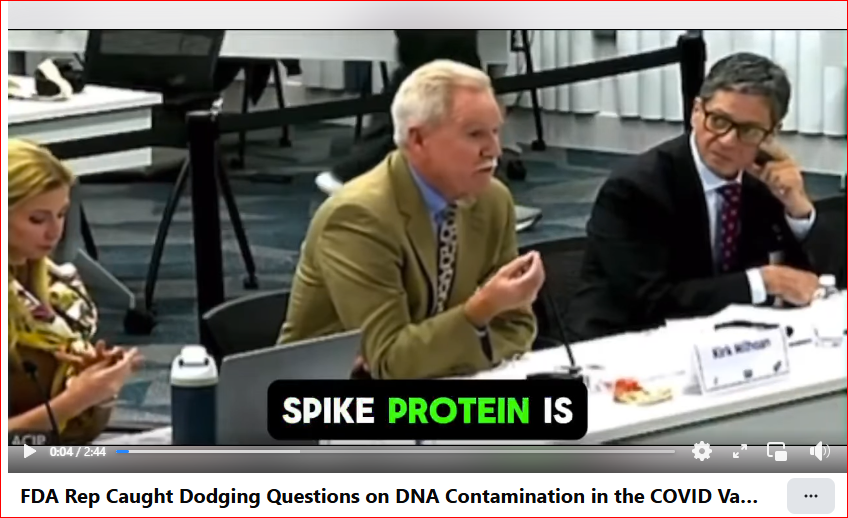
It is quite revealing when a cardiologist publicly describes the presence of the so-called “spike protein” in the body—doing so on the assumption that it must already exist (link). What is often overlooked is that the “spike protein” is, in fact, a chemical compound. As I have repeatedly emphasized, medical professionals generally possess limited, if any, expertise in chemistry—the very foundation of true science. Their belief in the existence of the spike protein is not based on their own analytical verification but rather on trust in what others—such as the FDA, CDC, or the pharmaceutical industry—have told them.

From a scientific standpoint, however, I have yet to encounter any validated analytical evidence confirming that this so-called spike protein actually exists. The situation mirrors the long-standing narrative of “viruses,” which most physicians have accepted as fact for decades without ever demanding scientific proof.

(more…)

The hidden aspect of the problem is that the entire pharmaceutical industry operates under the direction and authority of medical science — or, more accurately, the false belief in the authority of medical science. This so-called “science” dictates the rules, methods, and interpretations that the pharmaceutical world must follow. As long as this illusion remains unchallenged, nothing will change. Pharma will continue producing and promoting substances based on fraudulent assumptions, while presenting them as products of science.

Whenever someone attempts to expose or stop this falsehood, they are immediately confronted by physicians and their self-declared “scientific” authority. These individuals act as both the defenders and the enforcers of the same system. Naturally, they will never admit that pharmaceutical practices are built on their own unscientific foundation. Thus, the cycle of deception sustains itself — medicine validating medicine, doctors protecting doctors, and all under the banner of “science.” If this situation is ever to be corrected, the solution lies not with physicians or “medical scientists,” but with true scientists — the chemists. Medicine, after all, deals with chemicals: their composition, purity, reactions, and effects. Only chemistry — the real science — can examine and reveal what is genuine and what is false in medicine. Until chemists reclaim that role, the public will continue to suffer under the rule of false science disguised as healing.

A Plea for Scientific Clarity: An Open Letter to RFK Jr (link).

There has been a vigorous discussion lately about who truly qualifies as a scientist. I have often explained what science actually is — and, by extension, who can rightly be called a scientist. Many have reacted critically, even sarcastically. While disagreement is expected, the level of hostility is both amazing and laughable.

It is understandable, though. Challenging long-held assumptions is never easy. People prefer to describe science from afar rather than define it from within. For most, “science” has become a vague and symbolic term — something anyone can claim to represent, even without ever studying or practicing it. They often cite literature written by others, without realizing that much of it is built on a mistaken understanding of what science truly is.

(more…)

In general, my focus is on highlighting the fact that topics related to viruses and their components — such as RNA, mRNA, and spike proteins — including their isolation, characterization, purification, and testing, fall under the field of chemistry, which is one of the three pillars of true science, the other two being physics and mathematics.

However, in the medical field, these subjects are often described and interpreted by medical professionals who are not trained in science (chemistry) and its research. As a result, their explanations and claims in these areas are scientifically invalid. Although some doctors do challenge mainstream medical views, they, too, are unable to properly address the issues because they lack a grounding in actual science. This is why the problems in medicine persist — including misunderstandings about viruses and medicines in general.

To address these problems effectively, expertise in science, particularly chemistry, is essential. For example, the entire concept of the virus, vaccination, and pandemic response is based on PCR testing, which, by true scientific standards, is a fraudulent test. A proper scientific audit of this testing would immediately disqualify it, exposing the fields of virology and vaccination as fundamentally dishonest.

Unfortunately, the evaluation of such testing and viral claims has been left to physicians, who, due to their lack of scientific training, have developed and defended this so-called “medical science”—a made-up discipline that continues to promote false concepts about viruses, vaccines, and medicines in general.

In short, the claim of “medical science” made by medical professionals must be challenged as false and fraudulent, and the matter should be re-examined through the lens of true science — that is, chemistry, recognizing that medicines are, by their very nature, chemical substances. (from FB, link )

“If you claim that cancers are caused by a parasite, the burden of proof is on you to identify that parasite.” (From FB, link)

Fair enough. But I am not claiming that a parasite causes cancer. What I am suggesting is far more fundamental — that cancer itself may not exist as a distinct disease. What we call “cancer” might simply be a mislabelled condition — perhaps involving parasites or other microbial agents — that has never been properly examined from a true scientific standpoint.

It is time to think afresh. For decades, “cancer research” has produced endless classifications, new names, and countless studies, yet no real cure. Is it not legitimate to question what these researchers have actually achieved, beyond showing frightening images and promoting highly expensive treatments and services?

The deeper problem may lie in who is conducting the research. Medical professionals, rather than actual scientists, dominate the field. Most cancer researchers are trained in medicine or biology, not in the actual sciences — chemistry, physics, or mathematics — that form the foundation of real scientific inquiry. As a result, much of their work lacks the precision and discipline that true science demands.

The situation resembles what we see in virology (now commonly recognized as a false and fraudulent activity or research): vast amounts of funding, publications, and laboratory activity, yet no verifiable isolation or purification of the claimed entities — whether viruses or cancer “cells.” It is a bizarre state of affairs.

The real path forward lies not in more grants or drug trials, but in the courage to ask whether “cancer” has ever been defined scientifically at all — rather than through images and obscure chemical jargon.