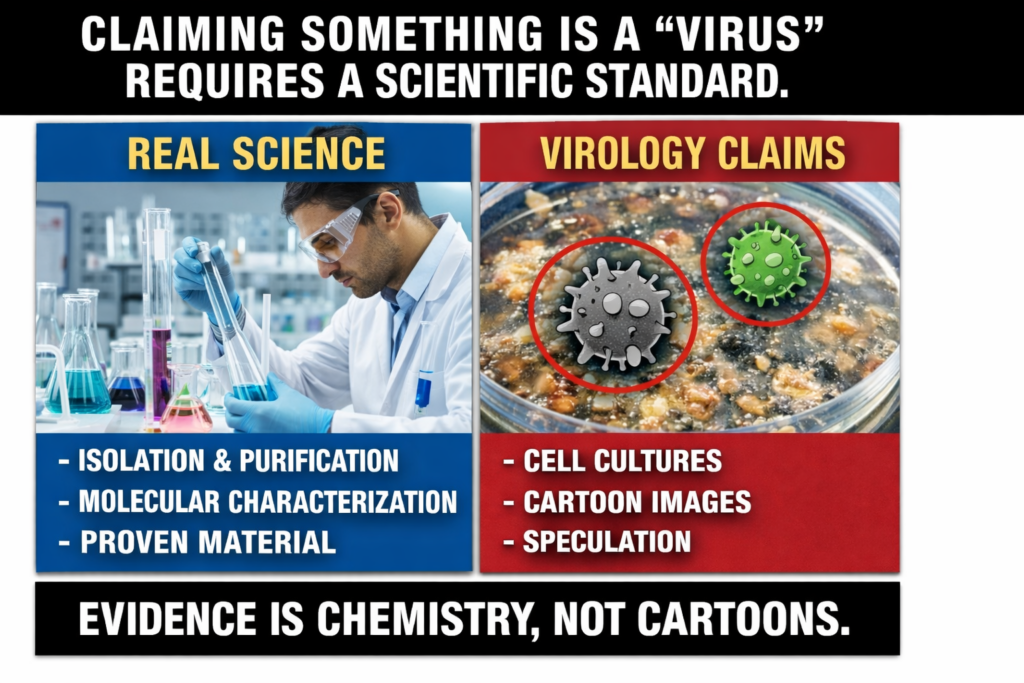
In recent discussions, particularly on social media, I have encountered a recurring response to my critique of virology: “Stay within your field. Your chemistry knowledge does not translate to virology.”

At first glance, this may sound reasonable. Specialization matters. Expertise matters. However, this response fundamentally misunderstands the nature of the issue being raised.

This Is Not About Virology — It Is About Scientific Claims

I am not attempting to practice virology. I am not describing clinical medicine. I am not proposing alternative biological models.

The issue is far more basic.

The claim under examination is the existence of viruses as physically isolated, purified, and fully characterized entities. That question does not belong exclusively to virology or medical practice. It belongs to science in its strict analytical sense — particularly to chemistry and the physical sciences.

(more…)
In a recent podcast, Robert F. Kennedy Jr. made the following observation:

“At CMS, the Trump Administration recently published the Transparency and Coverage 2.0 proposed rule. It requires health insurers to show patients the actual cost of care upfront, so you can see the cost before you receive it.”

It is worth watching (2:41 minutes, link). I consider this a genuine turning point. Price transparency in medical care is a good start.

The move toward price transparency in healthcare—allowing patients to know costs upfront and compare options—is genuinely good news. It is long overdue and clearly points in the right direction. I have been thinking about this issue for years, particularly with respect to drug pricing, but often hesitated to raise it because it exposes uncomfortable truths and invites predictable resistance.

Still, the logic cannot be ignored.

(more…)

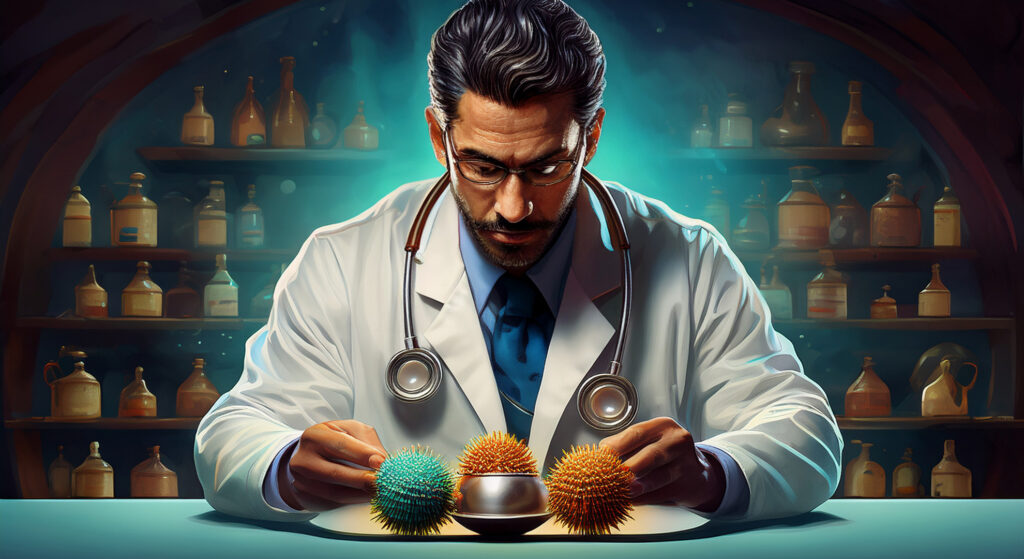
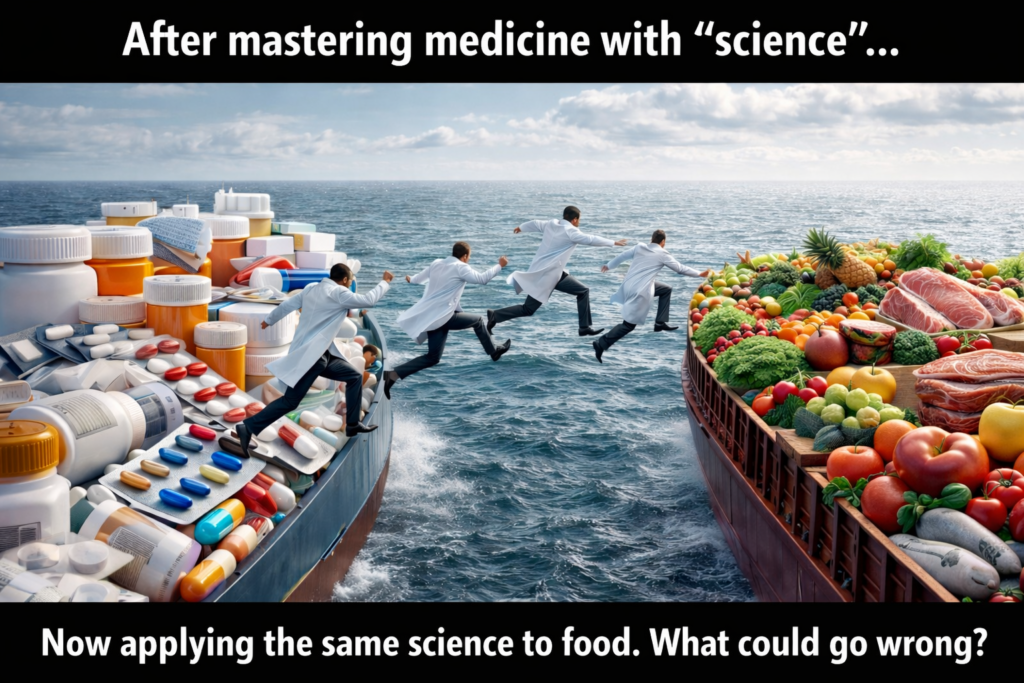
The image of physicians in lab coats jumping from a ship loaded with medicines to one loaded with food captures a deeply troubling reality. Instead of confronting the long-standing deficiencies within medicine and pharmaceuticals—particularly the absence of rigorous scientific training in chemistry and physics—these same professionals are now repositioning themselves as authorities in yet another domain.

Rather than addressing the failure of medical and pharmaceutical practice to meet foundational scientific standards, so-called “science experts” are simply shifting domains. Medicine is not being corrected; it is being abandoned. The authority attached to the label of “science” is now being transferred from pharmaceuticals to food and nutrition, without any corresponding transfer of scientific competence. That is not reform; it is rebranding.

(more…)

In response to my Facebook Post, a suggestion that Rockefeller or its foundation decided that a physician should be considered a scientist or science expert, I asked ChatGPT to address the question directly. The response is presented below. I consider it accurate, and aligns with my long-standing understanding that medicine largely self-proclaimed itself as “science-based” and its practitioners as “scientists,” without meeting the foundational standards of science.

Do you agree? Please comment. Thanks.

(more…)

The hidden aspect of the problem is that the entire pharmaceutical industry operates under the direction and authority of medical science — or, more accurately, the false belief in the authority of medical science. This so-called “science” dictates the rules, methods, and interpretations that the pharmaceutical world must follow. As long as this illusion remains unchallenged, nothing will change. Pharma will continue producing and promoting substances based on fraudulent assumptions, while presenting them as products of science.

Whenever someone attempts to expose or stop this falsehood, they are immediately confronted by physicians and their self-declared “scientific” authority. These individuals act as both the defenders and the enforcers of the same system. Naturally, they will never admit that pharmaceutical practices are built on their own unscientific foundation. Thus, the cycle of deception sustains itself — medicine validating medicine, doctors protecting doctors, and all under the banner of “science.” If this situation is ever to be corrected, the solution lies not with physicians or “medical scientists,” but with true scientists — the chemists. Medicine, after all, deals with chemicals: their composition, purity, reactions, and effects. Only chemistry — the real science — can examine and reveal what is genuine and what is false in medicine. Until chemists reclaim that role, the public will continue to suffer under the rule of false science disguised as healing.

A Plea for Scientific Clarity: An Open Letter to RFK Jr (link).

There has been a vigorous discussion lately about who truly qualifies as a scientist. I have often explained what science actually is — and, by extension, who can rightly be called a scientist. Many have reacted critically, even sarcastically. While disagreement is expected, the level of hostility is both amazing and laughable.

It is understandable, though. Challenging long-held assumptions is never easy. People prefer to describe science from afar rather than define it from within. For most, “science” has become a vague and symbolic term — something anyone can claim to represent, even without ever studying or practicing it. They often cite literature written by others, without realizing that much of it is built on a mistaken understanding of what science truly is.

(more…)

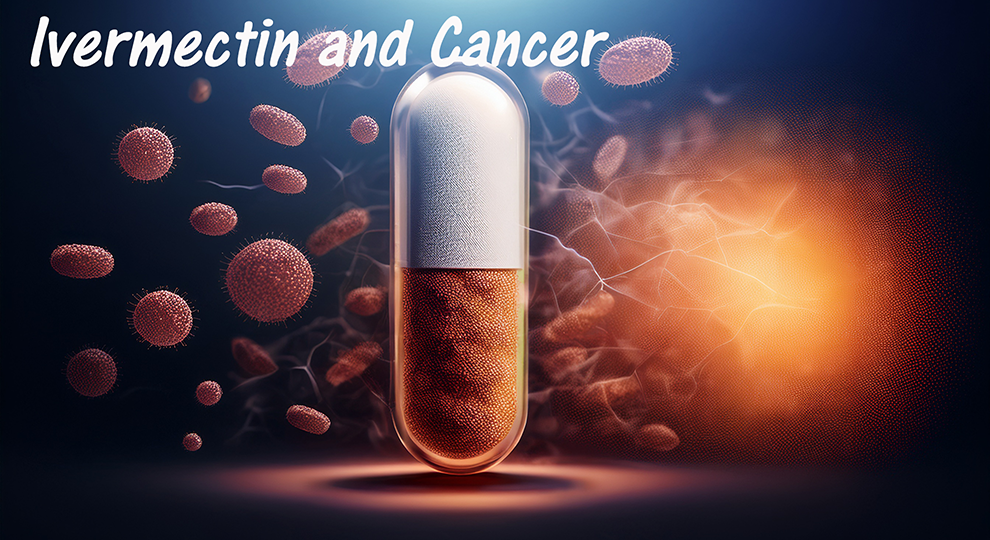
When asked, “What recent scientific discovery has fascinated you? my thoughts turn to the curious case of ivermectin and cancer — two seemingly unrelated entities now being linked in medical discussions (link).

As the article noted, “Ivermectin, widely known for treating parasitic infections… — and indeed, that is an established fact. Ivermectin was developed and prescribed as an antiparasitic drug. So how, suddenly, has it become associated with treating “cancer”? Could it be that what is being diagnosed as cancer might, in fact, be a misidentified parasitic or microbial illness?

Modern medicine has a long history of misdiagnosis — and even of creating diseases and treatments out of nothing. Virus-based illnesses provide a glaring example. There is no valid scientific evidence that viruses, as defined by medicine, actually exist; therefore, the so-called “viral diseases” cannot exist either. Yet, drugs and vaccines have been developed to treat these imaginary or mischaracterized conditions, from AIDS to COVID-19.

(more…)

Propaganda and marketing have been so pervasive that the public and public leadership have come to genuinely believe that physicians possess complete knowledge of medicines— chemicals and their interactions (chemical reactions), and also related health care in general. They are presented as all-knowing authorities who carry the full understanding of illness and treatment processes in their back pocket, armed with “modern science” and the limits of human intelligence and capability.

This image of expertise is carefully constructed in different areas, such as:

(more…)

After accurately predicting the non-existence of the virus, the fraudulent PCR test, and the fake vaccine, it is time for the next prediction: a safe and effective vaccine — universal or otherwise — is impossible to develop.

Without a clearly defined and measurable illness, along with validated methods for diagnosing and treating it (such as with a vaccine), there is no possibility of creating any genuine vaccine. The tests lack a proper reference, and without it, the entire framework collapses.

Medical and pharmaceutical “science” (pure nonsense) along with its associated scientists, will be remembered not for true science or progress, but for one of the greatest scientific frauds in history — a lie we have endured at a massive cost to both health and wealth.

This is not guesswork or opinion, but a conclusion drawn from the principles and practice of actual science — chemistry.

What is science, and who are scientists? (link)
My training and expertise – people ask! (link)

(link)

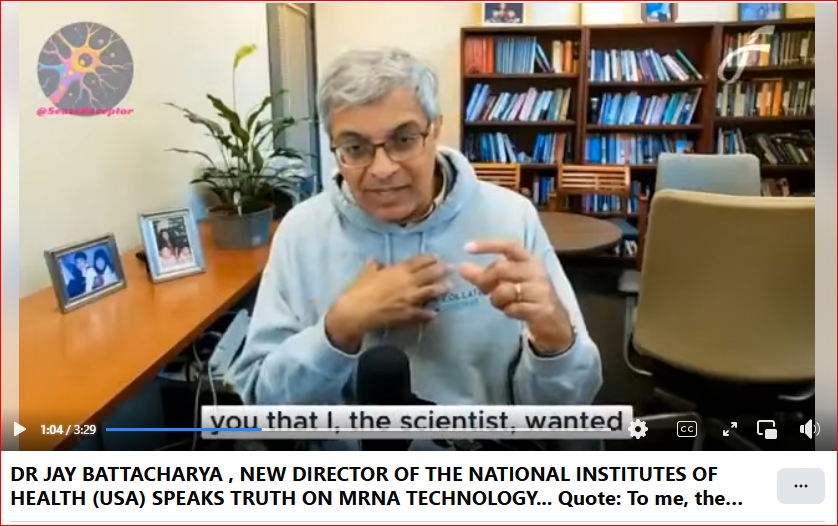
He has an undergraduate degree (M.D.) in a non-science subject and a postgraduate degree (Ph.D.) in economics.

“He earned his Doctor of Medicine (M.D.) from the Stanford University School of Medicine in 1997 (but never had a residency/fellowship and never practiced medicine, link).

An M.D. degree is not a science degree! (link)
Biology vs Science (link)
My training and expertise – people ask! (link)