
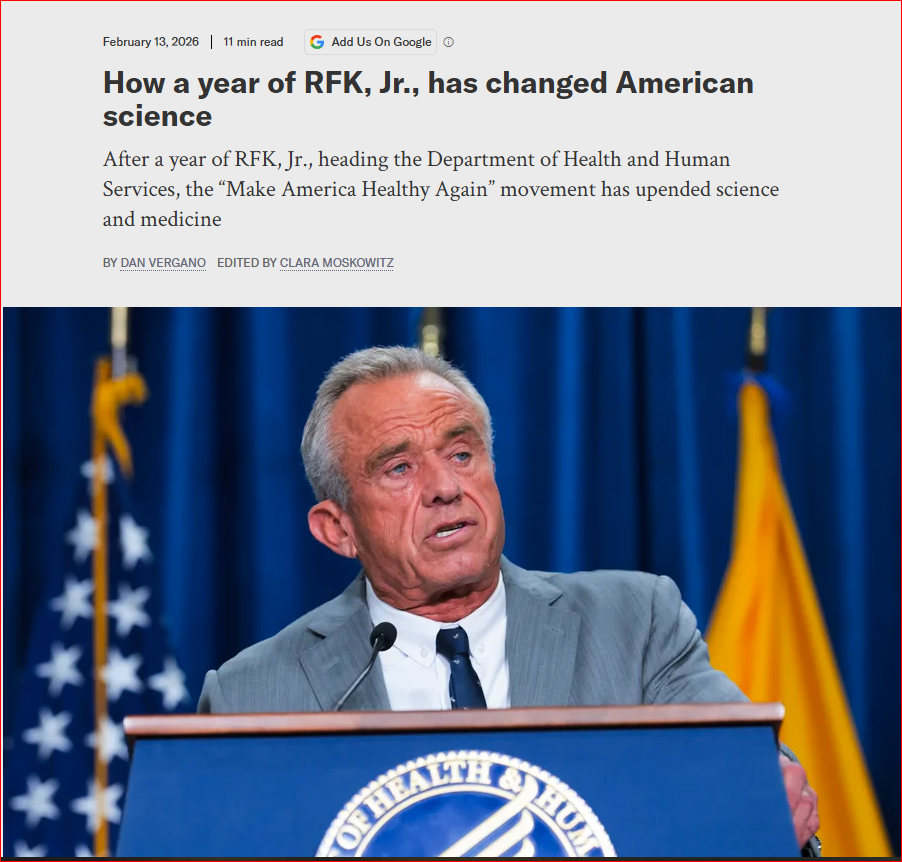
A recent Scientific American article argues that a year of RFK Jr.’s influence has “changed American science,” particularly within the U.S. Department of Health and Human Services (HHS). The underlying claim is that science at HHS has been disrupted, politicized, or undermined. (link)
That framing assumes something that deserves closer examination: that HHS is, in fact, a center of foundational science.
It is not.
HHS is primarily a clinical and regulatory institution. It is staffed and directed largely by physicians and public health professionals. Their training is clinical and applied. They diagnose, prescribe, regulate, and manage programs. That is a professional function — not foundational science.
Science, in its strict meaning, rests on physics and chemistry. Medicine, if it is to claim scientific status, must ultimately be grounded in chemistry, because the human body is a chemical system. Drug action, toxicity, metabolism, and immunological reactions — all are chemical processes. Therefore, the scientific authority in medicine should logically come from experts in science (chemistry), not from clinicians whose training is vocational and practice-oriented.
When critics say HHS has “upended science,” they are equating medical consensus with science itself. But medical consensus is not the same as foundational scientific validation. Much of what is defended as “science” in this context is clinical protocol, epidemiological modeling, regulatory policy, and statistical interpretation — not direct physicochemical investigation of defined material entities.
This distinction matters.
If the core claims in areas such as virology, testing methodologies, and vaccine development have not been established under strict chemical and physical standards — meaning properly isolated, purified, and characterized reference materials — then calling the resulting framework “science” does not make it so. It becomes a self-reinforcing professional structure presenting itself as a scientific authority.
From this perspective, the debate is not about whether science has been attacked. It is about whether what is being defended qualifies as science in the first place.
If foundational scientific standards have not been applied consistently, then institutional claims — whether made by HHS, medical societies, or regulatory agencies — must be re-examined. Authority does not substitute for scientific validation.
The real question is not whether American science has been disrupted.
The real question is whether American health institutions were grounded in true science to begin with.