The very idea of an “asymptomatic illness” collapses under basic logic and common sense. Illness, by definition, means symptoms—something felt, observed, and experienced. Without symptoms, there is no illness; there is only health. Put simply: healthy people are being declared sick.

This fabricated category of “asymptomatic illness” is nothing more than a semantic trick, created to justify endless testing, labeling, and treatment of people who are not ill. It has been used to drive fear, promote unnecessary interventions, and expand the reach of so-called “medical science.”

A prime example is PCR testing. Never validated as a diagnostic tool for illness, it has been used to manufacture disease and even justify pandemics—paraded as “science,” when in truth it is a fraudulent practice (test/testing), with no connection to real science. On the basis of this flawed test, healthy people are labeled sick. Instead of discarding it, medical science repackaged the fraud as a modern “advance”—a test that claims to detect illness before it exists. Pure deception. And physicians, lacking grounding in basic science, failed to see through the trick and simply went along with it.

Real science demands tests validated against illness—anchored in symptoms. Any test claiming to diagnose disease without symptoms must be rejected outright, and the use of such practices must be audited and stopped.

In this light, the notion of an “asymptomatic illness” is not merely illogical—it is absurd. An illusion serving interests other than health. Stop such testing!

Virus and the PCR test. link
Asymptomatic COVID = No COVID/Pandemic  (link)
PCR Test vs Fever Test (Thermometer). (link)
PCR test – irrelevant and invalid! (link).
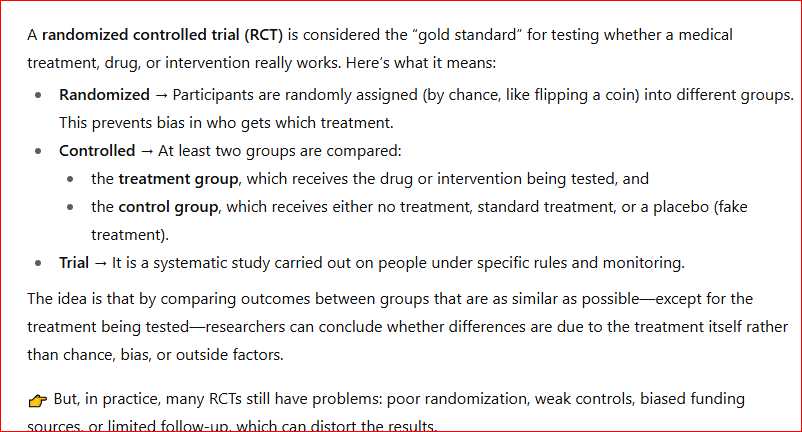
Responding to the question “What is meant by randomized control trial?

I asked this question to ChatGPT, and while I found the response valuable (attached below), I have concerns regarding the current practice of controlled trials.

Physicians often add the term “double-blind RCT” to make it sound more authentic—meaning that neither the person administering the treatment nor the person analyzing the data knows which treatment was given.

As ChatGPT stated, RCTs are considered the “gold standard.” However, many—including physicians and so-called experts—take this to imply that RCTs are a true scientific test or approach. They are not. At best, they can be considered a kind of survey. The reason is that subjects (patients) are treated as if they are constant, with little or no variability, which is simply incorrect.

Because of this flaw, extremely large numbers of subjects are required (at great financial cost and to the benefit of physician-researchers). Yet, even then, the results are always of limited scientific value. This helps explain why modern medicine research has failed to succeed in treating illness—and why, in fact, illness continues to increase.

For these reasons, I personally am not a supporter of, nor do I agree with, the (double-blinded) randomized controlled trial approach. It promotes not true science, but false science.

When people hear the word nanoparticle, they often imagine tiny hard specks—like dust or sand—floating around. But in pharmaceutical science, the “nanoparticles” used in vaccines are not solid particles at all. They are more like microscopic bubbles made of fatty molecules (lipids).

Lipids have a dual nature: one end of the molecule loves water, the other end avoids it. This is the same principle that makes soap work. When you wash your hands, soap molecules surround oily dirt or dust, hiding the “water-fearing” parts inside and keeping the “water-loving” parts outside. This forms small bubbles, called micelles, which carry away the dirt when rinsed with water.

In the same way, when lipids are mixed in water during pharmaceutical manufacturing, they self-assemble into tiny bubbles—liposomes or lipid nanoparticles (LNPs). Instead of dirt, however, these bubbles are said to carry messenger RNA (mRNA).

(more…)

Physicians and related medical experts claim to follow and practice science. Billions of dollars in funding support their so-called “scientific research.” Yet in reality, they hold no genuine credentials (education and expertise) in science or science research. Their education and expertise rest on a standard, non-scientific undergraduate degree—an M.D. Is it not outright fraud to practice and promote something for which one has no credentials?

Will HHS, FDA, CDC, NIH, and similar regulatory agencies worldwide dare to investigate this fraud?

What is science, and who are scientists? (link)
My training and expertise – people ask! (link)
Chemistry, Not Medicine, Defines Science (link)
An M.D. degree is not a science degree! (link)

Seeking advice from physicians on medications, including vaccines, is not the issue. They are trained for that purpose—mainly to prescribe medicines as needed. It is no different from asking the front-end clerk at an auto shop for advice about a car part or a potential issue with your car. Their role is functional, not foundational.

The real problem begins when physicians are assumed to understand how medicines are developed, how they actually work, or how they are manufactured. They do not. That knowledge belongs to science—specifically chemistry, a discipline with centuries of rigorous foundations.

Medicines are chemicals. Their discovery, testing, and production are properly the domain of chemistry, not medicine. Physicians are not scientists, and when they speak as though they are, their claims are misleading at best and fraudulent at worst. For this reason, anyone without training in science and chemistry should be excluded from directing or conducting scientific research.

This confusion has fueled dangerous misconceptions and harmful developments. Viruses, vaccines, PCR tests, antibody tests, and countless diagnostic products have been falsely presented under the banner of “medical science.” But there is no such thing as “medical science.” Medicine is a practice of prescribing and administering treatments; science—real science—belongs to chemistry and physics.

Allowing physicians to lead in areas where they have no true expertise has led to repeated disasters. The narratives surrounding viruses, infections, and even cancer—promoted as if grounded in science—are, in fact, constructs built on fragile foundations. These practices have not delivered genuine medical benefits; instead, they have imposed massive harm on public health and drained societal wealth.

The solution is clear: separate medicine from science. Let doctors prescribe, but let scientists—true scientists—develop and evaluate the treatments. Only then can society avoid the cycle of fraud, fear, and failure that has shaped the modern “medical science” – the fake and false one.

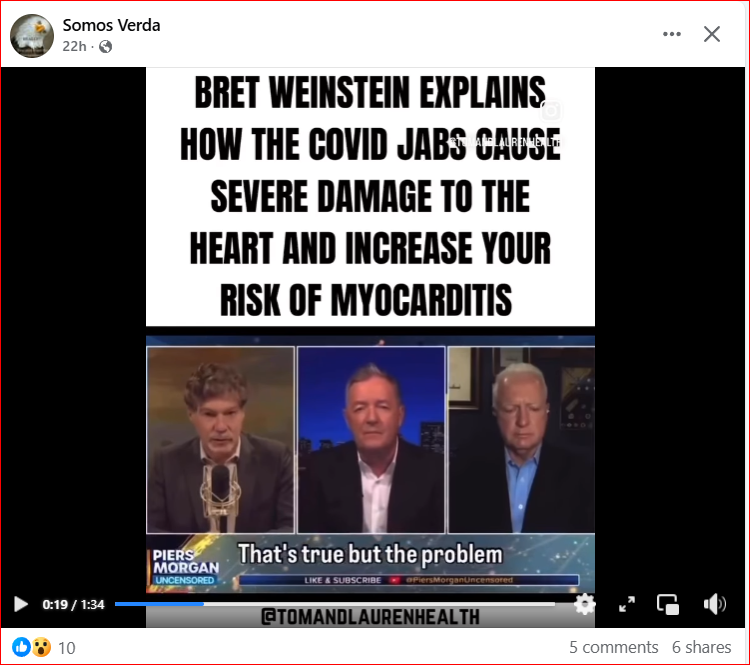
I listened to Dr. Bret Weinstein’s response to Piers Morgan’s question in this 1:34-minute video clip and noted several errors or unsupported claims (link). For example:

He stated: “… in an effort to provide immunity against COVID-19 …”

There is no scientifically valid evidence that COVID-19 exists. It is a belief that COVID-19 is caused by a virus named SARS-CoV-2. However, there is no evidence that this virus has ever been shown to exist. Therefore, a disease attributed to this virus cannot exist.

Dr. Weinstein is an evolutionary biologist or biology expert, not in the true sense of the word a scientist—particularly in the field of substance isolation and characterization, like viruses. That domain belongs to science proper, specifically chemistry, not biology. Hence, not only is he making a false statement, but he may not even realize it. He should reconsider his position on this topic.

(more…)

Propaganda and marketing have been so pervasive that the public and public leadership have come to genuinely believe that physicians possess complete knowledge of medicines— chemicals and their interactions (chemical reactions), and also related health care in general. They are presented as all-knowing authorities who carry the full understanding of illness and treatment processes in their back pocket, armed with “modern science” and the limits of human intelligence and capability.

This image of expertise is carefully constructed in different areas, such as:

(more…)

Doctors (physicians), please share your credentials in science and in conducting scientific research, including your education and expertise in true scientific subjects such as chemistry. After all, your work primarily involves research on medicines, which are chemicals, including:

  • Proteins (enzymes, antibodies, receptors)
  • Amino acids
  • Carbohydrates (glucose, glycogen, polysaccharides)
  • Lipids (cholesterol, triglycerides, phospholipids)
  • Vitamins (A, D, E, K, C, B-complex)
  • Minerals (calcium, iron, magnesium, potassium, zinc)
  • Neurotransmitters (dopamine, serotonin, acetylcholine)
  • Nucleotides (ATP, GTP, cAMP)
  • Cellular organelles (mitochondria, ribosomes, lysosomes)
  • Structural proteins (collagen, keratin, elastin)
  • Genetic material (DNA, RNA, genes, etc.)

Additionally, please include your education and expertise in testing, including test development, validation, and research processes.

What is science, and who are scientists? (link)
My training and expertise – people ask! (link)

I have written several articles on PCR for my blog, but it seems many readers may not have understood them fully. So, here is another attempt to explain.

PCR stands for Polymerase Chain Reaction. Breaking it down, polymerase is a combination of two parts: polymer and -ase. Polymers are chemical compounds that can come from natural or synthetic sources. Examples of natural polymers include cellulose, starch, glycogen, proteins, enzymes, and nucleic acids such as DNA and RNA, while synthetic polymers include polyethylene, polypropylene, polystyrene, PVC, Teflon, and nylon. All of these substances are well-characterized, certified, and widely available, mostly from chemical suppliers.

The suffix “-ase” indicates an enzyme, a protein that acts as a catalyst in biochemical reactions. For instance, hydrogen and oxygen will not combine to form water on their own; a spark or catalyst is required to initiate the reaction. Similarly, in biological systems, enzymes trigger countless reactions essential for life.

(more…)

Question Asked:

Are particles like urea in urine, sugar in blood, and bacteria in blood different from what we call “viruses”?

Response:


Urea, sugar, bacteria, and enzymes can all be detected, identified, and even purified with relative ease. These are real, demonstrable substances. I avoid using the term particles here because “particle” refers to a physical state that may or may not be observable under all conditions. For example, table salt exists as particles in solid form, but when dissolved in water, its particulate state disappears, forming ions—yet it is still considered salt. However, sand exists as particles almost all the time, even when mixed with water. The important point is that these substances are tangible, measurable, and their testing is valid.

(more…)