
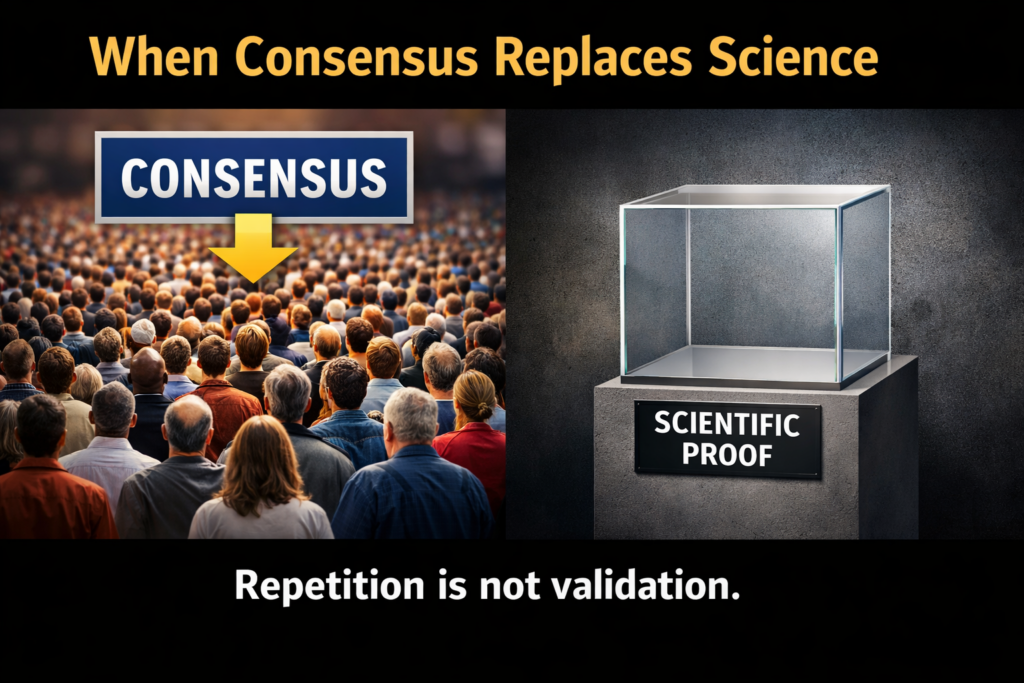
The persistence of the virus narrative is not accidental. It is the result of a framework constructed and maintained by medical and biological professionals under the label of “medical science.” The public—and even many experts—accept these claims because they assume that true science, credibility, and authority support them.
This assumption is the central problem.
The “science” invoked by medicine and biology is not science in the fundamental sense. It is a conceptual and observational narrative developed within disciplines that do not require formal education or training in the foundational sciences—particularly chemistry, which governs molecular identity, structure, and reaction mechanisms. Without this foundation, conclusions about causation, specificity, and efficacy cannot be scientifically established.
Even when medical or biological experts attempt to rebut criticism, they do so from within the same flawed framework. One incorrect scientific premise cannot correct another. As a result, the virus and vaccine narratives remain intact, expand unchecked, and continue to cause harm—most concerningly among children.
Another factor sustaining this situation is the extraordinary authority the medical profession attaches to the term “science.” This authority confers status, institutional power, and financial incentives, enabling control over information flows while discouraging meaningful scrutiny from outside the medical establishment.
Decades of experience as a scientist, combined with advanced formal education in the fundamental sciences applied to medical problems, clearly reveal these flaws. From this perspective, the issues can be explained with clarity, confidence, and precision—without relying on authority or consensus, but on scientific principles.
The conclusion is unavoidable: medical and biological professionals should not be regarded as experts in science unless they are formally trained in fundamental science. Their misuse of scientific language and methods has led to false assumptions and unsupported conclusions. In doing so, they have crossed professional boundaries and made claims beyond their expertise.
To correct this situation, proper boundaries must be restored. Medical professionals should be limited to their legitimate role—clinical diagnosis and treatment. They should not define disease and their mechanisms, develop medical products, or oversee their manufacture while claiming scientific authority they do not possess.
Only by reestablishing this distinction can the false virus narrative, the irrelevance of vaccines, and the broader misuse of science in medicine be addressed appropriately.
My training and expertise – people ask! (link)
What is science, and who are scientists? (link)