This is precisely the problem in biology and the so-called “medical science.” As I have emphasized for a long time, the work done in virology is assumed to be science-based simply because biology and virology are classified as “sciences.” This belief is both inaccurate and deeply problematic.

By its nature, biology is not a true science in the strict sense of the term. True science is founded on chemistry, supported by physics and mathematics. Consequently, all work related to vaccines, viruses, and testing (including method development, validation, and application) should rightfully be conducted in chemistry laboratories, where true scientific principles are applied.

(more…)

A few days ago, I came across a phrase that immediately caught my attention — “procedural declaration.”

It perfectly captured what I had been struggling to explain for years: why regulatory authorities such as the FDA and similar bodies around the world appear “scientific,” yet their drug approval processes are not truly based on science.

That phrase — procedural declaration — describes it exactly.

(more…)

There has been a vigorous discussion lately about who truly qualifies as a scientist. I have often explained what science actually is — and, by extension, who can rightly be called a scientist. Many have reacted critically, even sarcastically. While disagreement is expected, the level of hostility is both amazing and laughable.

It is understandable, though. Challenging long-held assumptions is never easy. People prefer to describe science from afar rather than define it from within. For most, “science” has become a vague and symbolic term — something anyone can claim to represent, even without ever studying or practicing it. They often cite literature written by others, without realizing that much of it is built on a mistaken understanding of what science truly is.

(more…)

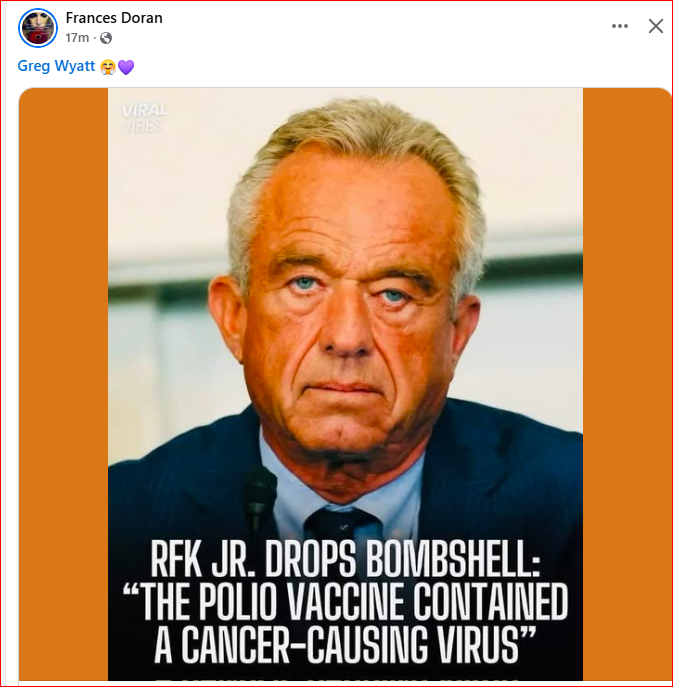
Dear RFK Jr.,

Please reconsider your position on this topic. There is no doubt that vaccines can be extremely harmful and may even trigger severe infections — sometimes mislabeled as “cancer,” which itself remains an ill-defined illness. However, such vaccine-related harm cannot logically be attributed to any “virus,” since no valid scientific evidence has ever demonstrated the existence of viruses.

Claims regarding viruses are based entirely on assumptions made by medical professionals who lack the scientific training and expertise required to isolate, purify, and characterize substances — including what they call viruses. It is only through the disciplined methods of true science — particularly chemistry — that such determinations can be made. Based on those scientific principles, no virus has ever been isolated or shown to exist.

A simple and valid requirement for proving the existence of any virus is the availability of a purified and fully characterized specimen — a tangible sample in a test tube or vial. No such sample exists.

The logical extension of this fact is that all related claims — including virus testing, so-called pandemics, and vaccine effectiveness — cannot be scientifically valid. There is no evidence that an actual viral specimen has ever been used in such investigations or research. These claims, therefore, are misleading and unsupported by real science.


Rethinking Cancer: A Mislabelled Mystery (link)
Vaccines and the COVID virus (link)
Claims of vaccines’ relevancy and efficacy – a big fat lie! (link)
The science behind COVID and vaccines! (link)
A Simple And Direct Question RFK Jr Needs To Ask – A Suggestion (link)
Quackery in White Coats (link)
Chemistry, Not Medicine, Defines Science (link)
Critical Review of Medical Authority and Scientific Legitimacy (link)
Questioning Medical Authority: Show Your Science Credentials (link)
What is science, and who are scientists? (link)
My training and expertise – people ask! (link)

There is little doubt that individuals like Dr. Marcus Zervos (M.D.) — and many others within the medical establishment — have failed to act in an honest and honorable manner (‘I’d Be Finished’: Vaccine Researcher Trashes Own Study to Save Career, link). Yet, a more profound and more important question arises: why would they not act honorably?

The answer is simple but disturbing. Any individual within the system who dares to question or expose misconduct would be judged by the very authorities he is accusing — the so-called medical experts operating under the umbrella of “medical science.” In such an environment, even legitimate criticism is dismissed as a “personal opinion,” or the critic is accused of conducting a “poorly designed study.” The system is structured so that the accused also serve as the judges, leaving no possibility of an objective review or scientific accountability.

This is not a theoretical concern. The same situation occurred to the author himself when he questioned the validity of the drug dissolution testing used to assess the quality of pharmaceutical products such as tablets and capsules. This test, long accepted by pharmaceutical authorities, is scientifically false and fraudulent. Despite raising these concerns for years, the issue was repeatedly deflected, with officials insisting that “medical and pharmaceutical authorities” must address it — the very bodies benefiting from its continued use.

Eventually, a formal complaint was submitted through a Citizen Petition to the U.S. FDA. Predictably, FDA experts reviewed the petition. The same experts enforce and defend the very technique in question. After nearly four years, the FDA’s final response was that the test “Method validation and verification encompasses the apparatus used in the method; the apparatus is not separately validated.” Case closed. The circular — and rather dodgy — reasoning was complete: the apparatus wasn’t validated, yet it was deemed validated simply because the authorities stated so (link).

The same fraudulent logic applies to the PCR test, which has been misused as a diagnostic tool for viruses and illnesses without any scientific validation. Despite repeated objections from independent scientists, medical authorities continue to rely on it — fueling false claims of viral diseases, pandemics, and vaccine needs.

At the core of this problem lies the medical and pharmaceutical establishment itself — the main culprit of dishonesty and fraud — which has falsely claimed to be practicing “science.” In truth, it operates under a counterfeit version of science, detached from the foundations of true science: chemistry, physics, and mathematics.

What makes the current exposure of this fraud possible is that certain inquiries — such as those initiated by the Secretary of Health and Human Services (RFK, Jr.) and Senator Ron Johnson— come from outside the medical hierarchy, from individuals not bound by medical credentials or interests. Only such independent third-party oversight can bring truth to light.

If genuine audits or evaluations of “medical science” are ever to occur, they must be conducted by experts in real science — chemists, physicists, and mathematicians — not by physicians judging themselves. Once such an independent review is undertaken, the fraud of “virus,” “vaccine,” and “medical science” will collapse swiftly, revealing the profession for what it has become: a trade built on unscientific assumptions rather than measurable truth. It is time, therefore, to handle this issue from its proper perspective — through the lens of true science (chemistry), not medical authority.

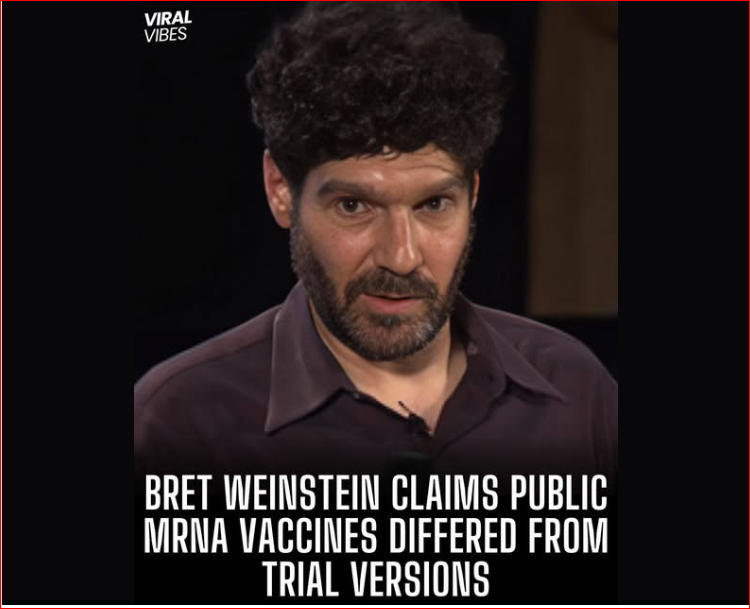
In general, my focus is on highlighting the fact that topics related to viruses and their components — such as RNA, mRNA, and spike proteins — including their isolation, characterization, purification, and testing, fall under the field of chemistry, which is one of the three pillars of true science, the other two being physics and mathematics.

However, in the medical field, these subjects are often described and interpreted by medical professionals who are not trained in science (chemistry) and its research. As a result, their explanations and claims in these areas are scientifically invalid. Although some doctors do challenge mainstream medical views, they, too, are unable to properly address the issues because they lack a grounding in actual science. This is why the problems in medicine persist — including misunderstandings about viruses and medicines in general.

To address these problems effectively, expertise in science, particularly chemistry, is essential. For example, the entire concept of the virus, vaccination, and pandemic response is based on PCR testing, which, by true scientific standards, is a fraudulent test. A proper scientific audit of this testing would immediately disqualify it, exposing the fields of virology and vaccination as fundamentally dishonest.

Unfortunately, the evaluation of such testing and viral claims has been left to physicians, who, due to their lack of scientific training, have developed and defended this so-called “medical science”—a made-up discipline that continues to promote false concepts about viruses, vaccines, and medicines in general.

In short, the claim of “medical science” made by medical professionals must be challenged as false and fraudulent, and the matter should be re-examined through the lens of true science — that is, chemistry, recognizing that medicines are, by their very nature, chemical substances. (from FB, link )

“Doctors and researchers are stunned after an experimental treatment using an anti-parasitic drug — originally designed to fight infections — showed unexpected success against cancer.” (link)

Why not look at it from another angle? Perhaps the anti-parasitic drug is simply doing what it was meant to do — treating a parasitic illness — and what we call cancer may actually be a misdiagnosed or mislabeled condition. With this kind of reasoning, not only could the so-called cancer be treated effectively, but it might also reveal that cancer has been misclassified from the start, much like “viral infections,” where no actual virus has ever been demonstrated to exist.

The reason such logical explanations are ignored is simple: most so-called medical experts — especially physicians — are not trained in real science, such as chemistry, nor in conducting genuine scientific research. As a result, they make unscientific and false claims or assumptions under the banner of “science.”

(more…)

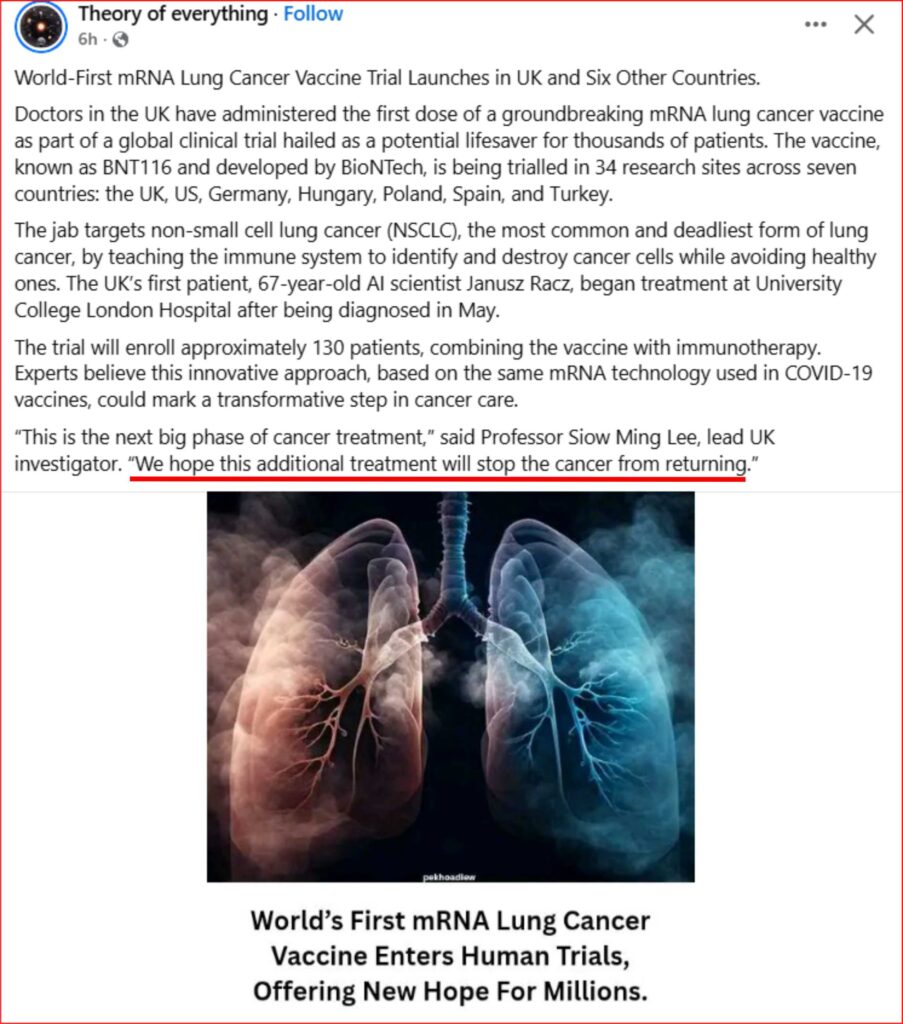
“We hope this additional treatment will stop the cancer from returning.”

They are working with hope, not with science. That is the essence of today’s so-called “medical science” — it runs on hope, not on evidence grounded in chemistry or physics.

Doctors speak of “mRNA technology,” but there is no such technology in the scientific sense. It is merely a chemical formulation—a mixture said to contain a compound called mRNA. In truth, there is no verified test to confirm the presence or purity of this mRNA, because no isolated or purified reference material exists.

So, what remains? Hope — the same hope that surrounded the COVID-19 “mRNA vaccines.” Everyone now knows how that turned out: a human tragedy of global proportions, buried under layers of denial and cover-ups.

Just as with “viruses” — unseen, undefined, and unverified entities — the medical world now constructs “cancer” as another illusion, a diagnosis based on images and tissue fragments rather than isolated, characterized substances. Despite decades of funding and experimentation, they have not found, controlled, or scientifically explained either.

Yet, the public continues to trust “medical science,” unaware that its foundation rests on untested methods like the clinical trial — celebrated as the gold standard, but never scientifically validated for its intended purpose. It is not a scientific tool; it is a commercial and regulatory instrument designed to maintain control and to continue medical foolishness and fraud.

And so, the cycle continues:

Hope, not science — marketing, not measurement — faith, not proof.

It should be clearly understood that when medical experts refer to science, they mean medical science, not true science.

True science is the study of physical and tangible substances, guided by precise observation, experimentation, and measurement. It includes disciplines such as chemistry, physics, and mathematics — fields that rely on verifiable data, reproducible results, and the logical interpretation of evidence. Those who study these subjects in depth, supported by rigorous academic education and extensive experimental training, are the real scientists.

In contrast, what is called medical science is not science in the true sense. It is a fraudulent imitation of science, borrowing its language and symbols — especially from chemistry — but without its rigor or proof. Physicians’ claims to be “scientists” rest mainly on non-scientific professional, mostly undergraduate degrees such as the M.D., which offer no meaningful training in science and provide little or no genuine scientific credentials.

Over the past five or six decades, most of what has been presented as “medical research” has been false, misleading, or irrelevant — bearing little connection to real illness, its testing, or its treatment. This deception is most evident in the diagnosis of virus-based illnesses, the testing for them, and the development and administration of vaccines.

Despite billions of dollars spent through research grants and donations, there remains no purified sample of any virus, no scientifically validated test, and no vaccine proven effective against an actual, demonstrable virus. What exists instead are claims — supported by publications filled with the terminology of true science (chemistry) but devoid of its substance.

Therefore, physicians’ repeated assertions that they are “following science” must be critically examined. Most of these claims would collapse under the standards of genuine scientific evaluation. It is time to recognize that medical science is not real science — and that true understanding of health and disease can only come through the actual sciences, led by chemistry.

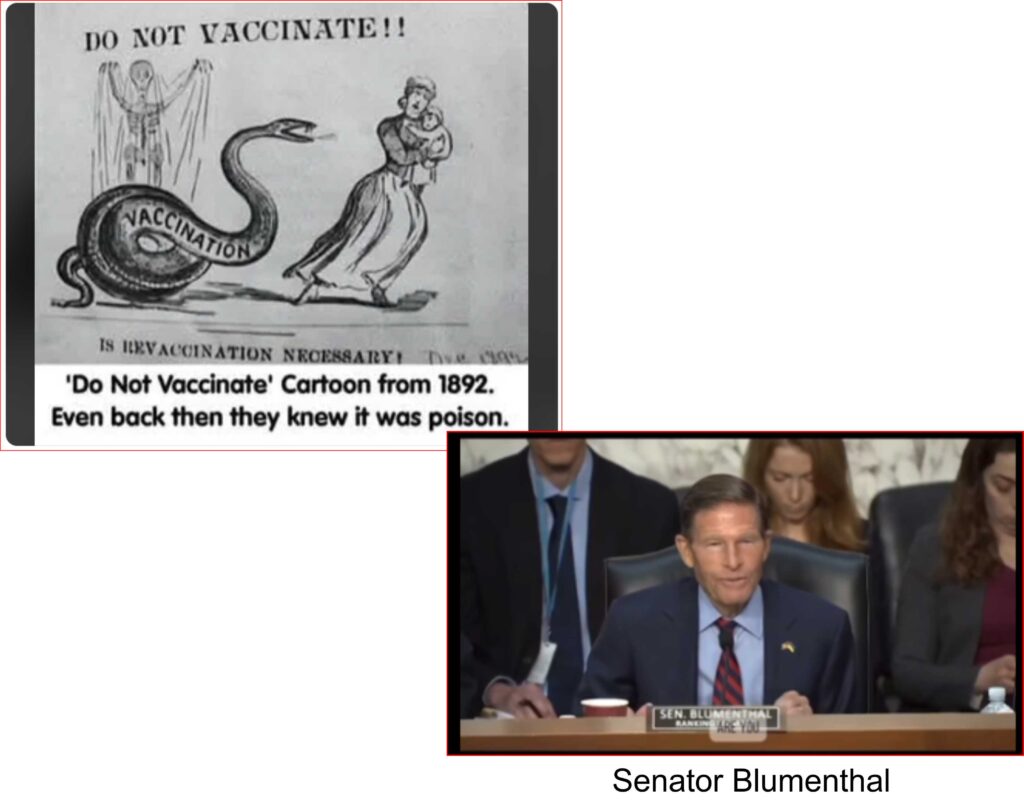
I saw this picture (left) and began to think: if the poisonous view of vaccines was already known and circulating in the late nineteenth century, how did vaccine use and recommendation become so widespread—even into modern times? A brief review of the literature shaped my conclusion: physicians are not scientific experts but rather professionals rebranded under a misleading titlemedical science, or more precisely, fraudulent science. No wonder we remain trapped in a profession that labels itself “science” when, in truth, it is not.

If this deception was recognized even in its early days, why has it continued to be accepted as legitimate science? The answer lies in the gradual transformation of the medical profession during that period. Until the mid-1800s, physicians were regarded as healers—educated in anatomy, herbs, and observation—but they were not engaged in experimental or physical science. Their practice was practical and empirical, at times even philosophical, but never chemical or quantitative.

(more…)