
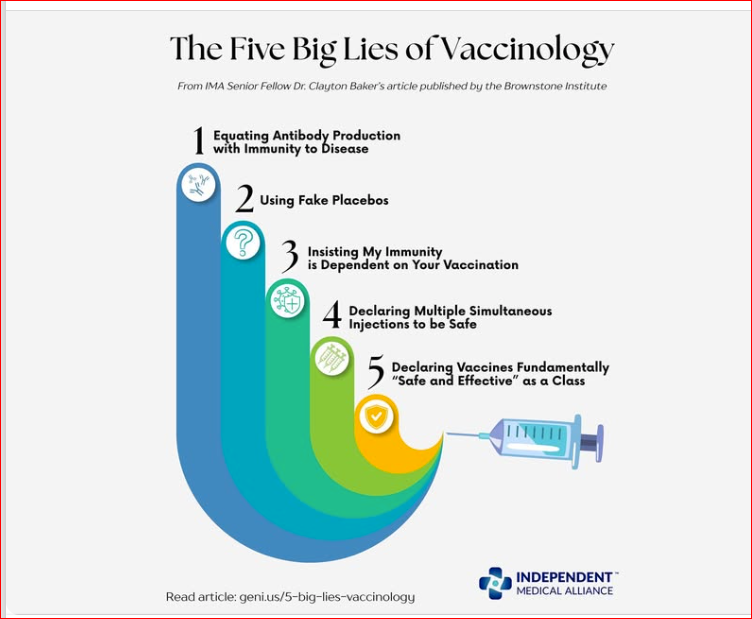
The article “The Five Big Lies of Vaccinology” presents itself as a scientific critique of vaccines—particularly mRNA products—by analyzing Pfizer trial data (link). However, this review is authored from a medical, not a scientific, perspective. This distinction is not semantic; it is fundamental.
In fact, the five lies of vaccinology are themselves the result of one larger and more consequential lie: that medical science is science, and that physicians are scientists.
The central problem with vaccines and vaccinology is therefore not merely flawed trials, exaggerated claims, or regulatory misconduct. Those issues are secondary. The primary problem is that modern medicine is not grounded in true science. Medical professionals—whether arguing for or against vaccines—are not educated or trained in the foundational sciences required to make scientific determinations: chemistry, physics, and mathematics.
As a result, both pro-vaccine and anti-vaccine medical arguments suffer from the same structural defect. They rely on assumptions inherited from medical doctrine rather than on independently established scientific evidence.
The Unexamined Premise: Virus Existence
The article critiques vaccinology while preserving its most critical assumption: that viruses exist as isolated, purified, and scientifically characterized entities. This assumption is never questioned. Yet from a true scientific perspective, this is precisely where scrutiny must begin.
There is no scientifically valid evidence demonstrating the isolation, purification, and characterization of viruses in accordance with the standards required by chemistry and physics (science). Without such evidence, the entire framework of virology—including disease attribution, pathogenic mechanisms, and vaccine targets—rests on an unverified premise.
If the causal agent itself has not been scientifically established, then:
- Claims of virus-specific diseases are unsubstantiated.
- Pathology attributed to viruses is speculative.
- Preventive or therapeutic interventions—vaccines included—are scientifically unjustified.
Under these conditions, debating vaccine safety, efficacy, or platform technology (including mRNA) is misplaced. There is no scientific necessity for vaccines to exist in the first place.
Medical Debate Is Not Scientific Debate
The article reflects an internal dispute within medicine, not a scientific evaluation of medicine itself. Medical experts reviewing medical studies—even critically—remain confined to a non-scientific framework. Statistical analysis of clinical trials does not substitute for establishing the physical reality of the entities being claimed.
This is why such reviews, while appearing rigorous, ultimately reinforce the same foundational error: they challenge vaccine implementation while leaving the existence of viruses—and thus virology itself—unexamined and implicitly validated.
Conclusion
The failure of vaccinology is not isolated. As even the article indirectly illustrates, it is part of a broader pattern. It is the consequence of medicine presenting itself as science when it is not, and of physicians being portrayed as scientists when they are not trained as such.
Until medicine is grounded in true scientific methodology—beginning with the physical isolation, purification, and characterization of claimed agents—both pro- and anti-vaccine arguments remain scientifically incomplete.
A genuine scientific critique must challenge first principles, not merely debate outcomes.
The Medical Shell Game: The Illusion of Science (link)