
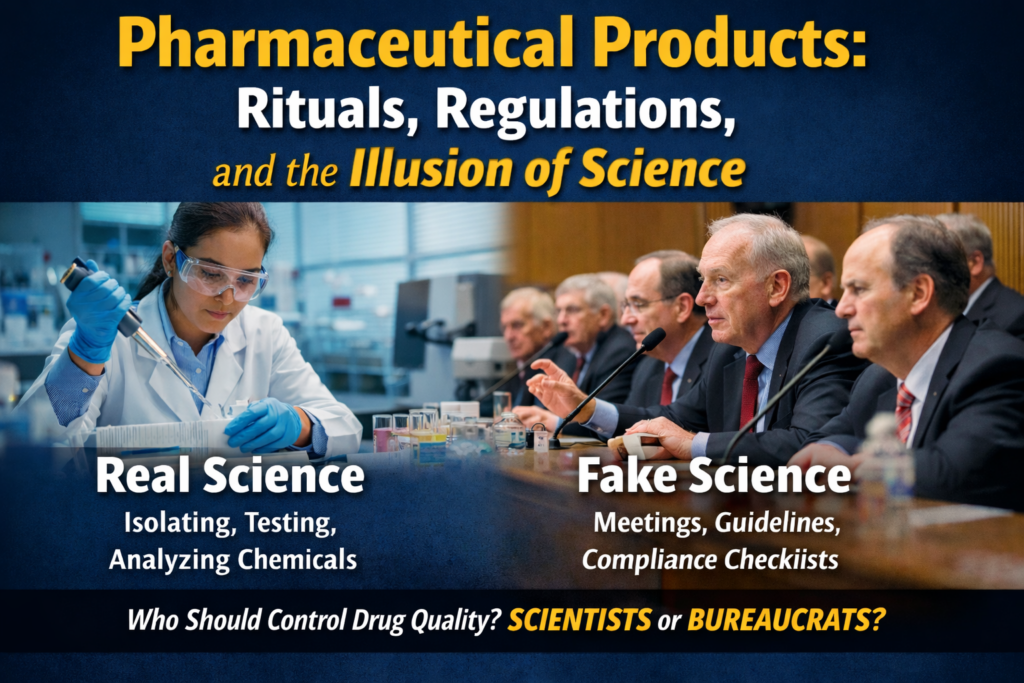
Most people assume that if there is a problem with drug quality, it must be a manufacturing issue, a company issue, or a regulatory oversight issue. Recently, I watched a clip from a Senate hearing on the quality of generic drugs (link), and the discussion gave the impression that lawmakers had “just” discovered an anomaly that needed to be investigated and fixed. But this is not an anomaly. This is not new. This is the predictable result of a system that replaced real science with rituals, regulations, and the illusion of science.
Drug products are not medical concepts. They are chemical products. Their identity, purity, strength, stability, and quality are chemical properties. Therefore, drug quality is a chemistry problem. Medicine is about diagnosing illness and prescribing drugs, not about defining chemical quality, developing analytical methods, or setting manufacturing standards. Those are scientific responsibilities, not medical ones.
Over time, however, the pharmaceutical field became dominated by medical thinking and regulatory procedures rather than by true scientific principles. The language of science is used everywhere — “medical science,” “pharmaceutical science,” “evidence-based,” “scientifically proven” — but the actual practice often does not follow the basic principles of science, particularly chemistry. What we see instead is a system of procedures, guidelines, and regulatory rituals that appear scientific and sound scientific, but are often not grounded in solid scientific foundations.
True science requires clear definitions, well-characterized materials, validated analytical methods, and standards based on measurable and reproducible properties. In chemistry, you must know what a substance is, be able to measure it accurately, and reproduce the results. Without these, you do not have science. You have assumptions and administrative procedures.
This is the core of the problem. We have created a system in which drug quality is defined by whether a company followed regulatory procedures and passed predefined tests, rather than by whether the product was truly understood and evaluated using sound scientific principles. In other words, compliance with procedure has gradually replaced scientific understanding. The ritual became more important than the science.
I have worked in this area for over forty years and have seen this problem develop step by step. Many times, I pointed out that the standards and tests being used were not always scientifically sound, and that we were moving away from real science and toward what I call ritual science—a system in which, as long as the ritual is performed correctly, the product is considered acceptable. These concerns were often dismissed by saying that this is “test tube science” and not relevant to complex biology or patients. But this argument misses the point completely. Before a drug can ever help a patient, it must first be a properly defined and properly tested chemical product. If the chemistry is wrong, nothing else can fix that.
The irony is that the system that replaced real science with rituals and regulations is now surprised that the products made under those rituals and regulations are of poor quality. Lawmakers hold hearings. Regulators issue warnings. Industry is blamed. But in reality, the industry is doing what the regulations require. If the standards are wrong, the outcome will be wrong. You cannot produce high-quality products using poor scientific standards.
I have explained this issue in much greater detail in my book Not Science. Not Scientists. (link) and on my blog (Bioanalyticx.com, link), where I discuss how the term “science” is often used in medicine and pharmaceuticals without the full application of the scientific principles and procedures as understood in chemistry and physical sciences. I also explain how regulatory standards are developed, how they become accepted over time, and how difficult it becomes to question them once they are institutionalized. Anyone who wants to understand why drug quality problems keep recurring should look at the science behind the standards, not just the manufacturing behind the products.
The solution to this problem is actually simple, but not easy. Bring real science back into the system. Let chemistry experts and analytical scientists define drug quality and manufacturing standards using real scientific principles. Let physicians do what they are trained to do — diagnose illness and prescribe treatments. They are not trained in analytical chemistry, pharmaceutical manufacturing, or quality assessment, and they should not be setting scientific standards in those areas.
In the end, the problem we are seeing today is not really a drug problem, a generic drug problem, or an inspection problem. It is a science problem. When procedures replace science, when checklists replace understanding, and when authority replaces evidence, the result is exactly what we are seeing now: rituals, regulations, and the illusion of science. Until real science returns to the foundation of pharmaceutical quality, these problems will not disappear, no matter how many hearings are held or how many new regulations are written.