
We are often told to trust the experts, trust the institutions, and trust the science. But what happens when the experts are not trained in science, the institutions are not truly scientific institutions, and what is presented as “science” is not science in the strict sense of the word? That is when a web of deception is created—so complex and so widely accepted that even politicians fall into it. What we are witnessing today in the debates about viruses, vaccines, and modern medicine is not a scientific debate, but a conflict of authority, credentials, and narratives, all presented under the powerful name of “science.”
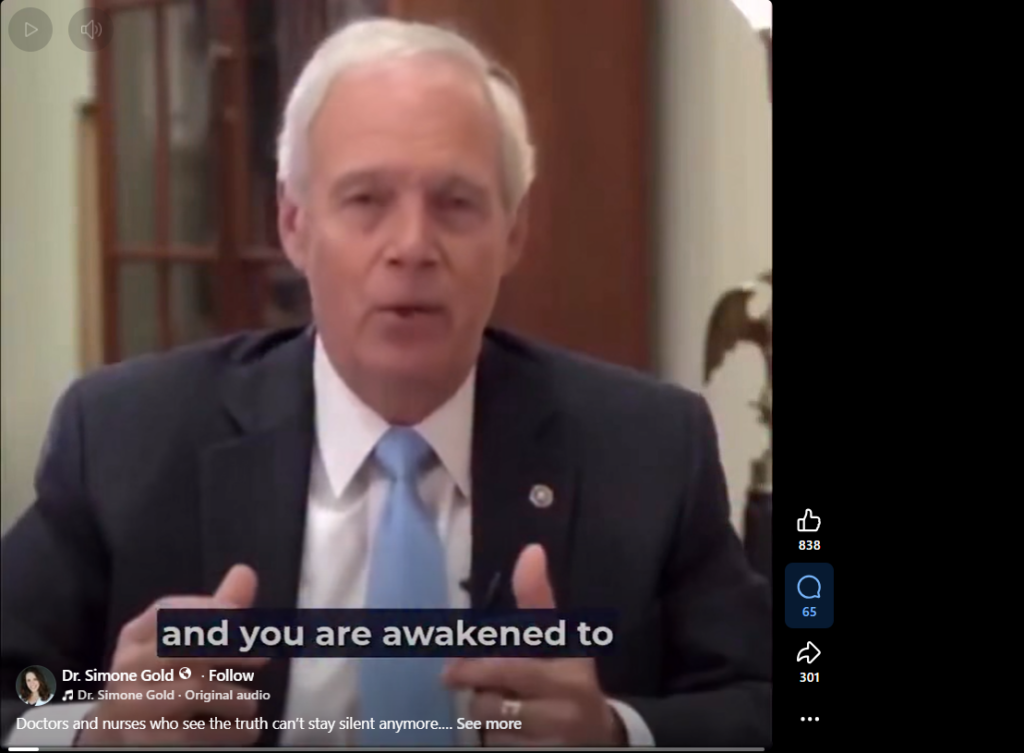
I recently listened to a short clip of Senator Johnson referring to physicians and other medical experts who are now speaking against mainstream medical experts who promote and support vaccines (link). What struck me was not the disagreement itself, but the deeper problem behind it. Political authorities, like most people, assume that doctors are capable of understanding and resolving issues related to viruses and vaccination. They do not realize that the issue is fundamentally about science and scientific research, not clinical practice. In this respect, both sides are working outside their actual training and credentials.
Doctors are trained in clinical practice, not in foundational science or scientific research in the strict sense, particularly in areas such as analytical chemistry, isolation, purification, characterization, and measurement of physical entities. Yet medical and virology researchers create theories among themselves, publish them in medical journals, and those journals are presented and promoted as scientific journals. This gives them authority and credibility in the eyes of the public and government authorities, which in turn leads to very large research funding. Unfortunately, this funding is often used to develop medicines, including vaccines, based on assumptions that have not been established using the methods of the physical sciences.
Physicians should not make claims about scientific matters beyond their training. Their version of “science” often consists of constructing explanations that sound scientific—often using chemistry terminology—and then developing chemical products based on those explanations, without fully understanding the chemical nature of those products or how these chemicals behave in the body from a true scientific perspective.
For example, medical experts may propose that a certain illness is caused by a virus—an entity that has not been properly isolated, purified, or fully characterized. Billions of dollars are then spent on research attempting to “identify” this assumed entity using methods described with scientific-sounding terminology, often borrowed from chemistry but not applied according to the standards of analytical science. On top of that, treatments such as vaccines are developed and claimed to provide protection against this assumed entity, even though the entity itself has not been physically isolated or established and tested in a controlled, scientifically valid way. All of this falls under the broader theory that germs cause disease, but in many cases, the germ remains hypothetical, while the treatments are very real.
On the other hand, there is now a second group of medical experts who oppose the mainstream view and claim that they have identified problems with vaccines and medical practices. However, this group has the same educational background and the same lack of foundational science training as the mainstream group. As a result, what we are seeing is not a scientific debate, but a conflict between two groups telling different stories. The mainstream group has authority, institutional support, and resources, so it dominates the narrative, while the opposing group struggles to be heard, even if it raises legitimate concerns.
A recent example is the situation involving ACIP, where individuals were brought in to address concerns about vaccines but eventually left, reportedly due to legal and political conflicts. This illustrates that the issue is no longer purely scientific or medical—it has become political and institutional. The system protects itself, and the underlying scientific questions are never properly addressed.
Therefore, the problems surrounding vaccines, modern medications, and public health policies will continue as long as medical experts are accepted as scientific authorities without proper scientific credentials. The weakness in the system is the assumption that medical training is the same as scientific training. It is not. Clinical practice and scientific research are different professions and require different expertise.
The solution is not more debate between medical experts, and not more political involvement. The solution is to return the question to where it belongs: science. Not medical opinion, not institutional authority, not political decision—but science. And science begins with a simple question: where is the physical, isolated, purified, and fully characterized sample?
Until that question is properly addressed using the methods of true science, the web of deception will remain, and more people—including politicians—will continue to fall into it.
I have discussed these issues in detail in my book Not Science, Not Scientists, and I encourage readers to examine the subject carefully and decide for themselves, based not on authority, but on science (link).