“The Trump administration can not stop Springer Nature from publishing, nor should they. But they can and should stop financially supporting their operations.

It is not a First Amendment issue, as some claim. Stopping payments that support woke science is a fiscal policy grounded in doing what is right for science (and science workers) in America.”

Dr. Malone wrote in a recent post on his blog (link), who was recently appointed to the Advisory Committee on Immunization Practices (ACIP) to address vaccine safety in general, with a particular focus on mRNA-based vaccines.

I read the article by Dr. Robert Malone—an M.D., not a Ph.D.—criticizing Nature and other high-profile journals for publishing what he calls “junk science.”

While I share concerns about the quality and bias of modern scientific publishing, Dr. Malone’s critique is ironic. He condemns biased, politically-driven science while defending the very institutions and funding streams that enable it. That contradiction deserves scrutiny.

(more…)

The idea that vaccines were deliberately designed to harm or kill may sound extreme—but it only makes sense if we assume the developers actually understood the science needed to do so. The truth is, they don’t. Most come from medical or biological fields, not from core scientific disciplines like chemistry. That’s not just a gap—it’s a fatal flaw.

This isn’t so much a case of malicious intent as it is a blatant fraud: people falsely claiming scientific authority they don’t have. They parade as scientists, yet lack the training, understanding, or qualifications. This deception has pulled in massive funding and driven the deeply flawed narratives around viruses and vaccines.

Pretending to be a scientist without real scientific grounding isn’t just dishonest—it is the root of the crisis. And it’s time we called it what it is: scientific fraud, hiding in plain sight.

An M.D. degree is not a science degree! (link)
Biology vs Science (link)
What is science, and who are scientists? (link)
My training and expertise – people ask! (link)

Response to the FB discussion (link)

This is an excellent and timely topic—actually, several questions wrapped into one. If even a trained pharmacist feels confused by the endless claims about supplements, nutrients, and health advice, imagine the situation for the average person constantly bombarded with contradictory information and marketing.

“I wanted to ask you what your opinion is on dietary supplements? Especially about what they call vitamin D, and the promotion that is made for minerals, trace elements? I am a Pharmacist in Greece, I know that all of these are chemicals, I am confused by the fact that they have a lot of promotion even from alternative doctors while we all know that their production is in the hands of big pharma.”

This is not just a valid question—it is a crucial one. I offer the following scientific perspective, which I hope helps clarify the confusion and cuts through the noise.

(more…)

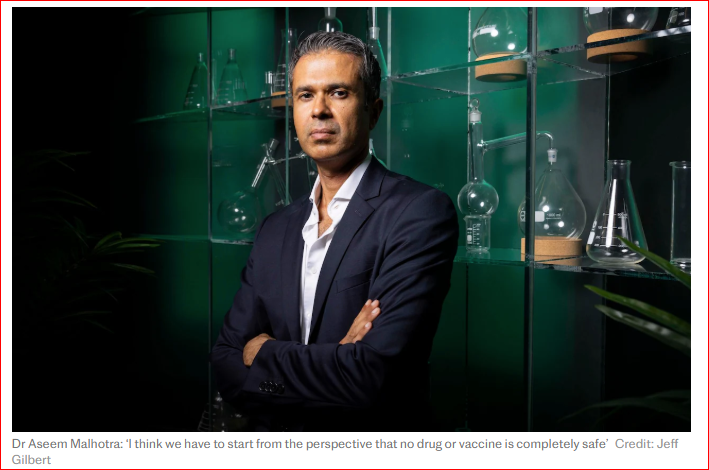
I was genuinely surprised to see a photo of Dr. Aseem Malhotra—a widely promoted UK cardiologist—posed in front of glass flasks and labware commonly used to symbolize a chemistry lab (link). It struck me as both ironic and misleading.

Physicians often distance themselves from chemistry, dismissing it as irrelevant to medical practice. Rarely do they study, engage with, or publish in actual scientific literature—particularly in fields like chemistry. So why pose with the trappings of a science they neither practice nor understand? It seems like a deliberate attempt to cloak medical opinion in the authority of science—especially when addressing issues like vaccine safety and toxicity.

(more…)

Recently, I’ve received an increasing number of hostile messages via Facebook and email—accusations of arrogance, of being a self-proclaimed and self-centered scientist, and of disrespecting others by insisting on my interpretation of science. These reactions largely stem from my critical evaluation of certain physicians’ and biologists’ work, including members of the so-called “no-virus group”—individuals some see as sincerely trying to help.

Unfortunately, some of these responses have taken on a disturbingly aggressive tone, with some bordering on intimidation and veiled threats.

The reality, however, is quite different. A careful review of my public commentary over the past five years—particularly my work challenging the existence of SARS-CoV-2—shows that my conclusions are grounded in rigorous academic training and decades of experience. They are not casual opinions but the product of over thirty years of scientific work at Health Canada. I have never been affiliated with individuals who present themselves as scientific authorities without the necessary credentials or expertise.

(more…)

mRNA Vaccines – are they real?

Medical experts have yet to provide concrete scientific evidence that mRNA is actually present in the vaccines. There is no verified proof that mRNA has been successfully manufactured, isolated, and incorporated into these formulations. To establish its presence, a validated analytical method/test is essential—one that must be based on a reference standard: an isolated, purified, and fully characterized sample of mRNA. Such a standard does not currently exist (link).

Therefore, all claims about mRNA and its purported role in these vaccines remain unverified and lack a sound scientific foundation.

While experts continue to debate the safety and efficacy of these vaccines, their conclusions are based on assumptions rather than proven facts. Without verified mRNA, the basis for these vaccines remains speculative at best.

This is not a matter of opinion—it is a matter of scientific rigor and evidence.

It is essential to note that biology is not a science, nor is it a science subject. Biology more closely aligns with the arts—similar to fields like psychology, sociology, or economics—drawing heavily on observation, interpretation, and speculative theorizing rather than direct experimentation with physical substances. In this framework, biology constructs narratives based on observed patterns and inferred mechanisms, rather than engaging with empirically verifiable entities.

For example, concepts like viruses and the diseases attributed to them must be viewed as theoretical (imaginary), rather than physically demonstrated realities. On the other hand, science (physics and chemistry, link) is concerned only with tangible substances. As the physical samples of the isolated and purified viruses are not available, claims about viruses and their illnesses cannot be considered science-based or scientific, but biological (non-scientific).

As medical practice and research heavily or solely depend on biology, it should also be considered a non-science discipline. Therefore, all claims by medical experts, particularly physicians, in medical research areas concerning diagnosis and their treatments, including vaccines, should be regarded as false and fraudulent from a scientific perspective.

After Years of Silence, New CDC Vaccine Panel to Vote on Mercury in Flu Shots (link)

Consider the credentials of the new ACIP membership. The eight new members are, according to Kennedy: (link)

  • Dr. Joseph R. Hibbeln, a psychiatrist and neuroscientist with a career in clinical research, public health policy, and federal service.
  • Martin Kulldorff, M.D., Ph.D., a biostatistician and epidemiologist formerly at Harvard Medical School and a leading expert in vaccine safety and infectious disease surveillance.
  • Retsef Levi, Ph.D., professor of operations management at the MIT Sloan School of Management and a leading expert in healthcare analytics, risk management, and vaccine safety.
  • Dr. Robert W. Malone, a physician-scientist and biochemist known for his early contributions to mRNA vaccine technology.
  • Dr. Cody Meissner, professor of Pediatrics at the Geisel School of Medicine at Dartmouth and a nationally recognized expert in pediatric infectious diseases and vaccine policy.
  • Dr. James Pagano, a board-certified emergency medicine physician with over 40 years of clinical experience following his residency at UCLA.
  • Vicky Pebsworth, OP, Ph.D., RN, who holds a doctorate in public health and nursing from the University of Michigan.
  • Dr. Michael A. Ross, clinical professor of obstetrics and gynecology at George Washington University and Virginia Commonwealth University, with a career spanning clinical medicine, research, and public health policy.

It is essential to note that none of the listed credentials indicate that they would reflect science literacy. They are based on self-proclaimed sciences, i.e., without education or expertise in actual science. Such expertise caused the disaster of vaccination in the first place. It is impossible that experts with such expertise would be able to address the issue of vaccinations or other chemical-based treatments.

If the issue needs to be resolved based on science, then actual science (chemistry) experts should be appointed, as medicines, including vaccines, are chemicals or chemical-based.

Science does not require voting or consensus, but rather valid data from well-designed scientific studies conducted by experts in the field (science or chemistry).  

Science And Medical Experts – An Oil And Water Mix! (link)  
For The Attention Of Respectable RFK Jr. (United States Secretary Of HHS) (link)

Below is my response to Malcolm Glass’s comment on Facebook (link). His comment is provided at the end of my response.

Thank you very much for taking the time to evaluate my view critically and for explaining your understanding of the subject.

In short, your narrative does not accurately describe my position. Your description is similar to those who consider there is no or limited need to know or understand science to resolve the virus or virology issue. A straightforward discussion (based on so-called logic) could easily and effectively resolve the issue. No true! If that had been the case, the problem would have been resolved a long time ago.

Unfortunately, both groups (virus and non-virus) have been arguing about science (without understanding it) and have failed to resolve the issue. My view is that if one wants to discuss science, then say so. Do not hide it under the rug of logic or high school stuff.

(more…)

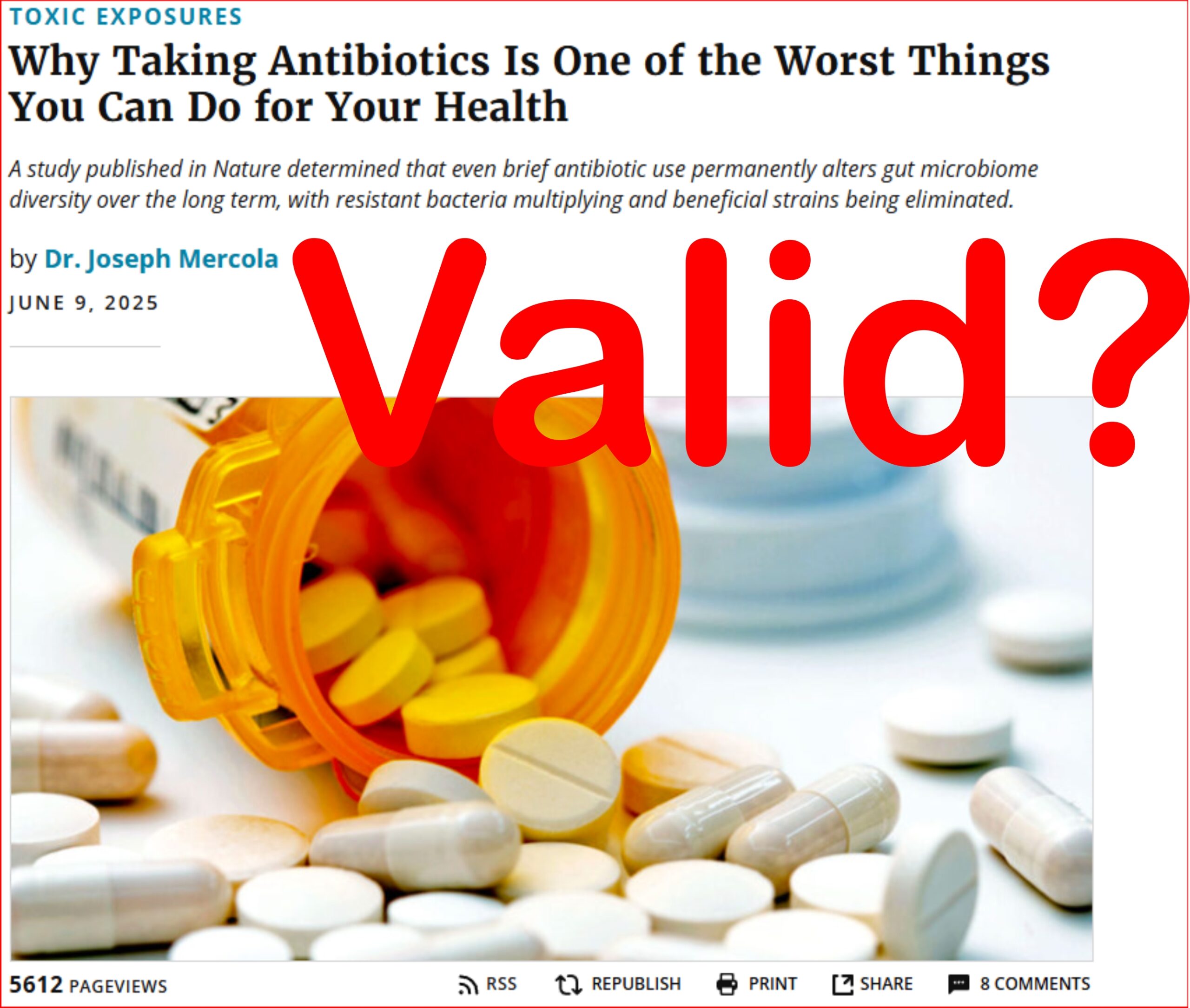
I started reading the article (link) but got bored after reading a few lines. I find it typical nonsensical narrative by medical professionals to sell fear to promote their “science” and products/services with convoluted and dodgy narratives.

For example, consider the first two words of the article “Antibiotic abuse.” Of course, the abuse of anything can be detrimental and must be avoided, but that does not mean it should be avoided all the time, including for its proper use. There is a definite need for antibiotics, and they have been used successfully for very long periods.

@ “According to the CDC, 2.8 million cases of antibiotic-resistant infections are diagnosed yearly, and 35,000 people die from them …” Citing the CDC claim is of limited authenticity of validity, as recently, the CDC has been under scrutiny for providing false or invalid reporting.

Next, are the narratives referring to “intrinsic resistance, acquired resistance, genetic change, DNA transfer.” These are all chemicals and chemistry/science terms, along with antibiotics, about which doctors have no knowledge or training. Therefore, it can be said with almost certainly that these are scientifically false or unproven narratives. It is like the hoopla about viruses and vaccines based on a genetic and DNA narrative, which has clearly been shown to be fraudulent.

Therefore, I suggest that medical professionals limit their practice and claims to the training and education they have received and refrain from engaging in science that has not been taught or learned – noting that a medical degree, such as M.D., is not a science degree.

An M.D. degree is not a science degree! (link)
Unlawful Science Practices By Physicians (link)