
Words, Definitions, and the Illusion of Proof
It is interesting to observe that the question of viruses has increasingly become a debate between two opposing camps: the “viruses are real” group and the “viruses are not real” group. What is particularly interesting is that this debate does not usually take place among experts in the foundational sciences such as chemistry and physics, but rather within medicine, virology, and biology, and among followers of these fields. This raises an important question: why has this become a debate at all? In true science, the existence of a physical entity is not decided by debate, opinion, or consensus, but by physical evidence that can be demonstrated, measured, and independently verified.
The core of the issue is that medicine and biology often present themselves as sciences in the same sense as chemistry and physics, even though their methods and training are very different. This creates confusion. The use of scientific terminology gives the impression that the work is grounded in the same scientific method used in the physical sciences. Terms such as “isolation,” “characterization,” and “validation” are used, but often they are not used in the same way as in analytical science. This difference in terminology and methodology is rarely explained clearly to the public or even to experts.
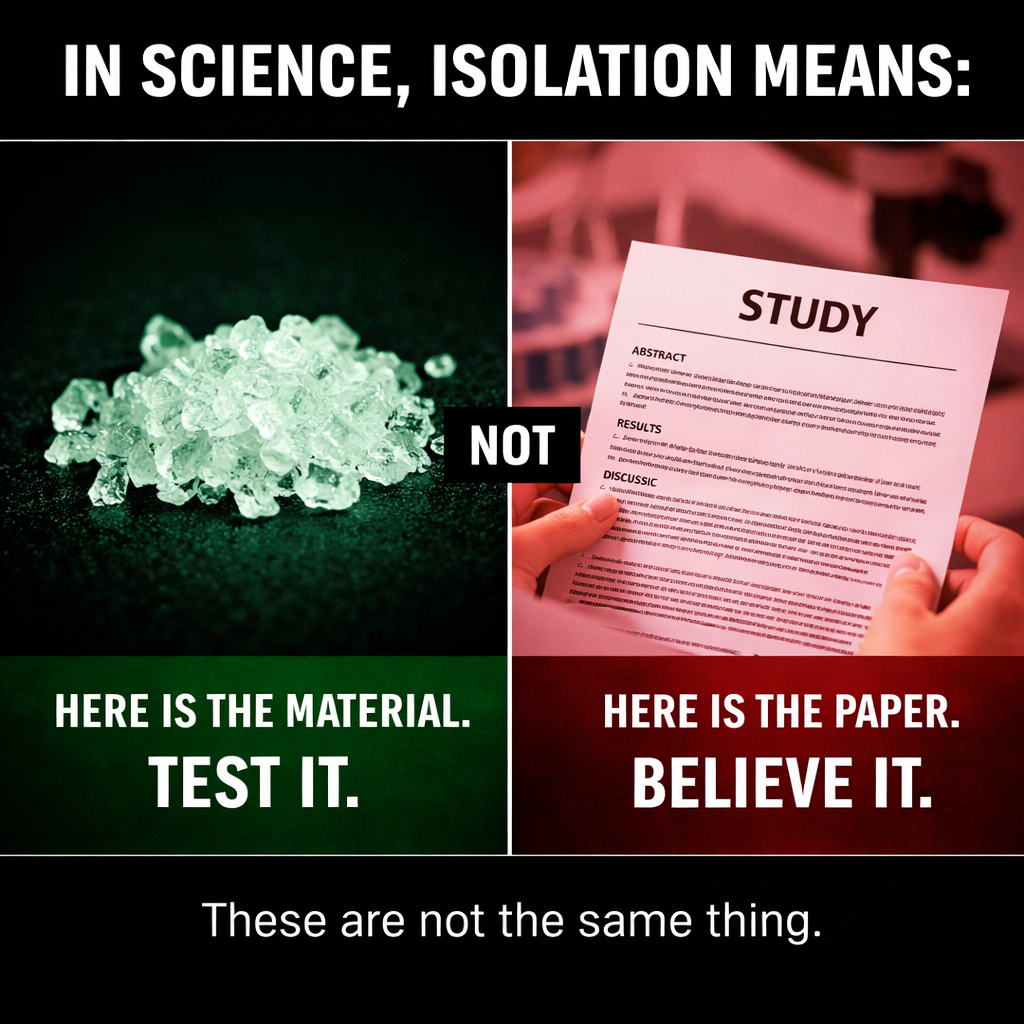
A good example is the word “isolation.” In analytical chemistry, isolation is the separation of a specific substance from a mixture and obtaining it in a form that allows independent testing, measurement, and characterization. If someone claims to have isolated a substance, the obvious scientific question is simple: where is the isolated material, and can it be independently analyzed and confirmed? However, in virology and biology, the word “isolation” is often used differently, sometimes referring to a processed biological mixture or culture rather than a purified, fully characterized entity. This difference in definition is at the heart of much of the confusion and disagreement.
On the other hand, when this question is raised, experts’ and scientists’ responses are often very confusing. Instead of presenting the isolated entity itself, they often provide a list of procedures, techniques, and chemistry-sounding methods as proof that isolation has occurred. However, from a strict scientific standpoint, describing procedures is not the same as presenting the isolated product. In science, the proof of isolation is the isolated material itself, not the description of the process used. Describing complex procedures as “modern science” or “the result of decades of research” does not replace the need to present the actual isolated entity. The end product of isolation should be the isolated entity itself, available for independent testing and verification.
When different fields use the same scientific words but with different meanings, it creates the illusion that the same level of scientific proof has been achieved, when in fact the methods and standards may be very different. This is not how science should work. In science, words must have clear and consistent meanings, and claims about physical entities must be supported by physical evidence that can be independently verified.
From a true scientific perspective, the matter should be straightforward. If an entity is claimed to exist and to cause disease, then it should be possible to isolate it, purify it, characterize it, and demonstrate its properties in a clear and reproducible way. The end product of isolation should be the isolated entity itself, available for independent testing and verification—just as one would expect if someone claimed to have isolated a chemical compound such as salt or sugar from a mixture.
Instead, what we see today is not a purely scientific discussion, but often a debate based on authority, credentials, publications, and consensus. When science becomes a matter of authority rather than evidence, it begins to resemble belief systems rather than scientific inquiry. Calling one side or the other a “cult” does not solve the problem. The real issue is not which side is louder, but which claims can be demonstrated scientifically using clear, measurable, and reproducible methods.
In the end, this issue will not be resolved by debate, authority, or ridicule, but by clear scientific evidence and proper scientific methodology. If a group claims that viruses exist and have been isolated, they should be able to provide a purified, fully characterized sample of the entity for independent verification. If this cannot be done (as is the case), then claims based on work conducted on unverified material should be withdrawn or re-examined. Everything that follows from those claims must then be reassessed accordingly. That is how scientific questions are supposed to be resolved.