
Question: The covid vaccine makers claim that the mrna sends a code to the cell to manufacture spike proteins. We don’t have an isolated virus or an isolated spike protein. So what is the code actually telling the cells? Is there a code? What are the vaccinologists actually seeing under their “microscopes?” (link)
Response:
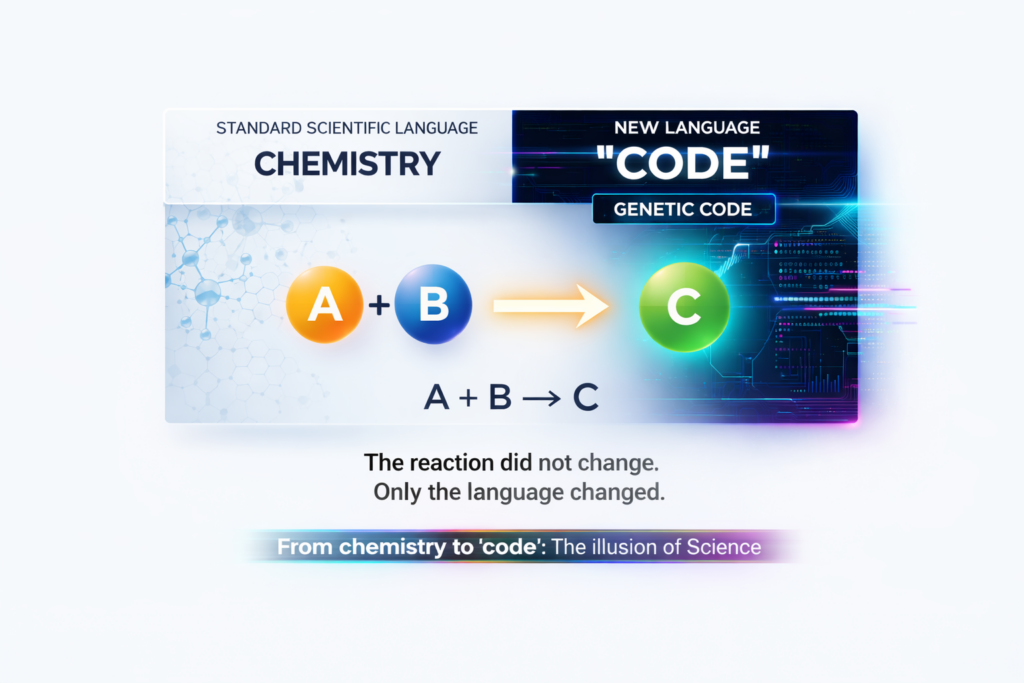
Before discussing mRNA “code,” one must first clarify what the word “code” actually means in scientific terms. The term creates the impression of something highly advanced and complex, often beyond the understanding of non-experts. However, in reality, the so-called “code” refers to a chemical sequence in a molecule called mRNA, which is claimed to cause the production of a protein in the body. When stripped of technical language, the entire process can be described as a series of chemical reactions between chemical compounds. Therefore, the subject should be examined from a chemical and analytical science perspective, not merely described in medical terminology.
In principle, or in theory, the word “code” refers to a specific chemical compound called mRNA. This compound is said to instruct another chemical component in the body (DNA) to produce another chemical compound, a protein (for example, the spike protein). The idea is that this process simulates the arrival of a foreign protein in the body, which is assumed to be part of a virus. The body then mounts a defense by producing antibodies (chemical compounds) that neutralize the protein and prepare the body to respond to future exposures.
This process is often described by medical practitioners in highly technical language. This can give the impression that something extremely advanced and beyond most people’s comprehension is happening. It may also create the impression that only doctors can understand it. However, if explained in simple scientific language—particularly in chemical terms—it can be viewed as a series of basic chemical reactions.
In simple terms, the body is injected with a chemical compound (mRNA), which is claimed to interact chemically with components inside the body to produce another chemical product (the spike protein). This protein is assumed to represent part of a virus (not shown to exist, so it is an assumption). The body then produces another specific chemical compound (antibodies) that binds to the spike protein and neutralizes it. In short, the entire explanation is based on fundamental chemical principles and reaction mechanisms. From a pure science perspective, there is nothing mysterious about reactions between chemical compounds.
However, if these claims were developed and presented strictly from a chemistry perspective, clear reference standards would be available for all the compounds involved, including mRNA, DNA, spike protein, and antibodies. The reactions would be demonstrated, measured, validated, and calibrated using established analytical techniques under controlled laboratory conditions.
The concern arises because much of this work is presented in the context of virology and medical fields rather than fundamental chemistry and analytical science. These fields frequently use chemical terminology and concepts, but the work does not always adhere to the same standards of isolation, purification, characterization, and reference validation as in the chemical sciences. The entire chain of claims begins with the virus (assumed), and from that point onward, the rest of the system—mRNA, spike protein, antibodies—is built on that initial assumption.
These claims are then accepted and promoted through regulatory authorities such as the FDA, CDC, and similar organizations, where medical professionals are often treated as scientific authorities. As a result, the narrative becomes widely accepted and repeated. However, from a strict analytical science or chemistry perspective, the foundational reference materials and validation steps have not been presented.
Therefore, when the word “code” is used, it may sound like a very advanced, high-tech concept. They (vaccinologists) are not seeing anything under the microscope in this respect. In simple terms, they refer to a proposed (assumed) sequence of chemical events in the body in which mRNA leads to the production of a protein, such as the spike protein. The structure of mRNA consists of a sequence of chemical units called nucleotides. There are mainly four types of nucleotides, and their arrangement (the sequence, or “code”) determines which protein will be produced. This sequence information is what is referred to as the “code,” meaning instructions for producing a specific protein intended to mimic a viral protein.
In summary, the issue is not whether complex terminology is used, but whether the claims are supported by clear chemical identification, validated reference standards, and reproducible experimental evidence in accordance with the principles of fundamental science. They are not. It is a grand-scale illusion from virology and “medical science” for creating non-existent illnesses and their treatments. The central issue is not the concept of mRNA, nor the use of the word “code,” but the claims and scientific standards under which these claims are developed, tested, and presented.
In real science, particularly in chemistry and analytical science, every claim must be supported by isolated and characterized reference materials, validated analytical methods, and reproducible experimental results. Without these, what is presented may sound scientific, may use scientific language, and may be promoted by scientific authorities, but that does not make it science or scientific.
Science is not defined by titles, institutions, or consensus. Measurable substances, controlled experiments, and reproducible results define science. Until claims related to mRNA vaccines are consistently presented within this framework, questions will continue to arise—not because people do not understand the science, but because they are asking for the science to be demonstrated according to the standards of science itself. Medical experts, and “science” is not providing those answers and often making false claims about them.